
The Hitman, the Handler, and the Foiled Plot: Inside the Guilty Plea That Exposed India’s Secret War on American Soil
Indian national Nikhil Gupta, 54, pleaded guilty in a New York courtroom to murder-for-hire and related charges for orchestrating a foiled plot to kill Sikh separatist leader Gurpatwant Singh Pannun, a plot that U.S. prosecutors allege was directed by Indian government officials and directly connected to the June 2023 assassination of Canadian Sikh leader Hardeep Singh Nijjar in British Columbia—with court documents revealing that Gupta received and shared a video of Nijjar’s body just hours after the killing as proof that “we have so many targets”—and while Gupta now faces up to 40 years in prison, the guilty plea has intensified scrutiny on the alleged involvement of Indian intelligence officer Vikash Yadav and renewed demands from victims’ advocates for accountability reaching beyond the “foot soldier” to the senior officials they believe orchestrated what appears to have been a coordinated campaign of state-sponsored assassinations targeting Sikh separatists on North American soil, a crisis that has severely strained diplomatic relations between India, Canada, and the United States.
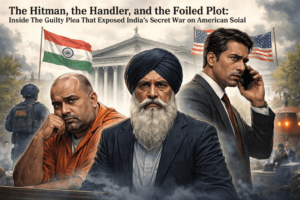
The Hitman, the Handler, and the Foiled Plot: Inside the Guilty Plea That Exposed India’s Secret War on American Soil
The courtroom sketch shows a heavyset man with a shaved head, his chin resting on his hand as he listens to the charges against him. Nikhil Gupta looks tired in the drawing, his eyes fixed somewhere in the middle distance as a federal judge in Manhattan accepts his guilty plea on a gray February afternoon.
Three counts. Murder-for-hire. Conspiracy to commit murder-for-hire. Conspiracy to commit money laundering. Maximum sentence: 40 years in a federal prison.
For the 54-year-old Indian national who once allegedly trafficked narcotics and weapons across international borders, Friday marked the end of a legal fight that began with his arrest in a Prague coffee shop nearly three years ago. But for investigators, diplomats, and intelligence agencies on three continents, Gupta’s guilty plea is merely a comma in a far more disturbing story—one that alleges the government of the world’s most populous democracy dispatched agents to assassinate its critics on foreign soil.
“This is not about one man in a Brooklyn jail,” says Gurpatwant Singh Pannun, the Sikh separatist leader who was the intended target of the plot Gupta helped orchestrate. “Nikhil Gupta is a foot soldier. The generals who gave the orders are still walking free.”
The Trap That Saved a Life
The plan unfolded with the cold efficiency of a spy novel, and like many spy novels, it depended on one crucial element: the bad guys trusted the wrong person.
In May 2023, Gupta received a message from a man he believed to be a criminal associate—someone who could connect him with a hitman willing to carry out a killing in New York City for $100,000. The target was Pannun, a lawyer and outspoken critic of the Indian government who had been advocating for an independent Sikh homeland called Khalistan.
What Gupta didn’t know was that his “associate” was a confidential source working for the U.S. Drug Enforcement Administration. Every message he sent, every detail he shared about the planned assassination, was being carefully documented by federal agents.
The indictment paints a chilling picture of the operation. Gupta, prosecutors say, was recruited by an agent of India’s foreign intelligence service, the Research and Analysis Wing (RAW), to broker the killing. The agent who allegedly recruited him, Vikash Yadav, would later be identified in court documents as the man who sent Gupta a video of a dead body just hours after it happened.
The video showed Hardeep Singh Nijjar, 45, gunned down outside a Sikh temple in Surrey, British Columbia, on June 18, 2023.
“Was also the target,” Gupta allegedly wrote to the undercover officer after sharing the footage. “We have so many targets.”
The Two Death Plots That Shook an Alliance
When Canadian Prime Minister Justin Trudeau stood in the House of Commons in September 2023 and told parliament that Canada had “clear and compelling evidence” linking Indian government agents to Nijjar’s killing, the diplomatic fallout was immediate and severe. India expelled Canadian diplomats, suspended visa services, and dismissed the allegations as absurd.
But the American investigation into the Pannun plot had already been underway for months by then, and the evidence U.S. prosecutors were gathering told a different story—one that suggested Nijjar’s assassination wasn’t an isolated incident but part of a coordinated campaign against Sikh separatist leaders in North America.
“These were not rogue actors,” says Michael Kugelman, director of the South Asia Institute at the Wilson Center in Washington, D.C. “The U.S. indictment alleges official Indian government involvement in a plot to kill someone on American soil. That’s not a diplomatic spat. That’s a potential breach of sovereignty with serious national security implications.”
The timing of the two plots adds another layer of intrigue. Nijjar was killed in June 2023. By that point, Gupta and Yadav were already deep in discussions about killing Pannun, communicating with someone they believed was a hitman but was actually an undercover officer. The Nijjar killing appears to have been used as proof of concept—evidence that the conspirators could deliver on their promises.
“He shared that video to show he was serious,” explains Sarah Miller, a former federal prosecutor who has handled international terrorism cases. “He was essentially saying, ‘Look what we just did in Canada. We can do the same thing in New York.'”
The Man in the Middle
So who is Nikhil Gupta, and how did a man accused of international narcotics trafficking become an alleged tool of Indian intelligence?
Court documents describe Gupta as an Indian national with connections to criminal networks spanning multiple countries. Prosecutors say he agreed to coordinate the Pannun assassination in exchange for having criminal charges against him dropped in India—a quid pro quo that, if proven, would suggest the Indian government was willing to leverage its justice system to facilitate a murder overseas.
Gupta’s attorneys have not commented on the plea, and he had maintained his innocence since his extradition to the United States in June 2024. But Friday’s guilty plea suggests the evidence against him was substantial—or that he saw little hope of prevailing at trial.
The extradition process itself was lengthy and complicated. Gupta was arrested in the Czech Republic on June 30, 2023, just days after Nijjar’s killing and weeks before the Pannun plot would become public knowledge. He spent nearly a year fighting extradition before being flown to New York in June 2024, where he appeared in court looking gaunt and disoriented.
Now, with his guilty plea entered, Gupta faces the prospect of spending the rest of his life in American prisons. But for investigators, his cooperation—if he offers any—could prove far more valuable than his incarceration.
“The question now is what he knows and what he’s willing to share,” Miller says. “A guilty plea doesn’t necessarily mean the investigation is over. Sometimes it’s just the beginning.”
The Handler Who Got Away
Vikash Yadav remains the ghost in this machine.
Identified in U.S. court documents as the Indian government agent who allegedly recruited Gupta and sent him the video of Nijjar’s body, Yadav is believed to be in India, where he faces separate criminal prosecution for an alleged kidnapping. The Indian government has dismissed him as a rogue operator who acted without authorization—a characterization that U.S. and Canadian officials view with deep skepticism.
“The idea that a mid-level intelligence officer could orchestrate two assassination plots in foreign countries without his superiors knowing strains credulity,” Kugelman says. “Intelligence agencies don’t work that way. There are protocols, oversight mechanisms, chains of command.”
Yadav’s alleged role in the conspiracy, as detailed in the indictment, was extensive. He allegedly communicated regularly with Gupta about the Pannun plot, helped arrange a $15,000 advance payment to the undercover officer posing as a hitman, and directed the operation from India. When Nijjar was killed, he reportedly sent video evidence to Gupta within hours—suggesting either direct involvement in that killing or access to those who carried it out.
India has consistently denied any role in either plot. In October 2024, when Canada expelled six Indian diplomats in a decision explicitly tied to the Nijjar investigation, New Delhi responded by expelling Canadian diplomats and accusing Ottawa of targeting India for political reasons.
“The Indian government’s position has been consistent: they had nothing to do with this,” says Anjali Bhardwaj, a New Delhi-based political analyst. “But the evidence from the U.S. investigation is mounting, and it’s becoming harder to simply dismiss these allegations as Canadian or American propaganda.”
The Target Who Refuses to Be Silenced
From his home in New York, Gurpatwant Singh Pannun has watched the case against Gupta unfold with a mix of grim satisfaction and frustrated impatience.
The lawyer and activist has spent decades advocating for Khalistan, a proposed Sikh homeland in India’s Punjab region. The Indian government considers such advocacy a threat to national unity and has designated Pannun a terrorist—a designation he rejects as politically motivated.
When U.S. prosecutors unsealed the indictment against Gupta in November 2023, Pannun learned that he had been marked for death by agents of a foreign government while living in the United States. The revelation was jarring, but not entirely surprising.
“I’ve known for years that I was a target,” Pannun says. “What I didn’t know was that the Indian government would go so far as to try to kill me on American soil. That crossed a line.”
Pannun has been clear about what he wants from the U.S. justice system: accountability that reaches beyond Gupta. In statements following the guilty plea, he emphasized that the “foot soldier” is now convicted, but the “generals” remain free.
“The United States has an opportunity here to send a message,” he says. “If you target American citizens on American soil, there will be consequences. Not just for the people you hire, but for the people who give the orders.”
Whether the U.S. government will pursue charges against Yadav or other alleged conspirators remains unclear. Yadav’s presence in India complicates any prosecution, as the U.S. and India do not have an extradition treaty. And the diplomatic fallout from such a move would be severe, potentially derailing the strategic partnership Washington has cultivated with New Delhi as a counterweight to China’s growing influence in Asia.
“There’s a tension here between justice and geopolitics,” Kugelman says. “The U.S. wants India as an ally against China. But it also can’t ignore evidence that India tried to kill someone in New York. Balancing those priorities won’t be easy.”
The Canadian Connection
For Canada, the Gupta plea is another reminder of a wound that refuses to heal.
Hardeep Singh Nijjar’s killing in June 2023 sent shockwaves through the Sikh community in British Columbia and beyond. The 45-year-old was a plumber and community leader, known for his work at the Guru Nanak Sikh Gurdwara in Surrey. He was also an advocate for Khalistan—a position that put him in the crosshairs of Indian intelligence, according to Western investigators.
Four Indian nationals have been charged in Nijjar’s slaying, but the investigation into who orchestrated the killing continues. The RCMP and Global Affairs Canada declined to comment on Gupta’s guilty plea, citing the ongoing investigation and diplomatic sensitivities.
But for the Sikh community in Canada, the connections between the Nijjar killing and the Pannun plot are unmistakable.
“They tried to kill Pannun in New York, and they succeeded in killing Nijjar in Surrey,” says Jaswinder Singh, a community leader in British Columbia who knew Nijjar personally. “These were not random acts of violence. These were planned, state-sponsored assassinations designed to silence anyone who speaks out for Khalistan.”
The Canadian government’s response to the killings has been cautious. Trudeau’s October 2023 announcement that Canada had evidence of Indian government involvement was a significant escalation, but subsequent steps have been more measured. The expulsion of Indian diplomats in October 2024 was framed as a response to India’s refusal to cooperate with the Nijjar investigation, not as a definitive finding of guilt.
Some critics argue that Canada should be doing more.
“We have a Canadian citizen who was murdered on Canadian soil, and the alleged masterminds are sitting in India, probably never to face justice,” says immigration lawyer Zool Suleman, who has represented the Nijjar family. “The government needs to decide whether it’s serious about pursuing this or whether it’s willing to let it fade away for the sake of diplomatic relations.”
The Diplomatic Tightrope
The timing of Gupta’s guilty plea adds another layer of complexity to an already delicate diplomatic situation.
In the two and a half years since Nijjar’s killing, Canada-India relations have lurched from crisis to crisis. Trade negotiations have stalled. Diplomatic expulsions have become routine. And the intelligence-sharing relationship between the two countries—once robust—has all but collapsed.
The United States finds itself in an awkward position. Washington has its own investigation into the Pannun plot, and the FBI has made clear that it views the alleged conspiracy as a serious breach of American sovereignty. But the U.S. also needs India as a partner in the Indo-Pacific, where both countries share concerns about China’s military expansion and economic coercion.
“We’re trying to walk and chew gum at the same time,” says a former State Department official who worked on South Asia policy. “We need India for our strategic objectives in Asia. But we also have a legal and moral obligation to hold them accountable if they tried to kill someone here. Those two things are in direct conflict.”
The Indian government has attempted to manage the fallout by cooperating with the U.S. investigation—up to a point. New Delhi established a high-level inquiry into the allegations and has reportedly shared some information with U.S. officials. But the government continues to deny any official involvement in either plot, and it has shown no willingness to extradite Yadav or other alleged conspirators.
“The Indian position is that they’ve addressed this,” Bhardwaj says. “They’ve set up an inquiry. They’ve said they’ll cooperate. But from the outside, it looks like they’re trying to contain the damage rather than get to the truth.”
What Comes Next
Nikhil Gupta now awaits sentencing, which could send him to federal prison for up to 40 years. His attorneys will likely argue for leniency, pointing to his cooperation—if he offers any—and the circumstances that led him to participate in the plot.
But for investigators, the real prize is what Gupta knows about the broader conspiracy. Who else was involved? What other targets were considered? And most importantly, what evidence exists linking the plot to senior Indian government officials?
The answers to those questions could determine whether Gupta’s guilty plea is the end of the story or just the beginning.
Pannun, for his part, continues to live in New York, aware that he remains a target. Security precautions that were once abstract have become concrete. Movements are monitored. Appearances are planned. The normal rhythms of life have been disrupted by the knowledge that a foreign government allegedly wanted him dead.
“I don’t live in fear,” he says. “But I live with awareness. I know what they’re capable of. I’ve seen the evidence.”
Outside the Sikh temple in Surrey, where Nijjar was killed, a memorial still stands. Flowers wilt and are replaced. Photographs fade in the sun. Community members stop by to pay their respects, to remember a man who was husband, father, and advocate.
In New York, in a federal courtroom, another chapter of that story closed with a guilty plea. But for those who knew Nijjar, and for those who believe the truth about his death has yet to fully emerge, the story is far from over.
You must be logged in to post a comment.