
The Himalayan Sediment Crisis: How India’s Race to Scour Rivers Is Backfiring Catastrophically
India’s aggressive efforts to manage Himalayan river sediment—through massive reservoir flushing operations like the one planned at Salal dam and unchecked industrial-scale riverbed mining—are backfiring catastrophically, scientists warn, as these interventions destabilize fragile mountain river systems, increase downstream flood risks, destroy aquatic ecosystems and irrigation infrastructure, and ignite diplomatic tensions with Pakistan, all while development authorities routinely ignore scientific evidence and local community resistance in favor of short-term engineering fixes and construction material extraction.
The Himalayan Sediment Crisis: How India’s Race to Scour Rivers Is Backfiring Catastrophically
On the banks of the Sukhnag River in Kashmir, Abdul Rashid still remembers watching the machines arrive.
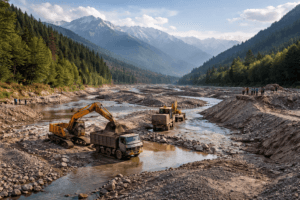
They came in the spring of 2024—massive excavators on steel tracks, their buckets tearing into riverbeds that had remained undisturbed for generations. The villagers of Kanigund, a hamlet tucked into the Himalayan foothills, gathered along the banks to watch. Some protested. One elder walked directly to the foreman and asked him to stop.
“Who are the villagers to deny material for a government project?” Rashid recalls the man saying.
Within months, stretches of the Sukhnag had been transformed into a lunar landscape—deep trenches where fish once spawned, dry irrigation canals that had watered family farms for decades, and fish farmers watching their livelihoods evaporate alongside the diverted water.
This is not an isolated incident. Across India’s mountainous northern arc, a feverish race is underway to extract, relocate, and reengineer one of the region’s most overlooked resources: its sediment.
The 95% Reservoir: A Dam’s Slow Death
Three hundred kilometers to the south, the Salal hydropower project on the Chenab River tells a different but equally troubling story. When it began operating in 1987, the 22-kilometer-long reservoir behind the dam held enough water to generate 690 megawatts of electricity—enough to power hundreds of thousands of homes.
Today, that reservoir is effectively dead.
Sediment has reduced its water storage capacity by up to 95 percent. What remains is not a lake but a slowly filling tomb of sand, silt, and gravel—material that the Chenab River has spent millennia carrying from the high peaks of the Hindu Kush Himalaya down toward the plains of Punjab.
This is not a design flaw. Dams in the Himalayas have always been temporary structures. The mountains themselves are temporary, at least in geological terms. The collision of the Indian and Eurasian plates continues to shove the Himalayas upward by several millimeters each year, creating slopes so steep and unstable that erosion becomes not an exception but a constant. Combine this with monsoon rains that can dump a meter of water in a single season, seismic tremors that shake loose entire hillsides, and fragile geology that crumbles at the touch of flowing water.
“These conditions generate exceptionally high sediment yields,” says Arun Bhakta Shrestha, an independent climate scientist who has studied Himalayan rivers for decades.
The numbers are staggering. Some Himalayan rivers transport more than 2,000 tons of sediment per square kilometer of drainage area annually—rates among the highest on Earth. The Ganges alone delivers nearly a billion tons of sediment to the Bay of Bengal each year.
And almost all of it, before the dam-building era, flowed freely to the sea.
The Gamble: Flushing 30 Years of Sediment in Days
When India’s power ministry announced last month that it would expedite the removal of sediment from Salal’s reservoir, the immediate international response focused on geopolitics. Pakistan protested, citing the Indus Waters Treaty, a 65-year-old agreement that has survived three wars and countless skirmishes. The treaty gives Pakistan certain rights over how India manages the rivers that flow westward across the border, including the Chenab.
But for scientists who study Himalayan river systems, the far more urgent concern is not diplomatic but hydrological.
The plan involves opening Salal’s sluice gates to flush the accumulated sediment downstream in a concentrated pulse—essentially releasing decades of accumulated material in a matter of days or weeks.
“It is a gamble with downstream safety in an already unstable region,” says Pratik Kad, a climate and water researcher at Norway’s Bjerknes Centre for Climate Research.
The problem is not the sediment itself. The problem is what happens when enormous volumes of it move all at once.
River channels are dynamic systems, constantly adjusting to the volume and composition of the material flowing through them. When a pulse of sediment—especially the coarse sand and gravel that accumulates in Himalayan reservoirs—is suddenly introduced downstream, the river responds by depositing some of it. Sandbars grow. The riverbed rises. The channel narrows. Water that once flowed smoothly begins to push against its banks, seeking new paths.
During the next monsoon, when the rains come and the river swells, that pent-up water has fewer places to go. It spills over banks that have held for generations. It carves new channels through farmland. It deposits sediment in villages that were never considered flood-prone.
This is not theoretical. Similar flushing operations on other Himalayan rivers have produced exactly these outcomes.
“A lowland engineering mindset applied to a high-mountain system where it does not fit,” Kad says.
The Extraction Economy: Sand as the New Gold
If reservoir flushing represents one approach to the sediment problem—moving it downstream in uncontrolled bursts—riverbed mining represents another: removing it altogether.
India is in the midst of a construction boom unlike anything the country has ever experienced. Highways, airports, housing complexes, and commercial towers are rising across the subcontinent at a pace that strains not only the workforce but also the supply of raw materials. Sand and gravel—the literal foundations of concrete—have become commodities almost as valuable as the crude oil used to transport them.
Himalayan rivers are tempting sources. Their sediment load is abundant, accessible, and free for the taking.
What began as a livelihood activity—local residents manually collecting sand and gravel for their own construction needs—has transformed into an industrial-scale operation. Excavators wade into river channels. Trucks line up along banks, engines idling. In some stretches of Kashmir’s Jhelum River and its tributaries, the sound of machinery has replaced the sound of flowing water.
“Mining used to be carried out manually by just a few locals, for livelihood, which never damaged the stream,” says Ghulam Hassan Mir, a resident of Panzan, a town on the Shali Ganga River. “But heavy machines were used for extracting boulders and gravel… destroying the river’s shape and flow.”
The transformation is visible from space. Satellite imagery shows Himalayan river channels that have widened, narrowed, shifted course, or been carved into trenches so deep they no longer reach their own floodplains.
The ecological impacts cascade. Fish lose spawning grounds. Aquatic insects—the foundation of river food webs—disappear from scoured streambeds. Groundwater tables drop when rivers are incised below the level of surrounding aquifers. Irrigation canals run dry, as they did in Kanigund, because the water surface is now lower than the canal intake.
And the human costs, as always, fall heaviest on those with the least power to resist.
The Legal Chasm: When Justice Arrives Too Late
Raja Muzaffar Bhat has spent years filing legal challenges against riverbed mining operations in Kashmir. As an environmental activist, he has documented violations, submitted evidence, and argued before India’s National Green Tribunal, the specialized court established to handle environmental disputes.
Sometimes he wins. The Tribunal has issued orders to stop illegal mining, directed government agencies to enforce regulations, and imposed penalties on violators.
But winning a legal case and stopping environmental destruction are not the same thing.
By the time an order is issued—through the Tribunal, through appeals, through the Supreme Court—the excavators have usually moved on. The sand and gravel have been sold. The riverbed remains reshaped, perhaps permanently.
Last year, India’s Supreme Court upheld a 2022 NGT order to halt mining on the Shali Ganga near Panzan. It was a significant legal victory. But Mir, the Panzan resident, can point to stretches of the river that will never recover, regardless of what any court says.
The disconnect between legal process and environmental reality reflects a deeper tension. India’s environmental laws are among the most comprehensive in the developing world. The National Green Tribunal has issued landmark rulings on air pollution, industrial waste, and forest conservation. The problem is not the absence of law but the absence of enforcement capacity, particularly in remote mountain regions where oversight is minimal and economic pressures are intense.
“Who are the villagers to deny material for a government project?” The foreman’s question echoes across dozens of river valleys where local resistance has been brushed aside in the name of development.
The Hungry Water Problem
The Salal reservoir and the Sukhnag mining pits represent opposite ends of the same sediment crisis. One is removing too much sediment from the river system. The other is releasing too much, too fast.
But both problems are about to get worse.
Climate change is thawing permafrost across the high Himalayas, freeing vast quantities of previously frozen sediment that will gradually make its way downstream. Glacial retreat—accelerating across the region—is exposing fresh moraine deposits that are easily eroded. And the Indian government has plans to build dozens of new hydropower dams in the coming decades.
Each new dam will create a new reservoir. Each new reservoir will begin filling with sediment the moment it is completed. And each dam will release what engineers call “hungry water”—clear, sediment-starved flows that emerge from the turbines with renewed erosive power.
This is the hidden cost of Himalayan hydropower. The dams trap coarse sediment that would otherwise move gradually through the system, but they cannot trap water. That water, stripped of its sediment load, immediately begins scavenging for replacement material downstream. It undercuts riverbanks. It scours riverbeds. It accelerates erosion at rates that can destabilize bridges, pipelines, and riverside communities.
“The Himalaya Dilemma,” as a team led by IIT Kanpur earth scientist Rajiv Sinha termed it in a 2025 book, is that the region’s development aspirations and its geological realities are fundamentally misaligned.
The Knowledge Gap: What We Don’t Know About Himalayan Rivers
For all the billions of dollars invested in Himalayan hydropower and infrastructure, the scientific understanding of how sediment actually moves through these mountain rivers remains surprisingly limited.
Researchers like Sunil Kumar De, a geomorphologist at North-Eastern Hill University and president of the International Association of Geomorphologists, describe sediment dynamics as one of the most understudied aspects of Himalayan environmental science. The region’s rivers are monitored primarily for water flow, not sediment transport. The instruments used to measure sediment loads—where they exist at all—are often outdated or poorly maintained. The models used to predict reservoir sedimentation rates are calibrated on lowland rivers and perform poorly in Himalayan conditions.
This knowledge gap has practical consequences. Dam designers routinely underestimate how quickly reservoirs will fill with sediment, leading to projects that generate far less power over their lifetimes than initially projected. Flushing operations are planned without adequate data on the downstream impacts. Mining permits are issued without understanding how much sediment a particular river reach can sustainably lose.
Pradeep Srivastava, a geologist at IIT Roorkee, says India’s national and state governments are funding research into sediment dynamics. Scientists are working to close the knowledge gap. But he acknowledges a more fundamental obstacle: “Officials in charge of development overlook or ignore scientists’ cautions.”
The Pakistan Dimension: Water as WMD
The Indus Waters Treaty, signed in 1960, is often cited as one of the most successful water-sharing agreements in history. It has survived the 1965 and 1971 wars, the Kargil conflict, and decades of cross-border terrorism and retaliation.
But the treaty was designed for a different era—an era when the primary threat to water security was variability in supply, not deliberate engineering interventions.
Sediment management was not a major concern in 1960. The treaty grants Pakistan certain rights regarding the construction of dams and other infrastructure on the western rivers (the Indus, Jhelum, and Chenab). It does not explicitly address the removal of accumulated sediment from reservoirs, nor does it anticipate the scale of riverbed mining now occurring along Himalayan tributaries.
India’s suspension of its participation in the treaty last year, following a military conflict with Pakistan, has further muddied the diplomatic waters. The Salal flushing plan has become a test case for how both countries will handle transboundary river management in this new, treaty-less environment.
For scientists like Kad, the geopolitical dimensions of the sediment crisis are a distraction from the more fundamental issue. Whether the Chenab flows through India or Pakistan, whether the treaty is in force or suspended, the physical reality of moving millions of cubic meters of sediment through an unstable mountain river system remains the same.
“Rivers don’t recognize borders,” he says. “And neither do floods.”
The Unanswered Question: Who Decides?
Beneath the scientific debates and diplomatic tensions lies a more basic question: Who has the authority to decide what happens to Himalayan rivers?
The Indian government, through its power ministry and water resources agencies, asserts jurisdiction over projects within its territory. State governments issue mining permits and regulate local extraction. Courts issue orders that are selectively enforced. Local communities resist, comply, or adapt depending on their circumstances.
No single entity has a complete picture of what is happening across the region. No comprehensive assessment exists of how much sediment is being extracted through mining, how much is being trapped behind dams, how much is moving through the system naturally, and what the cumulative impacts might be.
This fragmented governance structure is not unique to India or to sediment management. It reflects a broader pattern in which environmental problems that cross jurisdictional boundaries are addressed piecemeal, if at all.
But the Himalayas are not forgiving of fragmentation. The mountains operate on scales—geological, hydrological, temporal—that defy administrative divisions. A mining operation in one district reshapes a river that flows through three others. A flushing event at one dam affects communities in two countries. A century of sediment accumulation in a reservoir cannot be undone in a week, no matter how many sluice gates are opened.
The Long View: Living with Sediment
On the banks of the Sukhnag, Abdul Rashid still goes to check the irrigation canal that has watered his family’s fields for generations. It remains dry. The water flows past, several meters below the intake, on its way toward villages downstream that also cannot reach it.
“They said it would come back,” he says of the government officials who promised to restore the river after the mining project was completed. “But the river does not listen to promises.”
He is right. Rivers respond to slope, sediment, and flow—not to assurances, regulations, or treaties. The Chenab will continue carrying Himalayan sand toward the plains whether Salal’s gates are open or closed. The Jhelum will continue adjusting its channel in response to the material available to it.
The question is not whether India will manage its Himalayan sediment. It is whether the country will learn to manage it intelligently—with humility, with scientific rigor, and with genuine engagement from the communities whose lives and livelihoods depend on these rivers.
The alternative is a future in which more reservoirs fill prematurely, more rivers are incised beyond recovery, more communities lose their water access, and more downstream populations face floods that were never inevitable.
That future is not written. It is being constructed, one excavator bucket and one open sluice gate at a time. The mountains are watching. The rivers are waiting. And the sediment, as it has for millions of years, continues its slow, patient journey toward the sea.
This article is based on reporting by Athar Parvaiz for Science magazine, supplemented by interviews with scientists, local residents, and environmental activists in the Himalayan region. All quoted material is drawn from published sources or on-the-record interviews conducted between 2024 and 2026.
You must be logged in to post a comment.