
The High-Flying Politics of ICE’s Secret Deportations to the West Bank
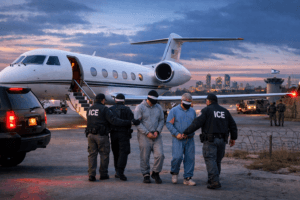
This investigation reveals that ICE secretly used a luxury private jet owned by Gil Dezer, a major Trump donor and business partner, to deport Palestinian men from the U.S. to the Israeli-occupied West Bank. The operation, which involved shackled passengers on flights costing up to $500,000 each, severed families and deported individuals like Maher Awad, who left behind a newborn son in Michigan. The flights, facilitated by Israel, mark a shift toward an aggressive, politically-charged deportation campaign that leverages private contractors for sensitive missions, raising serious legal, ethical, and conflict-of-interest questions about the privatization of enforcement and the disregard for deep human ties established in America.
The High-Flying Politics of ICE’s Secret Deportations to the West Bank
A new and controversial chapter in U.S. immigration enforcement has been written in the skies above the Atlantic. Recently, Immigration and Customs Enforcement (ICE) has twice used a luxury private jet, owned by a friend and donor of former President Donald Trump, to secretly deport Palestinian men from the United States to the Israeli-occupied West Bank. This operation, marked by unusual secrecy, high-level political connections, and severe human costs, raises profound questions about immigration policy, international law, and the privatization of government power.
The Secret Flights: A Logistical and Legal Anomaly
This operation was first brought to light through a joint investigation by The Guardian and +972 Magazine and has since gained wider attention. The flights represent a significant departure from standard deportation procedures.
The two known flights occurred on January 21 and February 1, 2026. They originated from an airport near a major ICE removal center in Phoenix, Arizona, and flew to Tel Aviv’s Ben Gurion Airport.
Here are the key details of these operations:
| Aspect | Details |
| Aircraft | A Gulfstream private jet owned by Florida property tycoon Gil Dezer. |
| Charter Company | Journey Aviation, a Florida-based firm frequently contracted by federal agencies. |
| Route | Arizona → New Jersey → Shannon, Ireland → Sofia, Bulgaria → Tel Aviv, Israel. |
| Passenger Treatment | Men were shackled by wrists and ankles for the entire journey. |
| Cost Estimate | Aviation sources estimate each flight cost ICE between $400,000 and $500,000. |
| Final Destination | After landing, men were transported by Israeli authorities and released at a checkpoint near the West Bank village of Ni’lin. |
Human Faces of the Deportation: Lives Severed
Behind the logistics are deeply personal stories of lives uprooted and families torn apart.
- Maher Awad (24): He arrived in the U.S. from the West Bank at age 15. He built a life in Michigan, graduating high school, working in family businesses, and starting a family with his American partner, Sandra McMyler. They have a four-month-old son he has never held. Awad’s deportation began when he was arrested after reporting a break-in at his home; an old domestic violence charge (later dropped) triggered ICE detention. “Everything I knew, everything I experienced was in the United States,” he said.
- Sameer Isam Aziz Zeidan (47): He lived in Louisiana for over two decades with his U.S. citizen wife and their five American children. He held a green card but failed to renew it. After being detained by ICE for over a year, he was deported, leaving his entire immediate family behind.
Upon arrival at the West Bank checkpoint, the men, dressed in light prison-issued tracksuits and ill-prepared for the cold, were disoriented. Mohammad Kanaan, a professor who found them, noted they had been out of contact with their families for so long that some were considered “missing”.
The Political Jet: Trump Ties and a “Favorite Toy”
The aircraft at the center of this operation is no ordinary government transport.
The jet is the “favorite toy” of Gil Dezer, a prominent Miami real estate developer. The Dezer family’s ties to Donald Trump are deep and long-standing:
- Business Partners: The Dezers partnered with Trump in the early 2000s and have since built six Trump-branded residential towers in Sunny Isles Beach, Florida.
- Political Donors: Gil Dezer and his father, Michael, have donated over $1.3 million to Trump’s presidential campaigns.
- Personal Friendship: Dezer has described Trump as a childhood hero and close friend, stating, “I was at his wedding. He was at my wedding”. His 50th birthday party featured performers dressed as Trump.
- Pro-Israel Affiliation: Dezer is also a member of the Miami branch of Friends of the Israel Defense Forces, a U.S. nonprofit that fundraises for the Israeli military.
In response to inquiries, Dezer stated he was “never privy to the names” of passengers or the purpose of flights when his jet was chartered through Journey Aviation. This arrangement raises critical questions about the potential for political favoritism in the awarding of lucrative government contracts, especially for such sensitive and costly missions.
A Pattern of Ideological Enforcement?
These secret flights do not exist in a vacuum. They align with a broader Trump administration policy of pursuing deportations based on political speech, a policy that has faced significant legal challenges.
A federal court in Massachusetts has already ruled against the administration’s efforts to deport noncitizens for pro-Palestinian advocacy. In a landmark ruling, Judge William G. Young declared such a policy a viewpoint-discriminatory effort to chill protected speech, violating the First Amendment.
Evidence from that case reveals that federal officials targeted individuals like Columbia student Mahmoud Khalil and Tufts student Rumeysa Öztürk solely for their protected speech—participating in protests, writing op-eds, or sharing poetry—rather than for any unlawful activity.
While the individuals on the private jet flights were detained on different grounds (often related to expired visas or past charges), the operation fits within an aggressive, politically-charged deportation campaign. Advocates argue it is part of an “opaque system without accountability” that disregards due process and family unity.
The Legal and Diplomatic Minefield
This secretive program ventures into complex and potentially unlawful territory under international law:
- The Principle of Non-Refoulement: A cornerstone of international human rights law, it prohibits returning individuals to a country where they face a real risk of persecution, torture, or ill-treatment. Sending Palestinians to the West Bank, where human rights organizations document ongoing violence and severe restrictions, may violate this principle.
- Deportation to Occupied Territory: By coordinating with Israel to release deportees in the West Bank—territory occupied by Israel since 1967—the U.S. operation becomes entangled in the politics of occupation, potentially legitimizing Israeli control.
- Complicity of Transit Countries: The refueling stops in Ireland and Bulgaria place legal and ethical responsibilities on those nations. If their authorities were aware of the flight’s nature, they could be implicated in the potential violation of non-refoulement.
The Bottom Line: A Paradigm Shift in Enforcement
These luxury jet deportations symbolize a profound shift in U.S. immigration policy, characterized by:
- Privatization and Secrecy: Utilizing private contractors and aircraft creates a layer of opacity, distancing the government from direct accountability and public scrutiny.
- Exorbitant Cost: At nearly half a million dollars per flight, the cost is astronomical compared to standard commercial deportations, raising serious questions about the efficient use of taxpayer funds.
- Political Entanglement: The use of an aircraft owned by a major Trump donor and friend blurs the line between state action and political patronage, creating a clear appearance of a conflict of interest.
- Human Cost Above Policy: The operation prioritized removal above all else, severely disrupting deep family and community ties established over decades in the U.S., with little regard for the consequences inflicted on the deportees or their loved ones.
As the Trump administration continues its aggressive deportation campaign, these flights serve as a stark, high-altitude metaphor for its approach: politically connected, exceptionally costly, legally dubious, and devastatingly human in its impact.
The story of Maher Awad, separated from his newborn son, and Sameer Zeidan, cut off from his wife and children, is now a story of U.S. policy, executed on plush leather seats high above the ocean, leaving broken lives on a dusty roadside checkpoint halfway across the world.
You must be logged in to post a comment.