
The Hidden Giant: Why a Company You’ve Never Heard of Just Soared 94% in Six Months
The Hidden Giant: Why a Company You’ve Never Heard of Just Soared 94% in Six Months
In the quiet, unassuming town of Veldhoven in the Netherlands, a corporate giant operates with a level of influence that rivals the world’s most famous tech brands. Yet, if you asked the average person on the street to describe what ASML does, you’d likely be met with a blank stare. This anonymity, however, belies a reality of staggering proportions. ASML Holding NV isn’t just another tech stock riding a wave of sector optimism. It is the linchpin of the entire global technology ecosystem.
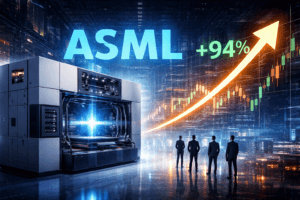
In the past six months, ASML’s stock has delivered a breathtaking return of over 94% on the Nasdaq exchange, outpacing almost every major player in the market. This surge isn’t a random blip or a product of speculative frenzy. It is a calculated, forward-looking bet by investors who understand a fundamental truth of the 21st century: in a world increasingly run on silicon, ASML holds the keys to the kingdom.
This article isn’t just about a stock chart. It’s about the story behind the numbers—a story of technological wizardry, geopolitical strategy, and the sheer, unassailable power of being the only game in town. We’ll peel back the layers to understand not just what happened, but why it happened, and what it tells us about the future of technology and the global economy.
The Unseen Hand in Your Pocket
To understand ASML’s meteoric rise, you first have to understand its product, which is arguably one of the most complex machines humanity has ever built.
ASML doesn’t manufacture the shiny gadgets we all know. It doesn’t make the iPhone in your pocket, the NVIDIA graphics card powering your AI experiments, or the AMD processor in your laptop. Instead, it manufactures the multi-ton, bus-sized, billion-dollar machines that are required to make the most advanced versions of those chips.
Think of it as the ultimate factory tool. Its specialty lies in a technology called Extreme Ultraviolet (EUV) lithography. Without getting lost in a sea of physics jargon, EUV lithography is a process that uses incredibly fine-tuned light to print minuscule patterns onto silicon wafers. These patterns become the transistors—the tiny switches that are the building blocks of all computer chips.
The challenge, and the genius, is in the scale. Modern high-end chips, like those used for AI, have transistors so small that you could fit hundreds of billions of them onto a fingernail-sized piece of silicon. Creating these nanoscopic features is like trying to draw a perfect, straight line on a football field from a satellite in space. The only way to do it is with ASML’s EUV machines, which manipulate light at a wavelength so short (13.5 nanometers) that it is absorbed by the air and must travel in a vacuum.
ASML’s machines are the result of decades of research and development, a global supply chain of over 5,000 suppliers, and an investment that has erected a virtually insurmountable barrier to entry. This technological monopoly is the single most important factor in the company’s success. They are the sole supplier of these high-NA and EUV machines on the planet. If you are a chipmaker wanting to produce the world’s most advanced processors—like an NVIDIA B200 AI chip or a next-gen smartphone processor—you have no choice but to get in line at ASML’s door.
Deconstructing the 94% Surge: Three Pillars of an Unstoppable Rally
With that foundation in mind, we can move beyond the news headline and deconstruct the specific catalysts that have supercharged ASML’s stock price over the last six months. It’s a confluence of three powerful forces.
- The Geopolitical Supercycle: Chips are the New OilFor decades, semiconductors were viewed primarily through a commercial lens. That has changed. Nations now view advanced chipmaking capacity as a matter of national security and economic sovereignty. The United States, with its CHIPS Act, and the European Union, with its European Chips Act, are pouring hundreds of billions of dollars into building up domestic semiconductor manufacturing capacity.
This is not a short-term trend. It’s a multi-year, multi-trillion-dollar restructuring of the global supply chain. Every new fab (chip factory) built in Arizona, Ohio, or Germany needs to be equipped. And the most advanced fabs, the ones that will produce the chips of the future, need ASML’s most advanced tools.
Investors are looking at this and seeing a decade-long demand curve. TSMC, Samsung, and Intel—ASML’s primary customers—are in a three-way arms race to build the most advanced fabs. To win that race, they must buy ASML’s latest systems. This isn’t cyclical demand that goes up and down with the economy; it’s structural demand, driven by the strategic interests of world powers. This visibility is incredibly rare and highly prized by the market.
- The Unquenchable Thirst of Artificial IntelligenceWhile geopolitical maneuvering provides the long-term backstop, artificial intelligence is the immediate, explosive catalyst. The launch of sophisticated AI models like ChatGPT was the “Sputnik moment” for this new era. It made the world realize that AI wasn’t a future concept; it was a present reality.
Training and running these massive AI models requires an unimaginable amount of computational horsepower. This has led to an insatiable demand for the most advanced GPUs and AI accelerators, which are built by companies like NVIDIA and AMD. These chips are the epitome of complexity and performance, and they are manufactured on the cutting-edge process nodes that require EUV lithography.
Think of it as a chain reaction: The public’s desire for better chatbots and image generators fuels a frantic build-out of AI data centers. These data centers require millions of high-end chips. The chip designers (like NVIDIA) place massive orders with the foundries (like TSMC). And the foundries, in turn, must rapidly expand their advanced production capacity by ordering more of the only machines that can make those chips: ASML’s EUV systems.
The market is effectively pricing in that this AI-driven demand is not a one-time event. Each new generation of AI model will require more powerful chips, creating a perpetual cycle of technological escalation. ASML is the ultimate pick-and-shovel play in the AI gold rush. It doesn’t matter which AI startup wins or which chip design is superior; they all rely on the physical chips that can only be made with ASML’s machines.
- The Power of the Unmatched Order BookThe combination of these two forces has created a third, which is the most tangible for investors: a backlog that stretches for years. ASML’s order book is effectively a window into the future of the semiconductor industry. When TSMC or Intel places an order for an EUV machine today, it knows it won’t be delivered for 18 to 24 months. The machines are simply that complex to build.
This forward visibility is a dream for financial analysts. While other companies struggle to forecast revenue a quarter ahead, ASML has a clear line of sight into its earnings for years to come. The recent quarterly reports have shown that orders are not just strong; they are shattering records. This gives investors the confidence to buy and hold the stock through broader market volatility, knowing that the company’s future earnings are already largely secured. This scarcity of supply combined with a super-abundance of demand is the textbook definition of a pricing power and a business moat.
The Human Element: What This Means for You and the World
Beyond the stock charts and corporate strategy, ASML’s story has profound implications for our daily lives and the future of human progress.
The Cost of Progress As ASML’s machines become more advanced, they also become exponentially more expensive. A single high-NA EUV machine can cost over $350 million. This cost inevitably trickles down the supply chain. It raises the barrier to entry for new chip companies and concentrates power in the hands of a few mega-corporations. Ultimately, the staggering cost of R&D and manufacturing is one of the key reasons your next smartphone or laptop might not get cheaper, even as it gets more powerful.
The Geopolitical Hot Potato ASML is no longer just a Dutch company; it is a strategic global asset. It sits at the very center of the US-China tech cold war. The US has placed pressure on the Dutch government to restrict ASML from exporting its most advanced machines to China, fearing they could be used to bolster its domestic chip industry and, by extension, its military capabilities. This puts ASML in an incredibly difficult position. It wants to sell to the world’s largest market (China) for older-generation machines, while being caught in a political tug-of-war over its most advanced technology. The company’s ability to navigate these choppy geopolitical waters is a constant focus for investors. A sudden escalation in restrictions could disrupt a significant portion of its revenue stream.
The Future of Innovation Perhaps the most exciting aspect of ASML’s story is what it enables. The company isn’t just making existing chips cheaper; it is enabling the chips of the future. The machines they are developing today will be used to build the processors that power the next generation of scientific discovery—from drug development and climate modeling to fusion energy research and advanced robotics.
Every leap forward in computational power has unlocked new eras of human achievement. By creating the tools for that leap, ASML has positioned itself as a silent partner in humanity’s most ambitious projects. The 94% stock surge is, in a way, a vote of confidence in that very future.
Risks on the Horizon: Is the Momentum Sustainable?
While the story is overwhelmingly positive, a balanced perspective requires acknowledging the risks. No stock moves in a straight line forever, and ASML faces several potential headwinds.
- Valuation Concerns: After a 94% rally, the stock is undeniably expensive. It is trading at a high multiple of its future earnings. While this is justified by its monopoly and growth prospects, it also makes the stock vulnerable to any whiff of bad news or a broader market correction. The expectations baked into the price are sky-high.
- Technological Disruption: It seems impossible now, but all technologies eventually face a challenger. While ASML’s EUV technology is currently unassailable, research is already underway into next-generation lithography techniques, such as high-NA EUV (which ASML is also leading) and even beyond, like directed self-assembly. A paradigm shift in how chips are made could, in theory, create a new competitor. However, the lead time for such a shift is likely decades away.
- Geopolitical Fallout: As mentioned, geopolitics is a double-edged sword. While the global push for chip sovereignty is driving demand, it also creates immense complexity. A full-blown trade war between the US, China, and Europe could severely restrict ASML’s addressable market. Furthermore, it adds a layer of uncertainty that can make long-term planning difficult.
- Cyclicality of the Chip Market: Despite the structural demand, the semiconductor industry is still known for its boom-and-bust cycles. A sudden, unexpected downturn in consumer electronics or data center spending could cause chipmakers to delay their fab expansion plans, leading to order cancellations or push-outs from ASML.
Conclusion: The Quiet Force Shaping Our World
ASML’s 94% stock surge is a fascinating case study in modern capitalism. It’s a story not about a catchy product or a charismatic CEO, but about the profound power of deep tech and an unassailable market position. It highlights a fundamental shift in how the world operates: our economy, our security, and our future progress are now inextricably linked to our ability to produce ever-more-powerful silicon.
The company in the quiet Dutch town may never be a household name. You won’t see its logo on a consumer product or an advertisement during the Super Bowl. But its influence is woven into the fabric of every digital interaction you have.
As long as we demand more from our devices—faster processing, smarter AI, richer experiences—we will be demanding more from ASML. The 94% rally over the last six months is not just a reflection of past success; it is a reflection of that inextricable link between a single, irreplaceable company and the boundless ambition of the human race to compute, to create, and to know more. It is, in every sense, the invisible giant upon which the digital world is built.
You must be logged in to post a comment.