
The Hidden Engine of India’s Digital Leap: Power and Cooling in Focus
India’s celebrated digital transformation, driven by visible advancements in 5G, AI, and cloud computing, is fundamentally enabled by a critical but often overlooked backbone: advanced power and thermal management systems.
This essential infrastructure ensures reliability and scalability, from powering thousands of distributed 5G nodes and fiber connections with high-efficiency, ruggedized solutions to managing the extreme heat and energy demands of modern AI data centers through innovations like direct liquid cooling and 800V power architectures. By designing and manufacturing these robust, climate-resilient technologies locally, companies are not only solving for India’s unique grid and environmental challenges but also building the sustainable and reliable foundation upon which the nation’s entire digital economy depends.
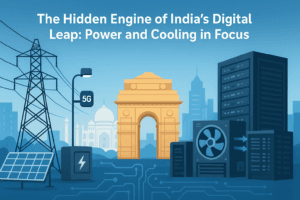
The Hidden Engine of India’s Digital Leap: Power and Cooling in Focus
When discussing India’s rapid digital transformation, headlines are dominated by 5G rollouts, artificial intelligence breakthroughs, and soaring data consumption. Yet, beneath these visible advancements lies a less glamorous but absolutely critical foundation: the robust, reliable, and intelligent infrastructure for power delivery and thermal management. This unseen backbone doesn’t just support the digital economy—it dictates its scale, sustainability, and reach.
The Silent Enablers: Connecting Ambition to Reality
India’s digital ambitions are colossal. The digital economy, contributing nearly 12% to GDP, is projected to reach 20% by 2026. This growth is powered by millions of new connections, data centers, and smart devices. Each component, from a 5G small cell on a streetlamp to a sprawling hyperscale data center, has two fundamental, non-negotiable needs: a constant supply of clean power and a way to dissipate intense heat.
The table below illustrates how these critical “invisible” technologies directly enable India’s most prominent digital goals:
| India’s Digital Ambition | Critical Infrastructure Need | Enabling ‘Invisible’ Technology | Impact on Growth & Sustainability |
| Nationwide 5G & Broadband | Powering millions of distributed network nodes in diverse climates. | High-efficiency rectifiers (up to 98% efficiency), GaN-based adaptors, and rugged outdoor thermal management. | Enables network densification and rural reach while controlling massive OPEX from energy and maintenance. |
| AI & Data Center Expansion | Managing extreme power density and heat from AI servers sustainably. | 800V HVDC power architectures, liquid cooling systems (up to 1,500 kW capacity), and containerized prefab solutions. | Allows higher compute in smaller footprints, cuts energy loss by over 4%, and enables rapid deployment. |
| Smart Cities & IoT | Ensuring reliability for countless critical sensors and automated systems. | Power quality management (Active Power Filters, Static Var Generators) and industrial-grade power supplies. | Protects sensitive equipment from grid harmonics, prevents data loss, and reduces failure rates in public infrastructure. |
| Modernized Manufacturing | Providing clean, stable power for precision automation and robotics. | Customized power solutions for automation, coupled with IoT-enabled predictive maintenance systems. | Minimizes production downtime, improves quality consistency, and integrates with Industry 4.0 goals. |
Beyond the Grid: Powering a Distributed Nation
India’s 5G and fiber broadband revolution represents a fundamental shift from centralized to hyper-distributed architecture. This is not just a telecommunications upgrade but a massive nationwide power logistics challenge.
- The 5G Power Dilemma: Deploying thousands of small cells means placing sensitive electronics on rooftops, street poles, and in remote areas. These locations face India’s harsh climatic extremes—from the desiccating heat of Rajasthan to the humid conditions of the Northeast—and often suffer from inconsistent grid power. The solution lies in power conversion systems that are incredibly efficient (to minimize waste heat and energy bills), compact, and ruggedized. Technologies like Gallium Nitride (GaN)-based adaptors are pivotal here, offering superior efficiency and thermal performance in a small package, which is essential for space-constrained sites.
- Last-Mile Reliability: For a fiber broadband connection, the reliability of the Optical Network Terminal (ONT) in a home is just as important as the central exchange equipment. Specially designed, long-life power adaptors that can handle voltage fluctuations are what make the user experience “always-on,” turning a physical fiber line into a dependable digital service.
Data Centers: Where Every Percentage Point of Efficiency Multiplies
The explosion of AI has turned data centers from data warehouses into “AI factories,” with power demands per rack soaring from traditional levels to over 1 megawatt. In this context, energy efficiency transitions from a cost-saving measure to a strategic imperative for scalability and environmental responsibility.
The industry is responding with architectural revolutions. Delta’s 800V High Voltage Direct Current (HVDC) system is a prime example. By minimizing the number of power conversion steps and reducing electrical current, this architecture cuts distribution losses, saves on copper wiring, and lowers the thermal burden—reportedly improving total power usage effectiveness by over 4%. Complementing this are direct liquid cooling solutions, such as cold plates for GPUs and rack-scale coolant distribution units, which are far more effective at removing heat from high-density AI servers than traditional air conditioning alone.
For rapid deployment, especially for edge computing, prefabricated containerized data centers are becoming key. These self-contained units, integrating power, cooling, and IT racks, can be deployed in weeks, bringing high-performance compute closer to users and to locations where building a traditional brick-and-mortar facility is impractical.
Thermal Management: The Invisible Shield Against Failure
In electronics, heat is the primary agent of degradation and failure. As power densities climb, managing thermal load is no longer an afterthought but a core design challenge. Effective thermal management is what ensures the reliability promised by robust power systems.
This goes beyond simple fans. Advanced thermal solutions employ heat pipes, vapor chambers, and sophisticated airflow modeling to create targeted cooling. In mission-critical environments, the choice of a fan matters significantly. Brushless DC (BLDC) fans, for instance, offer higher efficiency, longer lifespan, and precise speed control compared to traditional AC fans, contributing to both system reliability and lower energy consumption over time.
The Strategic Imperative: Localization and Integration
Perhaps the most critical insight for India’s context is that this backbone cannot be entirely imported. The “Make in India” initiative aligns perfectly with the need for localized infrastructure solutions. Designing and manufacturing within India allows for products to be tailored to local grid conditions, climate profiles, and cost structures. It also enables faster response times and spurs innovation that addresses uniquely Indian challenges.
Furthermore, the future lies in integration. The true potential of smart cities and Industry 4.0 is unlocked not by standalone technologies, but when power systems, cooling, IoT sensors, and AI analytics work in concert. For example, an Integrated Command and Control Center (ICCC) in a smart city relies on flawless power and connectivity to synthesize data from traffic cameras, water sensors, and lighting systems into actionable intelligence. This seamless operation is impossible without the underlying, invisible infrastructure performing flawlessly.
Conclusion: Building for the Future, One Watt at a Time
India’s journey to a digitally empowered, self-reliant economy is underpinned by a complex physical ecosystem. The innovations in power efficiency and thermal management are quiet triumphs of engineering that make the noisy, visible progress possible. As the nation continues its breakneck digital expansion, sustained investment and innovation in this essential backbone will determine not just the speed of transformation, but its resilience, inclusivity, and long-term sustainability. The real story of India’s digital decade is being written in the language of watts, volts, and degrees Celsius—a narrative of foundational strength that promises to support generations of innovation to come.
You must be logged in to post a comment.