
The Hidden Cost of Growth: How IndiGo’s Operational Crisis Exposes the Tightrope Walk of Indian Aviation
IndiGo’s widespread flight disruptions stem from a critical collision between its high-efficiency business model and newly enforced safety regulations, exposing the vulnerabilities of scale in a lean system. The newly implemented Flight Duty Time Limitations (FDTL) norms, which increase mandatory pilot rest and reduce night landings, have created a severe crew shortage for an airline whose operations depend on ultra-high utilization of both aircraft and personnel. This regulatory shift has turned routine issues like airport congestion and weather into cascading failures, forcing mass cancellations to realign schedules with available crew. While pilot unions accuse the carrier of poor planning to pressure regulators, the crisis underscores a broader industry inflection point: India’s dominant airline must now reinvent its low-cost architecture to accommodate sustainable workforce practices, balancing its legendary efficiency against the imperatives of safety, reliability, and long-term resilience in the world’s fastest-growing aviation market.
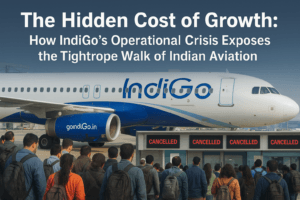
The Hidden Cost of Growth: How IndiGo’s Operational Crisis Exposes the Tightrope Walk of Indian Aviation
For thousands of Indian travelers this week, the promise of low-cost, efficient air travel has dissolved into a familiar scene of frustration: crowded airport counters, blinking “Cancelled” notifications on screens, and endless waits. The country’s aviation behemoth, IndiGo, is in the midst of a significant operational meltdown. While the airline cites a “multitude of unforeseen challenges,” a closer examination reveals a more instructive story—one of rapid expansion colliding with regulatory changes, and a business model being stress-tested by its own scale. This isn’t just a bad week for an airline; it’s a case study in the complex dynamics of modern air travel.
Beyond the Headlines: A Perfect Storm of Factors
IndiGo’s official statement points to technology glitches, airport congestion, winter schedule changes, and adverse weather. While these are all legitimate, intermittent challenges for any airline, they have acted as triggers to a much deeper vulnerability: a severe crew shortage exacerbated by newly implemented Flight Duty Time Limitations (FDTL) norms.
The new FDTL rules, mandated by the Directorate General of Civil Aviation (DGCA) and upheld by the Delhi High Court, are designed with pilot welfare and passenger safety as the undisputed priorities. Key changes include increasing weekly rest for pilots from 36 to 48 hours, and drastically reducing permitted night landings. For an airline like IndiGo, which has built its empire on ultra-high utilization of both aircraft and crew—particularly with a dense network of red-eye flights—this is a seismic shift. It’s akin to changing the engine rules midway through a Formula 1 race.
The result is a mathematical crisis in rostering. Pilots who could previously complete more sectors, especially at night, now hit their duty caps sooner. The airline, which reportedly opposed the phased implementation of these norms arguing for more time to hire and train, now faces a gap where the number of flight schedules exceeds the available, legally compliant crew. The “calibrated adjustments”—essentially pre-emptive cancellations—are a painful but necessary reset to align reality with regulations.
The Scale Problem: When Dominance Becomes a Vulnerability
Here lies the central paradox. IndiGo’s staggering success—its over 60% domestic market share, 400+ aircraft, and 2,300+ daily flights—is precisely what makes it uniquely susceptible to this disruption. Its low-cost model thrives on efficiency: planes flying more hours per day, with quick turnarounds, and crews working optimal patterns. This machine-like precision, however, lacks slack. In a complex, interdependent system, a delay at a congested airport like Delhi or Mumbai doesn’t just affect one flight. It cascades.
The affected aircraft is now late for its next three rotations. The crew on that delayed flight may now exceed their FDTL caps for their following scheduled sector. Finding a fresh, compliant crew at short notice becomes a logistical nightmare, leading to cascading cancellations. While other airlines like SpiceJet or Akasa Air reported better on-time performance this week, their networks are smaller and less tightly packed, giving them more buffer to absorb shocks. IndiGo’s vast, interconnected web magnifies every snag.
A Clash of Narratives: Operational Failure or Regulatory Pressure?
The pilot unions, like the Air Line Pilots’ Association of India (ALPA) and the Federation of Indian Pilots (FIP), have launched a pointed critique. They argue this is not an unforeseen crisis but a failure of “proactive resource planning.” Their contention is that the airline, despite years of notice and a court-directed timeline, chose to run a “lean manpower strategy” to protect profits, hoping to pressure regulators into diluting the norms. They warn against allowing operational disruptions to become a tool for “arm-twisting” safety regulations.
IndiGo’s perspective, undoubtedly, is one of a business navigating a sudden and significant increase in its operational costs. Hiring and training hundreds of new pilots is a capital-intensive, time-consuming process. The new norms effectively reduce the productivity of their existing crew resource, necessitating a larger workforce for the same number of flights. From a purely financial standpoint, this impacts the low-cost structure that defines their competitive advantage.
The Passenger’s Plight and the Erosion of Trust
Caught in this crossfire is the passenger. The real human insight here is the erosion of a tacit trust. Travelers choose airlines based on reliability and price. For years, IndiGo has traded on a reputation of punctuality. This week, with an on-time performance (OTP) plummeting to 35%, that reputation has taken a severe hit. Social media is a testament to the real-world consequences: missed business meetings, disrupted wedding travel, exhausted families, and the financial burden of last-minute alternative arrangements.
While the airline is legally obligated to offer refunds or re-accommodation, the compensation for intangible losses—time, stress, missed opportunities—is zero. This incident educates the traveler on the fragility of the air travel system and encourages behaviors like purchasing travel insurance or avoiding tight connections, which ultimately add cost and complexity back into the journey.
The Path Forward: More Than a 48-Hour Fix
IndiGo’s 48-hour “calibrated adjustment” band-aid will likely stabilize the immediate chaos, but the underlying condition requires longer-term treatment.
- Accelerated Hiring and Training: There is no shortcut. The airline must aggressively ramp up its recruitment from both domestic and international pools and expand its training pipeline, even if it pressures margins in the short term.
- Network and Schedule Re-engineering: The airline may need to fundamentally reassess its flight schedule, potentially reducing some marginal, high-frequency routes or adjusting timings to better align with the new crew rest norms, even if it means slightly lower aircraft utilization.
- DGCA’s Role as Arbiter: The regulator’s investigation must be thorough. It needs to ensure compliance is not being sacrificed for operational convenience, while also engaging with the industry to understand genuine implementation hurdles. Its credibility is tied to enforcing safety without crippling connectivity.
- Transparent Communication: Moving beyond boilerplate statements to clear, proactive communication with passengers about the nature of the problem and the expected timeline for full normalization is crucial to rebuilding trust.
The Bigger Picture: A Turning Point for Indian Aviation
This crisis marks a potential turning point. For years, Indian aviation has been a story of breakneck growth, often outpacing the development of its supporting infrastructure—including human resources. The new FDTL norms, championed as a victory for pilot fatigue management, are forcing the industry’s most successful player to reconcile growth with sustainability and safety.
The coming months will reveal whether IndiGo can adapt its legendary efficiency to a new, more stringent operational reality. Can it retain its low-cost DNA while investing in a larger, well-rested workforce? The answer will determine not only its own future but also set a precedent for how India balances the dual imperatives of being the world’s fastest-growing aviation market and one of its safest.
For the traveler, the lesson is clear: in an ecosystem built on precision and thin margins, resilience can be scarce. The true cost of a ticket is measured not just in rupees, but in the robustness of the system behind it. This week, that system showed its cracks, offering a sobering reminder of the complex machinery that carries us through the skies.
You must be logged in to post a comment.