
The Herzog Visit: Protest, Division, and Australia’s Diplomatic Dilemma
The Herzog Visit: Protest, Division, and Australia’s Diplomatic Dilemma
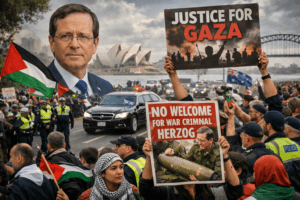
The upcoming official visit of Israeli President Isaac Herzog to Australia has ignited a political firestorm, exposing deep societal fractures and presenting the Albanese government with one of its most complex diplomatic and domestic challenges. What was intended as a gesture of solidarity in the wake of tragedy has instead become a flashpoint, pitting principles of international law against diplomatic protocol, and testing the limits of free speech in a climate of heightened tension. This controversy reveals more than just disagreement over foreign policy; it strikes at the heart of Australia’s national identity and its role on the global stage.
The Controversial Figure at the Centre
Isaac Herzog’s journey to the presidency is a story of political transformation. Once the leader of Israel’s centre-left Labour Party and an advocate for a two-state solution, his presidency has been marked by a noticeable shift to the right, aligning more closely with Prime Minister Benjamin Netanyahu’s government. This alignment has placed him at the centre of international condemnation following the war in Gaza.
The most damning criticisms stem from his own words. In the aftermath of the October 7 attacks, Herzog stated, “It’s an entire nation out there that is responsible. It is not true, this rhetoric about civilians who were not aware and not involved. It is absolutely not true”. These comments were cited by South Africa in its genocide case against Israel at the International Court of Justice (ICJ). A 2025 UN Human Rights Council commission of inquiry found that while the statement did not expressly call for genocide, it “may reasonably be interpreted as incitement” given the context of the newly launched military operations.
Herzog has defended himself, arguing his words were taken out of context and pointing to other statements where he said there was “no excuse for murdering innocent civilians”. Nevertheless, the imagery of him signing Israeli artillery shells with the phrase “I Rely On You” has become a potent symbol for protesters.
The Legal Battle: Immunity vs. Accountability
Calls for Herzog’s arrest upon landing in Australia, primarily from groups like the Greens, face an immovable legal obstacle: head of state immunity.
- Immunity in Practice: International law professor Don Rothwell explains that while Australia’s Commonwealth Criminal Code theoretically allows for prosecution for incitement to genocide, any case would be swiftly dismissed on the grounds of immunity. The Australian Federal Police confirmed there is no active investigation and that Herzog enjoys “full immunity” as an invited head of state.
- The ICC Distinction: This differs from the situation of Prime Minister Netanyahu, who is subject to an International Criminal Court (ICC) arrest warrant. Herzog is not, meaning Australia has no international obligation to detain him.
- The Visa Character Test: Opponents have focused on a different legal avenue. A coalition of seven Jewish organisations wrote to Home Affairs Minister Tony Burke, urging him to rescind Herzog’s visa under Section 501 of the Migration Act. They argue that his alleged conduct fails the “character test” for visa applicants, citing the UN commission’s findings.
The government has shown no indication of pursuing this path, prioritizing diplomatic protocol. This legal reality—that a visiting head of state is practically untouchable regardless of allegations—forms the bedrock of the protesters’ frustration and sense of injustice.
Protest, Police, and the Shadow of Bondi
The planned protests against the visit have triggered a separate but related conflict over the right to assembly in New South Wales.
NSW Police Commissioner Mal Lanyon extended controversial protest restrictions for a fourth time, citing the “significant animosity” surrounding Herzog’s visit as a key factor. The restrictions, originally implemented after the Bondi terror attack, ban authorised marches (Form 1 applications) in parts of Sydney’s CBD and eastern suburbs, though Hyde Park is exempt.
- A Planned Defiance: The Palestine Action Group (PAG) has announced a rally at Sydney’s Town Hall, with a march to state parliament—a route that falls within the restricted zone. PAG organiser Joshua Lees labelled the extension a move to “silence opposition to the visit of war criminal Israeli President Isaac Herzog”.
- Police Position: Police maintain they are “not here to take sides” but to balance free speech with community safety. They have offered to facilitate a protest in Hyde Park but warn that participants in an unauthorized march lose legal protections and could face charges for obstructing traffic.
- Political Rebellion: The situation has caused a rift within NSW Labor. Three Labor MLCs—Cameron Murphy, Stephen Lawrence, and Sarah Kaine—have vowed to attend the rally in defiance of Premier Chris Minns. Murphy stated he would protest because “we should not be welcoming to Australia the head of a state engaged in an ongoing genocide”. This internal dissent highlights how the issue transcends typical political lines.
A constitutional challenge to the protest laws is pending in the NSW Supreme Court, but its delayed hearing means a ruling will not come before the visit, setting the stage for potential confrontation.
A Jewish Community Divided
The government’s stated aim for the visit is to “provide support for Jewish Australians” after the Bondi attack. However, this very framing has drawn criticism for conflating Jewish identity with the actions of the Israeli state, a concern raised by multiple Jewish groups.
The community’s response is far from monolithic:
- In Support: Organisations like the Zionist Federation of Australia have welcomed the visit as a show that “Australia stands with its Jewish citizens, and Australia stands with Israel”.
- In Opposition: The left-wing Jewish Council of Australia (JCA) has been vocal in its opposition. This prompted Israeli opposition leader Yair Lapid to lash out, calling the JCA “extremists” and “useful idiots” for Hamas. Meanwhile, the seven organisations that wrote to Minister Burke represent a segment of the community that sees Herzog’s actions as antithetical to Jewish values and a risk to Jewish safety worldwide.
This division underscores a critical point: the visit, intended to foster unity, risks exacerbating tensions by forcing a political litmus test upon a diverse community.
Australia’s Diplomatic Tightrope
For the Albanese government, the Herzog visit represents a profound dilemma. On one hand, it seeks to maintain a crucial bilateral relationship and offer comfort after a national trauma. On the other, it has positioned itself as a champion of a “rules-based international order”.
There is a stark contradiction in advocating for new laws against hate speech and incitement while hosting a leader whose words are under scrutiny at the ICJ for possible incitement. As lawyer Josh Bornstein argues, the invitation “undermined [the government’s] own efforts to promote social cohesion and respect for the rule of law”.
Furthermore, the visit directly follows Australia’s recent recognition of a Palestinian state, a move that angered Israel. Former Israeli diplomat Alon Liel suggests Herzog will be under pressure from Netanyahu to criticise Australia for this decision during his visit.
Conclusion: A Nation’s Identity Under Scrutiny
The furore over Isaac Herzog’s visit is more than a diplomatic spat or a protest logistics issue. It is a moment of national reckoning. Australia is being forced to weigh its diplomatic alliances against its commitment to international legal norms, to balance community safety with the fundamental right to protest, and to navigate the delicate space between supporting a grieving community and endorsing a controversial foreign government.
The outcome of this visit—how protests are policed, how dissent within the Labor party is managed, and what messages are sent internationally—will leave a lasting imprint. It will reveal not just the government’s foreign policy priorities, but the kind of nation Australia aspires to be when faced with the world’s most intractable and morally charged conflicts. The path the government chooses will either bridge divides or deepen them, with consequences for social cohesion that will endure long after the presidential motorcade has departed.
You must be logged in to post a comment.