
The Heretic’s Pulpit: Inside the Orthodox Left’s Struggle to Critique Israel Without Losing Its Faith
The Heretic’s Pulpit: Inside the Orthodox Left’s Struggle to Critique Israel Without Losing Its Faith
At the second annual U.S. conference for the Jewish left, the battle for the soul of Orthodoxy—and the morality of Zionism—erupted not between rivals, but within the ranks of the dissenters themselves.
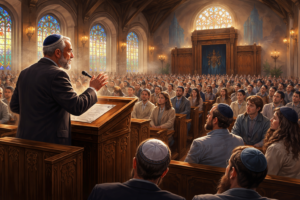
The sanctuary of B’nai Jeshurun on Manhattan’s Upper West Side is not usually a place for heretics. But on a recent Sunday, the historic synagogue became the venue for a different kind of religious service: one where the liturgy was replaced by political dissent, and the closing hymn was the sound of footsteps as disgruntled attendees walked out.
The occasion was the second annual conference of Smol Emuni U.S.—Hebrew for “the faithful left”—a nascent movement attempting to carve out a theological and political space for observant Jews who find themselves alienated by the rightward march of mainstream Orthodoxy and its unwavering embrace of Israeli government policy.
For the roughly 300 attendees who packed the pews, the event was a lifeline. It was a chance to breathe freely in a Jewish world that often feels claustrophobic to those who harbor doubts about the occupation, who mourn the deaths of Palestinian children, and who believe their ancient faith demands a universal standard of justice, not a tribal one.
But as the day wore on, it became clear that this movement, still in its infancy, is not just fighting an external battle against the Orthodox establishment. It is wrestling with a much more intimate demon: its own internal contradictions. The conference was a pressure cooker of ideas, and by the afternoon, it exploded, exposing the raw, unresolved tension between a progressive political conscience and the deep, ancestral pull of Jewish peoplehood and theology.
A Collision of Conscience and Creed
The fissure cracked open during a keynote address by Rabbi Saul Berman, a titan of Modern Orthodoxy. At 86, Berman is a living legend: a civil rights activist who was arrested in Selma, a mentor to generations of rabbis, and the former spiritual leader of Manhattan’s prestigious Lincoln Square Synagogue. His presence on the Smol Emuni stage was meant to be a bridge—a signal that the movement had roots in the respectable, mainstream Orthodox world.
But bridges, it turns out, can also be battlegrounds.
Berman was invited to speak about his recent activism against ICE immigration raids in Minneapolis, a topic that neatly aligned with the conference’s theme of applying Jewish values to social justice. Instead, he used his pulpit to settle a score. He was rankled by comments made earlier in the day by Gregory Khalil, a Palestinian-American peace activist and co-founder of the Telos Group.
During a morning panel on Gaza, Khalil had suggested that for many Palestinians, Zionism “functions like a religion”—an ideology so sacrosanct that it becomes immune to critique and, in its most extreme forms, a justification for dispossession. He spoke of the inevitability of “resistance” in the face of a decades-long military occupation, siege, and the denial of fundamental human rights.
To Berman, this was not just a political disagreement; it was a theological insult.
Standing at the podium, his voice thick with disappointment, Berman abandoned his prepared remarks. “I did not appreciate the assertion that somehow the Jewish passion for Israel need not be heard,” he told the crowd, his words hanging in the hushed air. “I didn’t appreciate the sense that the theological root of Zionism is the source of horror and enmity and evil.”
Then, he went further. He pivoted from defending Jewish theology to attacking Islam, asserting that the “theological position within Islam is fundamentally at the root of the incapacity of the Islamic world to recognize the rights of Israel to exist as a Jewish state.” He claimed this idea is “taught actively by imams all over the world, including here in the United States.”
The sanctuary stirred. It was a sweeping generalization about a billion-strong, diverse faith, delivered in a space that had, just hours earlier, been dedicated to the nuanced, human reality of Palestinian suffering. For many, it was a step too far. A few attendees didn’t hesitate; they stood up and walked out. One held aloft a piece of paper with a single, scrawled word: “BOOO.”
The Rebuke
The moment crystallized the core dilemma of Smol Emuni. How do you build a “big tent” that includes both anti-Zionists and right-wing Zionists? How do you critique the occupation without appearing to delegitimize the Jewish longing for homeland? And how do you hold space for the trauma and theology of one people without erasing the humanity of another?
The conference organizers were forced to answer these questions in real-time. As Berman concluded, Rachel Landsberg, Smol Emuni’s program director, took the microphone. With the entire room watching, she delivered a public, respectful, but unequivocal rebuke to the man who had been their headliner.
“We invited you to speak about immigration and you expressed other views. We appreciate hearing them,” Landsberg said, her voice steady. “As organizers of Smol Emuni, we want to say that we respectfully disagree, but we’re very glad to have you here with us.”
The room erupted in applause. It was a stunning moment of organizational clarity. The “faithful left,” it declared, would not allow its platform to be used to paint all of Islam with a broad brush, even by one of its own icons.
Later, Esther Sperber, the organization’s executive director, reflected on the incident. She acknowledged that Berman had been transparent about his disagreements with Smol Emuni’s approach before accepting the invitation. But she drew a clear line.
“Our intention was for the conference to focus on what we as Orthodox and observant Jews can do better,” Sperber told the Forward. “And I think our sense was that Rabbi Berman’s comments were more focused on what Palestinians can do better.”
It was a subtle but profound distinction. The movement, Sperber implied, is an exercise in cheshbon nefesh—a Hebrew term for a rigorous, introspective accounting of the soul. Its gaze is directed inward, at the corruption of its own tradition, not outward, at the perceived failings of the “other.”
The Personal is Political
For attendees like Riva Atlas, a financial researcher from New York, the friction was not a sign of weakness, but of authenticity. The struggle to reconcile progressive values with Zionist identity is, for many, a daily lived experience.
“It’s very hard to thread the needle and say, ‘OK, I am progressive, and I am a Zionist, and I disagree with some things that the Israeli government is doing,’” Atlas explained. The conference, she said, offered a rare sanctuary for that messy, complicated work. It validated the idea that you don’t have to check your Judaism at the door to care about Palestinians, and you don’t have to abandon your critique of Israel to remain an observant Jew.
This theme of painful reconciliation echoed throughout the day. On a panel about Gaza, the discussion veered into the theological. Rabbi Mikhael Manekin, one of the founders of the original Smol Emuni movement in Israel, joined via Zoom from Jerusalem. He gently pushed back against Khalil’s secular framing, reminding the audience that faith cannot be so easily dismissed.
“No matter what word you use to identify yourself—Zionist, non-Zionist, anti-Zionist—at the end of the day, so much of our tradition centers the holiness of the land of Israel,” Manekin said. “A third of our Mishnah is about keeping commandments in Israel.”
He was arguing that the connection to the land is not a political add-on; it is the very fabric of Jewish religious life. To ignore it in pursuit of a purely political solution is to miss the point for religiously observant people. This is the unique burden of Smol Emuni: to find a language that honors that sacred connection while simultaneously condemning the political structures built in its name that perpetuate violence and suffering.
A Sickness in the Soul
The most visceral moments of the conference came not from the disputes between panelists, but from the testimonies of those suffering under the weight of their communities’ politics.
Rabbi Chaim Seidler-Feller, a longtime Hillel director and revered figure in Los Angeles, shared a story that made the audience gasp. He described messages he received from friends in Israel—described as “decent, religious, fair-minded and highly educated people”—on the recent holiday of Purim.
The holiday, which celebrates the Jewish people’s salvation from a genocidal plot in ancient Persia, is traditionally marked by gift-giving, feasting, and charity. But this year, for some religious Zionists, it was marked by something else.
“In place of mishloach manot [gifts of food], a bomb has been dropped in Tehran in your honor. Purim Sameach,” Seidler-Feller read aloud, his voice heavy with disgust. He looked out at the crowd, his expression one of profound grief. “What an obscene perversion. A sickness has overtaken the religious Zionist community.”
The line drew a direct connection between messianic fervor, militarism, and the war with Iran. It was a condemnation of a worldview that has, in the eyes of many at the conference, “hijacked” their tradition, transforming a faith of law and compassion into a tool for nationalist vengeance.
Esther Sperber echoed this sentiment, voicing a concern that transcends the immediate danger of war. “My other very deep, deep concern is not just the danger of war, but its corruption of our faith and our Judaism,” she said. “Our tradition has been hijacked.”
This is the central thesis of the “faithful left”: that the greatest casualty of the conflict is not just Palestinian lives or Israeli security, but the moral integrity of Judaism itself.
The Loneliness of the Dissenter
The struggle for that integrity comes at a high personal cost, a fact made painfully clear by the youngest voices at the conference.
Gershon Rosenberg, a junior at the SAR Academy, a prestigious Modern Orthodox day school in the Bronx, spoke on a panel about Israel education. He described the firestorm he ignited after writing an op-ed for his school paper. His sin was not advocating for a boycott or denying Israel’s right to exist. He simply argued for a more nuanced, empathetic understanding of the conflict in Gaza—one that acknowledged the Palestinian perspective.
The backlash was immediate and intense. He faced the kind of communal shunning that can feel like a death sentence to a teenager in a tight-knit religious community.
But then, something unexpected happened. In the shadows of the hallway, in the whispers between classes, peers began to approach him. “A lot of people would reach out to me and say, ‘It was so meaningful for me to see someone else, a young person, show that I’m not alone,’” Rosenberg recounted.
His story was the living, breathing mission statement of Smol Emuni. The conference was, in many ways, a large-scale version of those whispered conversations. It was a formal acknowledgment of the loneliness that comes with being a political minority in a community that demands ideological conformity.
Rabbi Sharon Brous, the charismatic leader of the unaffiliated Los Angeles synagogue Ikar, described the phenomenon in her own community. Before the national conference, she said, local Smol Emuni gatherings were organized through “whispered invitations.” People were terrified of being found out. The gatherings served one crucial purpose: they helped people realize they were not alone.
A Movement in Its Awkward Adolescence
By the end of the day, the conference at B’nai Jeshurun had done what all successful movements must do: it surfaced its own fault lines. The walkout during Rabbi Berman’s speech was not a failure; it was a definition. It drew a border around what Smol Emuni is and is not.
It is not a fan club for Israel, nor is it a platform for anti-Israel diatribe. It is not a space for liberal Zionism that stops at the Green Line, nor is it a space for anti-Zionism that dismisses Jewish attachment to the land as a colonial delusion. It is, instead, a wrestling match.
It is a movement trying to answer a question that has no easy answer: In a world of profound moral complexity, where one people’s liberation is tied to another’s subjugation, how do you remain “faithful”—to your God, to your tradition, and to your universal human conscience?
The answer, if Sunday was any indication, is not found in comfortable consensus. It is found in the sharp exchange, the public rebuke, the walked-out protest, and the quiet whisper of solidarity. It is found in the messy, painful, and holy work of building a home for heretics who refuse to abandon their faith, and for believers who refuse to abandon their humanity.
You must be logged in to post a comment.