
The Green Wall: How the EU’s Carbon Tax is Forcing a Reckoning on Global Trade and Climate Justice
The EU is poised to reject India’s demand for an exemption from its Carbon Border Adjustment Mechanism (CBAM), a move that significantly complicates negotiations for a landmark trade deal both sides aimed to finalize by year’s end. India had proposed levying its own export fee based on product value rather than carbon content, but EU officials argue this fails to incentivize emissions reductions and would set a dangerous precedent for other trading partners.
Instead, the EU offered to reduce CBAM levies if India implements its own domestic carbon pricing scheme, a contentious proposition for India, which views the carbon tax as a protectionist “trade barrier” that threatens its industrial growth and highlights a fundamental clash between developed-world climate policy and developing-world economic ambitions.
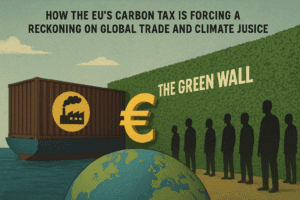
The Green Wall: How the EU’s Carbon Tax is Forcing a Reckoning on Global Trade and Climate Justice
The hurried promise made in February 2025 between European Commission President Ursula von der Leyen and Indian Prime Minister Narendra Modi—to finally seal a long-stalled trade deal by year’s end—is crashing into a formidable green wall. The barrier isn’t made of brick and mortar, but of policy and principle: the European Union’s Carbon Border Adjustment Mechanism (CBAM). What unfolds in this negotiation is more than a simple trade dispute; it is a fundamental clash between a developed world’s vision for a decarbonized future and an emerging economic powerhouse’s right to develop, a conflict that will define the rules of 21st-century commerce.
At its heart, the CBAM is the EU’s ambitious and controversial tool to prevent “carbon leakage”—the phenomenon where European industries, burdened by the world’s most robust carbon pricing scheme (currently around €80 per tonne), might relocate to countries with looser environmental rules. Starting in January 2026, the EU will begin levying tariffs on imports of carbon-intensive goods like steel, aluminium, and fertilisers, calibrated to the emissions embedded in their production.
For Europe, this is a matter of environmental integrity and economic fairness. For India, it is perceived as a “trade barrier” dressed in green cloth, a protectionist move that could stifle its manufacturing ambitions and penalize it for a problem it did not historically create.
The Unworkable Compromise: India’s Value-Based Carbon Fee
The core of the current impasse lies in India’s proposed workaround. New Delhi has suggested bypassing the EU’s mechanism entirely by implementing its own export fee on the affected goods. Crucially, this fee would be based on the value of the product, not its carbon content.
From the EU’s perspective, this proposal misses the entire point of the CBAM. As four EU officials bluntly stated, a value-based tax does nothing to incentivize manufacturers to invest in cleaner technologies or reduce their greenhouse gas emissions. The CBAM is designed to be a mirror, reflecting the EU’s internal carbon price onto its trading partners. A flat fee, regardless of value, would simply be a financial transfer, not an environmental tool.
More dangerously for Brussels, acquiescing to India’s demand would open a floodgate. The United States, China, and other major economies are watching closely. Granting India an exemption would set a precedent that would be impossible to deny others, effectively gutting the CBAM before it even takes full effect. The EU’s green trade policy, a cornerstone of its geopolitical identity, would be holed below the waterline.
The EU’s counter-offer is telling: reduce your CBAM liability by adopting your own domestic carbon pricing scheme. If Indian steel is produced under a national carbon tax or a cap-and-trade system, that cost would be deducted from the EU’s border levy. This move is strategically shrewd. It exports the EU’s climate policy, encouraging the creation of a global carbon market built in its own image. For India, however, this presents a monumental challenge.
India’s Development Dilemma: Growth vs. Green Compliance
India finds itself in a bind that encapsulates the developing world’s climate justice argument. The country is in the midst of Prime Minister Modi’s flagship “Make in India” initiative, a push to modernize its vast, but often inefficient and domestically focused, manufacturing base. Its heavy industries, particularly steel and aluminium, are crucial for domestic infrastructure and as export earners. Many of these facilities rely on coal-powered energy, resulting in a higher carbon footprint per unit than their European counterparts.
Implementing a stringent domestic carbon price could hamper this industrial growth, making Indian goods less competitive not just in Europe, but globally. It would impose a developed world’s solution on an economy still lifting millions out of poverty. This is why Indian officials have previously denounced the CBAM as unilateral and unfair.
Yet, the economic reality is inescapable. The EU is India’s largest trading partner, with bilateral trade exceeding $139 billion. Losing preferential access or facing steep CBAM costs would be a significant blow. The Modi government, which has successfully inked trade deals with Australia, the UK, and the European Free Trade Association, views a pact with the EU as a crown jewel, a vital counterbalance to potential protectionism from a Trump-led United States.
This creates a powerful, if uncomfortable, incentive for India to seriously consider the once-unthinkable: a national carbon pricing mechanism. The fact that the Indian government is already consulting on the matter signals a pragmatic recognition that the rules of global trade are changing irrevocably, and green compliance is becoming the price of admission to wealthy markets.
Beyond CBAM: A Looming Clash of Regulations
The carbon border tax is merely the sharpest edge of a broader regulatory clash. India also objects to the EU’s deforestation regulation, which bans imports of commodities like coffee, cocoa, and rubber if they are linked to cleared forests. While its implementation has been delayed, it represents another instance of the EU using its market power to enforce its environmental standards extraterritorially.
For European negotiators, these green measures are non-negotiable pillars of their political mandate. For Indian negotiators, they are sensitive “non-tariff measures” that threaten to derail a deal whose traditional components—tariff reductions on EU cars, spirits, and dairy—are already complex enough.
The Road to December: A Test of Geopolitical Pragmatism
With a self-imposed deadline of the end of 2025, the negotiations are entering a critical phase. The “possible landing zones” discussed by Trade Minister Piyush Goyal and EU Trade Commissioner Maroš Šefčovič in October remain shrouded in difficulty.
A potential compromise might involve a phased approach. The EU could agree to a transitional period for CBAM’s full application to Indian imports, coupled with significant technical and financial assistance to help Indian industries measure and reduce their carbon footprint. In return, India would need to present a credible, detailed roadmap toward a carbon pricing system, satisfying the EU that it is moving in the right direction.
The outcome of this high-stakes argument will resonate far beyond Brussels and New Delhi. It is a proxy battle for a central question of our time: who bears the cost of the global green transition? The EU is betting that its economic heft can force the world to play by its climate rules. India is fighting for the principle that the path to net-zero cannot be one-size-fits-all.
Their eventual agreement—or failure to reach one—will not just shape the future of EU-India trade. It will write the early playbook for how the world navigates the treacherous and interconnected demands of economic development, geopolitical rivalry, and planetary survival.
You must be logged in to post a comment.