
The Green Party’s Reckoning: Is a Vote for Palestinian ‘Resistance’ a Vote for Political Oblivion?
The Green Party is facing a defining political crisis as it prepares to vote on a motion that would formally define Zionism as a “racist ideology,” endorse the Palestinian right to “resistance by all available means,” and reject the two-state solution in favor of a single Palestinian state—language that has drawn fierce condemnation from Israel’s deputy foreign minister as “hateful and racist” and threatens to alienate Jewish voters while testing leader Zack Polanski, whose own mother is a Zionist. The motion, co-proposed by British-Palestinian activist Lubna Speitan who has previously voiced support for armed struggle, forces the Greens to choose between appeasing their activist base, which has been energized by the Gaza conflict, and protecting their unprecedented 15 per cent polling surge among moderate voters, echoing the antisemitism controversies that crippled Jeremy Corbyn’s Labour Party and raising fundamental questions about whether a party that legitimizes armed resistance against a UN member state can be considered a credible governing alternative in Britain.
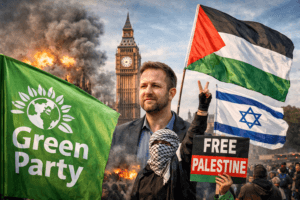
The Green Party’s Reckoning: Is a Vote for Palestinian ‘Resistance’ a Vote for Political Oblivion?
As the Green Party prepares to vote on a motion defining Zionism as racism and supporting the Palestinian right to “resistance by all available means,” it faces a defining moment that pits ideological purity against its unprecedented electoral momentum.
The polite fiction of British politics is that the Green Party is a single-issue movement, a collection of well-meaning environmentalists who can be safely indulged with a protest vote. But a motion heading to the party’s spring conference next month threatens to shatter that perception, dragging the Greens into the fiery heart of the Middle East conflict and forcing a fundamental question: can a party polling at nearly 15 per cent afford to adopt language that the Deputy Foreign Minister of Israel has labelled “hateful and racist”?
At the centre of the storm is Zack Polanski, the party’s leader. He is a man whose very name embodies the schism now tearing through his party. As the son of a mother who is a staunch supporter of Israel, Polanski is being asked to navigate a motion that implicitly labels her beliefs—and the beliefs of millions of Jews worldwide who support a Jewish homeland—as a “racist ideology.”
The motion, titled Zionism is Racism and co-proposed by British-Palestinian artist Lubna Speitan, is not merely a critique of Israeli government policy. It goes to the existential heart of the Israeli state. It calls for the “right of the Palestinian people to resistance and liberation” and states that “the struggle to achieve that liberation by all available means under international law is legitimate.” Furthermore, it explicitly rejects the two-state solution, the bedrock of international diplomacy for decades, in favour of a “single democratic Palestinian state” in “all of historic Palestine.”
For the Israeli government, the language is unambiguous. Deputy Foreign Minister Sharren Haskel did not mince her words, describing the document as having the “intent… to justify the destruction of the Jewish homeland and deny the right of Jews to a national home.”
The Semantics of ‘Resistance’
The most incendiary word in the motion is “resistance.” To its proponents, it is a noble term, evoking the struggle against colonial oppression. Lubna Speitan has been clear about her interpretation. In remarks made outside a courthouse last year, she stated that “what was taken by force must be returned by force” and voiced support for “the armed struggle.” She has previously argued that the Palestinian territories have a right to defend themselves by “whatever means necessary.”
To critics, this is not the language of peaceful protest but a justification for the violence of October 7th, 2023, when Hamas terrorists killed 1,200 people, and for the ongoing strategy of groups dedicated to Israel’s annihilation.
The motion attempts to shield itself by appending the qualifier “under international law.” However, international law is a murky pool regarding the “right to resist” occupation. While it affirms the right to self-determination, the means of resistance are heavily proscribed, with the deliberate targeting of civilians—a cornerstone of Hamas’s tactics—being a clear war crime. By refusing to condemn specific means and by calling for the proscription of Palestine Action—a group known for vandalising factories linked to Israel—to be lifted, the motion’s critics argue it creates a political umbrella for tactics that veer into illegitimacy and terror.
The Polanski Paradox
For Zack Polanski, the motion is a political and personal minefield. When challenged on LBC to say whether his own mother would be considered a racist under the party’s proposed definition, he sidestepped, arguing it would depend on her definition of Zionism.
It was a classic political dodge, but it revealed a deeper truth: the motion forces a distinction between a “good” and a “bad” Zionist. The party’s position seems to be that one can support the existence of Israel as a refuge and homeland for the Jewish people, but the moment that support translates into defending the state’s actions or its character as a Jewish state, it becomes racism.
This is a distinction that many Jewish voters, including those deeply critical of the current Israeli government, may find impossible to make. For them, Zionism is simply the expression of Jewish self-determination, a movement born from the ashes of pogroms and the Holocaust to offer a place of safety. To have that identity formally classified as racist by a major British political party is an act of profound alienation.
Polanski’s response to the Israeli condemnation was to pivot immediately to the war in Gaza. “For years we’ve seen an ongoing genocide,” he said. It is a framing that resonates with much of his party’s activist base, who see the motion not as an attack on Jewish identity, but as a necessary stand against the tens of thousands of Palestinian deaths in the recent conflict.
Yet by framing the debate solely in terms of the Gaza conflict, Polanski risks ignoring the motion’s longer-term implications. This is not a document about a ceasefire; it is a document about the final disposal of a nation-state.
The Ghost of Labour’s Past
For observers of British politics, the Greens’ predicament has a chilling familiarity. The party is walking the same tightrope that Jeremy Corbyn’s Labour Party walked—and fell from. Under Corbyn, Labour became riddled with accusations of antisemitism, with the party’s complaints system overwhelmed and Jewish members leaving in droves. The Equality and Human Rights Commission (EHRC) eventually found Labour guilty of unlawful acts of harassment and discrimination.
The Green motion, with its focus on Zionist conspiracy and its delegitimisation of the Jewish state, taps directly into the wellspring of rhetoric that fuelled that crisis. The claim that “nothing could be more anti-Semitic than Zionism itself,” as Speitan has argued, is a textbook example of what the International Holocaust Remembrance Alliance (IHRA) definition of antisemitism describes as “denying the Jewish people their right to self-determination, e.g., by claiming that the existence of a State of Israel is a racist endeavor.”
The Greens are not Labour, and their internal structures are different. But the underlying dynamic is identical: a hard-left activist base, fuelled by a visceral anger at Israeli policy and a romantic attachment to anti-colonial “resistance,” is pushing a leadership that is either ideologically aligned or too fearful of its own grassroots to push back effectively.
Speitan’s response to the controversy attempts to inoculate the party from charges of racism by highlighting Jewish co-sponsors of the motion. “Written alongside Jewish colleagues, we refuse to accept the supremacy of any one racial group over any other,” she stated. This is a common rejoinder, but it misunderstands the nature of the criticism. The presence of a few Jewish voices does not sanitise a motion that many Jewish organisations, from the Board of Deputies to the Jewish Leadership Council, find deeply troubling. It weaponises a minority within a minority to dismiss the concerns of the majority.
The Electoral Calculus
The political landscape in which this debate is taking place is critical. The Greens are soaring in the polls. Under Polanski’s leadership, they have doubled their support and now flirt with the 15 per cent mark, positioning themselves as a genuine alternative to a stagnant Liberal Democrat party.
This growth has been built on a coalition of voters: the traditional environmentalists, the young left-wingers disillusioned with Keir Starmer’s centrist Labour, and a growing contingent of Muslim voters angry at Labour’s stance on Gaza. The motion is clearly aimed at the latter two groups. It is a bid to become the authentic voice of the pro-Palestinian movement in British politics.
But the electoral gamble is colossal. For every voter the Greens gain on the streets of Bradford or Birmingham over Gaza, they risk losing two in the leafy, Remain-voting, cosmopolitan suburbs where they have made their deepest inroads. These voters—often university-educated professionals—may be uneasy about Israel’s actions, but they are unlikely to endorse a platform that calls for the dismantling of a UN member state and refuses to clearly condemn terrorism.
Furthermore, by adopting such a hardline position, the Greens are gifting their opponents a devastating line of attack. The Liberal Democrats, and even Labour, will be able to paint them as extremists. The Conservative Party and Reform UK will use it to tarnish the entire left-of-centre project as inherently anti-Western and antisemitic.
A Defining Moment
As the Green members prepare to cast their votes online next month, they are not just deciding on a policy document. They are deciding on the soul of their party.
If the motion passes, the Greens will become the first major British political party to formally adopt a platform that calls for the end of Israel as a Jewish state. They will have enshrined a definition of Zionism as racism into their rulebook. They will have signalled to Jewish voters that there is no place for them if they hold even the most moderate attachment to the state of Israel.
If it fails, it will be a major victory for the party’s moderate wing and for Polanski’s leadership, proving that he can stand up to the activist base and steer the party toward the electable centre.
Lubna Speitan argues that her motion “opposes racial hierarchy” and is a stand against “apartheid, genocide and war crimes.” But politics is the art of persuasion, and by using language that dehumanises and delegitimises the national aspirations of the other side, the motion risks importing the very maximalism it claims to oppose.
For Zack Polanski, the question posed by his mother’s Zionism was a clever trap. But the real question is far larger: Can a party that legitimises the armed struggle against one nation-state ever be trusted to govern a pluralistic, multi-ethnic Britain? The answer to that question will determine whether the Greens’ current poll surge is the beginning of a breakthrough, or the high-water mark before a long retreat into the political wilderness.
You must be logged in to post a comment.