
The Great Unravelling: How ‘New Climate States’ Are Redefining Disaster in India
A study presented by scientist Arpit Tiwari at the Anil Agarwal Dialogue 2026 reveals that India is entering unprecedented “new climate states” where historical weather patterns no longer apply, driven by the compound effects of rising temperatures and shifting rainfall. The research shows that heat has emerged as a primary driver of drought alongside rainfall deficits, with rising maximum and minimum temperatures dramatically increasing the atmosphere’s evaporative demand and desiccating soils even during normal rainfall years.
This creates “hot droughts” that traditional early warning systems fail to detect. Regionally, the findings paint a stark mosaic: the critical Indo-Gangetic Plain, Himalayas, and Northeast India face significant drying trends due to combined rainfall decline and temperature increases, while Western and Peninsular India show deceptive wetting trends driven by extreme convective events that may cause flooding rather than beneficial moisture. Tiwari urgently calls for abandoning one-size-fits-all national policies in favor of hyper-regional adaptation strategies, including multi-dimensional drought early warning systems that integrate temperature and evaporative demand data, development of crop varieties resilient to combined heat-water stress, and sustainable groundwater management focused on demand reduction rather than just supply augmentation.
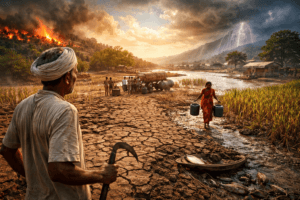
The Great Unravelling: How ‘New Climate States’ Are Redefining Disaster in India
The language of climate change has long been one of gradual shifts: rising mercury, receding glaciers, creeping sea levels. But for those on the frontlines of a warming planet, the change is not gradual at all. It is abrupt, jarring, and unprecedented. At the Anil Agarwal Dialogue 2026 in Nimli, Rajasthan, scientist Arpit Tiwari of the National Centre for Medium Range Weather Forecasting (NCMRWF) presented findings that strip away the last vestiges of climate predictability in India. We are no longer just experiencing “more” of the same—more heat, more drought, more rain. We are entering entirely new climate states.
This isn’t about a 0.5-degree Celsius shift in a temperature chart. It is about the fundamental breakdown of the seasonal rhythms that have dictated life on the subcontinent for millennia. Tiwari’s research, which analyzes rainfall and temperature data from 1951 to 2020, reveals a terrifying mosaic: a country where the very definition of “drought” is being rewritten by heat, where the Himalayan foothills are drying while the deserts of the west see more rain, and where the air itself is demanding more water from an already parched earth.
The Death of the Normal: Understanding Non-Analogue Climates
To grasp the gravity of Tiwari’s message, one must first understand the concept of a “non-analogue climate.” For centuries, farmers, planners, and policymakers could rely on the past as a prologue. The monsoon might be weak one year and strong the next, but it operated within a known spectrum—a range of possibilities that history had mapped out.
Tiwari’s study, however, shows that combined forces of warming and shifting circulation patterns are pushing temperature and precipitation combinations outside these historical ranges. We are creating climates that have no historical equivalent. This is the “novel climate regime.”
Imagine a farmer in Uttar Pradesh who knows that if the rains fail in August, the soil moisture will last another two weeks based on decades of experience. Now, imagine that the rain fails, but instead of the usual warm August, the region is hit by a blistering heatwave. The soil moisture evaporates in days, not weeks. The crop fails not because of a lack of rain, but because of an atmospheric demand for water that the ground cannot satisfy. This combination—a moderate rainfall deficit paired with extreme heat—is a non-analogue event. It has never happened before, and therefore, the farmer’s traditional knowledge is useless.
The Four Seasons of Unrest: How Drought Has Evolved
Perhaps the most striking revelation from Tiwari’s work is how the drivers of drought have shifted across India’s traditional seasons. The research dissects the year into its four climatic periods, revealing a country at war with itself.
- Pre-Monsoon (March-May): The Heat DominatorHistorically, the pre-monsoon summer is a period of dry heat, with everyone waiting for the rains. But now, high maximum and minimum temperatures have become thedominant driver of landscape stress. This is not just about discomfort; it is about physics. Extreme heat raises the “evaporative demand”—the thirst of the atmosphere. Even if the soil contains some moisture, the air sucks it out at an unprecedented rate. This desiccates vegetation and primes the land for rapid-onset flash droughts, creating a moisture deficit before the monsoon even arrives.
- Monsoon (June-September): The Traditional TriggerDuring the core monsoon months, a deficit in rainfall remains the primary trigger for drought. However, Tiwari’s data suggests that when this rainfall deficit coincides with even marginally warmer temperatures (which are now the norm), the drought intensity is far greater than similar dry spells experienced decades ago. The baseline has shifted; a “normal” dry spell now has the teeth of a historical severe drought.
- Post-Monsoon (October-December): The Prolonged SufferingAs the monsoon retreats, the country usually settles into a pleasant, cool autumn. This is changing. Tiwari notes that post-monsoon conditions are beginning to mirror pre-monsoon heat. With the withdrawal of cloud cover and the return of intense solar radiation, high temperatures persist well into the season. This prolongs the agony for Rabi crops, which are sown as the monsoon ends. The ground, already depleted by the summer and the monsoon’s variability, is stripped of its residual moisture, forcing farmers into a cycle of intensive irrigation or crop failure.
- Winter (January-February): The Wild CardEven winter is not safe. Tiwari points out that while Western Disturbances—storm systems that bring life-giving rain and snow to northern India—can still bring precipitation, their behavior is becoming erratic. When they do bring rain, they can create sudden “wet conditions,” disrupting the dry, cool period that winter crops rely on. The predictability of the cold, dry winter is eroding.
The Regional Mosaic: Winners and Losers in the New Climate Lottery
India is not a monolithic landmass, and its climate future is not uniform. Tiwari’s study paints a stark picture of a country fracturing along climatic lines.
The Drying Giants: Northeast India, the Himalayas, and the Indo-Gangetic Plain (IGP) This is the most alarming finding. The breadbasket of the nation (the IGP) and its water towers (the Himalayas) are showing significant drying trends. This is not merely due to declining rainfall. It is the compound effect of less rain and rising maximum temperatures. As Tiwari explains, the rising heat increases the “evaporative demand,” turning every drop of missing rain into a crisis.
Even nights are getting hotter. Tiwari notes that rising minimum temperatures (night-time warmth) are exacerbating drying in the IGP and Himalayas. Warmer nights mean plants respire more, consuming energy and moisture without photosynthesis, further stressing crops. Conversely, this same factor shows a “slight moistening signal in Peninsular India,” a testament to the complex, hyper-regional nature of these changes.
The Wetter West and Peninsula: A Deceptive Gift? Western and Peninsular India are bucking the trend, displaying wetting signals driven by increasing rainfall and more frequent convective events (like thunderstorms and cloudbursts). On the surface, this seems like a positive development for arid and semi-arid regions.
But a climate scientist would urge caution. “Wetting” does not mean “useful water.” Increased rainfall in these regions is often coming in the form of extreme, erosive downpours. The water runs off before it can soak into the ground, leading to flash floods rather than recharging aquifers. For a region like Rajasthan, more rain but in fewer, more violent bursts could mean more soil erosion and dam failures, not agricultural prosperity. It is a deceptive gift, wrapped in the guise of relief.
The Human Cost: Why Policy Must Catch Up to Physics
The data presented by Tiwari is not just for academic journals; it is a death warrant for outdated agricultural and water policies. As he told the gathering at AAD 2026, “Heat is a new driver of drought.” Our early warning systems, however, are still looking for rain.
Currently, India’s drought declaration is largely tied to rainfall deviation. If a district gets 30% less rain than normal, alarms go off. But Tiwari’s work reveals a terrifying blind spot: a region could receive “normal” rainfall and still experience severe agricultural drought because of the accompanying heat. The crops are dying, but the government sees “normal” monsoon data and declares the region fine. Relief is not triggered, and farmers are left to fend for themselves against an invisible enemy.
This calls for a radical overhaul of the drought early warning system. It must become multi-dimensional. We need to integrate forecasts for temperature, evaporative demand, and soil moisture stress, not just rainfall. We need to map “novel climate” indicators—the specific geographical zones where the old rules no longer apply.
The Path Forward: From National Policy to Local Reality
The concluding remarks of Tiwari’s presentation are a blueprint for national survival. “India needs region-specific adaptation plans,” he urged, calling for a shift from broad national policy to “finely tuned region-specific strategies.”
This is the core challenge. A farmer in the IGP facing “hot droughts” needs a different solution than a farmer in Kerala facing wetter, more intense storms.
- Agricultural Reboot: We must urgently develop and deploy crop varieties that can withstand “hot droughts”—the simultaneous combination of heat and water stress. Traditional drought-resistant crops may fail if they are not also heat-resistant. This must be paired with revising agricultural calendars; the fixed dates for sowing and harvesting are becoming relics of a stable climate. Promoting water-efficient practices like micro-irrigation is no longer a choice, but a necessity.
- Water Management in Drying Zones: The IGP and the Northeast are critical for food security and ecology. Policies there must move beyond tokenism. They require a wartime footing for sustainable groundwater management. This means massive, scientifically planned water harvesting, but more importantly, a fierce focus on demand-side interventions. We cannot supply our way out of this; we must consume less. This involves pricing reforms, cropping pattern shifts (moving away from water-guzzling crops in water-scarce zones), and public awareness.
Conclusion
The “new climate states” emerging in India, as revealed by Arpit Tiwari, signal the end of climate stationarity. The familiar cycle of seasons—the gentle rhythm of life in India—is being replaced by a cacophony of extremes. Drought now has a partner in crime: heat. Wetness now often comes with a flood.
The conversation at the Anil Agarwal Dialogue 2026 is a wake-up call. The data is clear. The science is settled. The only question that remains is whether our policies, our infrastructure, and our collective will can evolve fast enough to meet the country in this terrifying, unfamiliar place. The future is not going to look like the past. The only way to survive it is to admit that we are in uncharted territory and start building a new map, one region at a time.
You must be logged in to post a comment.