
The Great Unraveling: How Trump’s Trade Deal Turned Into Modi’s Political Crisis
A trade deal that began as a diplomatic victory for Narendra Modi—securing a sharp reduction in U.S. tariffs on Indian goods—has quickly devolved into a major political liability, as conflicting statements from Washington and New Delhi reveal that India may have quietly agreed to halt Russian oil purchases, open its politically sensitive pulse markets to American imports, and commit to buying $500 billion in U.S. products, terms that were never publicly acknowledged by India and have since sparked accusations of sovereignty surrender from farmers, opposition parties, and even former trade officials, leaving Modi trapped between fulfilling American expectations he never explicitly endorsed and managing a domestic backlash that threatens to reunite the very agricultural coalition that broke him once before.
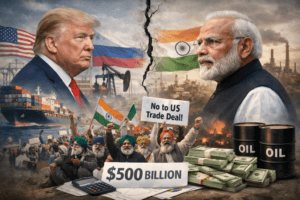
The Great Unraveling: How Trump’s Trade Deal Turned Into Modi’s Political Crisis
When Prime Minister Narendra Modi tapped out his effusive thank-you note to Donald Trump on February 3, he likely expected a week of triumphant headlines. Instead, he got a political firestorm that has united farmers, opposition parties, and even some of India’s most business-friendly economists in uneasy agreement: something went very wrong.
The deal that began as a straightforward tariff reduction—from a crippling 50 percent to a competitive 18 percent on most Indian exports to America—has metastasized into something far more complicated. What India received was clear and immediate. What India promised in return has proven disturbingly elastic, expanding with each subsequent American clarification like hot air finding every crack in a hastily sealed vessel.
The Pulse That Became a Political Heart Attack
To understand why this trade agreement has hit India so hard, you have to understand what happened in the three days between February 3 and February 6. And you really have to understand pulses.
On Monday, the joint Indian-American statement mentioned agricultural tariff reductions in broad strokes—fruit, soybean oil, “and several other categories.” Nothing remarkable. India has lowered agricultural tariffs before, usually with sufficient safeguards to prevent domestic disruption.
Two days later, the White House fact sheet arrived in New Delhi like an uninvited guest who knows where the bodies are buried. Between the fruit and the soybean oil, someone had inserted two words: “certain pulses.”
This was not a clerical addition. This was a geopolitical grenade.
Just 48 hours earlier, India’s own agriculture minister, Shivraj Singh Chouhan, had stood at a public podium and declared that importing pulses was “not joy, but shame.” He had announced a new policy of self-reliance in these protein-rich legumes that form the backbone of nearly every Indian meal. Dal is not just food in India—it is memory, it is comfort, it is the affordable nutrition that has sustained generations.
And now, without parliamentary debate, without stakeholder consultation, without even a mention in the joint Indian statement, the United States was announcing that India had agreed to open its pulse markets to American competition.
The farmers who marched on Delhi in 2020, enduring months of camping through winter and summer until Modi repealed his agricultural reform laws, recognized the smell of this deal immediately. They have not forgotten that protest, nor has Modi. When the Samyukt Kisan Morcha called for a strike on Thursday, the phones started ringing in government offices across Delhi.
By Wednesday evening, the White House had quietly edited the fact sheet. “Certain pulses” disappeared. But the political damage was already done, and the edit itself raised an uncomfortable question: Why does the text of India’s trade agreement keep changing at America’s discretion?
The Russian Oil Problem That Won’t Stay Quiet
The pulses dispute was painful, but it was ultimately fixable with some frantic late-night diplomacy. The Russian oil issue is not fixable, because it requires India to choose between two relationships it has spent decades carefully maintaining.
Since Russia’s 2022 invasion of Ukraine, India has pursued what it calls “strategic autonomy”—a polite way of saying it kept buying discounted Russian crude while Western nations imposed sanctions. This policy made economic sense: Russian oil saved India billions, helped manage inflation, and demonstrated that India answers to no bloc or power. It also nodded to a six-decade defense relationship with Moscow that has supplied everything from fighter jets to nuclear submarines.
The joint Indian-American statement never mentioned Russia. It spoke vaguely of “economic security alignment” and promised that energy products would feature in India’s pledge to buy $500 billion in American goods. Read charitably, this was India agreeing to diversify its energy imports. Read realistically, it was India refusing to explicitly abandon Russia.
The White House fact sheet read differently. It stated plainly that Trump dropped the punitive tariff “in recognition of India’s commitment to stop purchasing Russian Federation oil.”
Commitment. Not intention. Not consideration. Commitment.
Commerce Minister Piyush Goyal has spent the week dodging questions about this with the practiced agility of a man who knows he cannot answer truthfully without angering someone vital. The foreign ministry has been similarly evasive. The oil ministry is not returning calls.
This is not how India typically negotiates. For decades, Indian diplomacy has prided itself on never being cornered into explicit choices between major powers. Non-alignment may be a Cold War relic, but its strategic instinct survives: India does not do ultimatums, and India certainly does not announce its capitulation to them in foreign fact sheets.
Yet here, the capitulation was announced anyway—by the other side, in language India never approved.
The $500 Billion Question
India’s pledge to buy $500 billion in American goods over five years sounds impressive until you do the math. That is roughly double India’s current annual imports from the United States. It requires India to absorb American products at a pace that would fundamentally restructure its trade relationships and domestic industries.
The joint statement used the word “committed.” The White House fact sheet originally used “committed” as well. Then, after the pulses backlash, someone changed it to “intends.”
This linguistic retreat matters. “Commits” is a contract. “Intends” is a hope. The gap between them is where sovereignty lives.
Former Indian trade official Ajay Srivastava, who now runs an independent Delhi think tank, circulated a memo this week arguing that the deal sacrifices precisely this kind of autonomy. “Tying its economic and security policies too closely to any single country carries significant risks,” he wrote. This is the diplomatic equivalent of a former intelligence officer saying you should probably vary your routes to work.
The criticism is particularly pointed because India does not need this deal to survive. Its economy was growing at a respectable clip before the tariff reduction. The reforms Modi pushed through in recent months—simplifying taxes, liberalizing labor laws—were already bearing fruit. BMI, a Fitch Solutions unit, had just predicted “another quarter of stellar economic performance.”
So what exactly did India gain that was worth the political headache now cascading through its ministries? A tariff reduction that brought it in line with competitors? That is a defensive win at best. A photo opportunity with Trump? Those have historically depreciated rapidly.
The Bangladesh Complication
Even the defensive victory has proven slippery. On Tuesday, the Trump administration signed a separate trade arrangement with Bangladesh that could give its garment industry preferential access to American markets.
For India’s textile sector, this is not an abstract concern. Bangladesh has already overtaken India in ready-made garment exports by leveraging lower labor costs and, until now, preferential trade terms with Western buyers. The Confederation of Indian Textiles had greeted the India-U.S. deal “with sincere gratitude.” Within 48 hours, its chairman, Ashwin Chandran, was issuing anxious statements about “awaiting clarity” on the implications of America’s Bangladesh gambit.
This is the recurring pattern of the entire episode: India celebrates a concession, then discovers the concession came with hidden costs that become visible only when it is too late to renegotiate.
The Farmers’ Unfinished War
The agricultural dimensions of this deal resonate beyond pulses because they reopen Modi’s deepest domestic wound.
The 2020–2021 farmers’ protest was the longest and largest in Indian history. At its peak, an estimated 250 million people participated in some form of solidarity action. The movement united farmers from Punjab’s wheat belts to Tamil Nadu’s paddy fields, transcending the regional and caste divisions that usually fragment Indian agriculture.
Modi eventually capitulated and repealed his farm laws—a rare retreat from a politician not known for backward steps. But neither side forgot the encounter. The farmers learned that sustained, unified pressure could force the government to bend. The government learned that farmers remain the most politically volatile constituency in India’s electoral calculus.
Now the trade deal has handed the farm unions a ready-made grievance. American agricultural imports are not inherently threatening—India already imports palm oil from Indonesia and soybeans from South America. But the framing matters. When tariff reductions are negotiated secretly and announced by foreign governments before Indian stakeholders are informed, the deal smells like surrender.
The farmers’ call for Goyal’s resignation, and their branding of him as a “traitor,” is theatrical politics. But the underlying sentiment is genuine: Indian agriculture was not consulted about this deal, and Indian agriculture suspects it is being offered as a sacrifice to American trade ambitions.
The Opposition’s Opening
For India’s fractured opposition, the trade deal is a gift that keeps giving. Rahul Gandhi’s Congress party has called it a “wholesale surrender” of national interests. Regional parties from West Bengal to Tamil Nadu have issued condemnations calibrated for local consumption. Even some of Modi’s usual corporate supporters have fallen silent, unwilling to defend a deal whose full terms remain opaque.
The opposition’s advantage here is that it does not need to prove the deal is bad—it only needs to demonstrate that Modi cannot explain what he agreed to. Every minister who ducks a question, every government statement that contradicts the White House fact sheet, every edit made on an American website to Indian commitments—all of it accumulates into a narrative of a prime minister who negotiated poorly and got outmaneuvered.
This is, for Modi, unfamiliar terrain. He has dominated Indian politics for a decade partly by projecting decisiveness and control. His foreign policy has been marketed as muscular, ensuring India’s interests are never subordinated to foreign pressure. The Trump deal undermines both perceptions.
The Deeper Current
Beneath the immediate controversies over pulses, oil, and import targets flows a more fundamental anxiety about India’s trajectory. The country has spent three decades cautiously integrating with global markets while preserving policy space to protect vulnerable sectors and strategic industries. This balancing act has produced impressive growth without the kind of wholesale policy surrender imposed on developing countries in the 1990s.
The Modi-Trump deal, as it has actually unfolded rather than as it was initially announced, suggests that balancing act is becoming unsustainable. India is being asked to choose: American market access or Russian oil. American agricultural exports or domestic pulse self-sufficiency. American strategic alignment or independent foreign policy.
These are not choices India wanted to make, and they are not choices India anticipated making when Modi posted his cheerful thank-you note. They have arrived anyway, bundled inside a trade agreement whose terms seem to be written not in Delhi but in Washington, and not all at once but gradually, through fact sheet edits and official clarifications that trickle out long after the celebratory social media posts have faded.
The farmers striking on Thursday, the opposition MPs demanding parliamentary debates, the former trade officials writing concerned memos—they are all responding to the same underlying realization. The deal India thought it signed on February 3 is not the deal America thinks it signed. And in trade negotiations, the version that prevails is rarely the Indian one.
What Happens Now
The interim agreement is expected to be finalized in March, assuming both sides can reconcile their competing accounts of what they actually agreed to. The White House insists India made binding commitments; India’s commerce ministry continues to speak vaguely about intentions and aspirations. At some point, this gap must close, and the closing will require one side to concede it misrepresented the deal.
History suggests that side will be India.
For Modi, the political calculation is brutal but clear. He can admit that his government overpromised and underdelivered, that the tariff reduction came with hidden costs his negotiators missed or underestimated. This would be honest but politically damaging, a rare acknowledgment of fallibility from a leader who has built his brand on infallibility.
Alternatively, he can push ahead, accept the terms America has articulated, and manage the domestic fallout as best he can. This means formally abandoning Russian oil purchases, a move that will anger Moscow and unsettle India’s defense establishment. It means opening agricultural markets to American competition, inflaming the farm sector ahead of several state elections. It means embracing an import target that may prove unachievable without distorting India’s trade patterns in economically irrational ways.
Neither option is good. Both require Modi to choose between constituencies he has carefully balanced for years. The Trump trade deal, sold as a clean victory for Indian exports, has instead forced India’s prime minister into a series of painful trade-offs with no clean exits.
The sugar rush of early February has given way to a grinding political hangover. Indian businesses still benefit from lower American tariffs. The rupee is still stronger than it was two weeks ago. But the mood has shifted from celebration to apprehension, from gratitude to suspicion.
When Modi thanked Trump on behalf of 1.4 billion Indians, he probably assumed he was announcing a triumph. Instead, he was opening a negotiation whose final terms are still being written—and not by his own hand. That is the real headache, and it is not going away when the March trade deal is signed.
You must be logged in to post a comment.