
The Great Unraveling: How Canada’s Business Titans Are Navigating a World Turned Upside Down
The past week in Canadian business revealed a unsettling convergence of unraveling stories—from CAAT Pension Plan CEO Derek Dobson’s resignation over a $1.6-million vacation payout that exposed deep governance failures in institutions entrusted with retirement security, to Canadian Natural Resources’ pause of an $8.25-billion oil sands expansion that highlighted how policy uncertainty is stalling major economic projects and the livelihoods dependent on them. Meanwhile, Mark Carney’s India trip underscored Canada’s struggle to gain meaningful traction in the world’s fastest-growing major economy despite ambitious trade targets, as global instability from the Strait of Hormuz closure drove gasoline prices up 11 cents in a single week, demonstrating how distant conflicts immediately hit Canadian wallets. The tragic arc of John Risley’s empire—once the embodiment of entrepreneurial success, now facing over $2 billion in liabilities—serves as the week’s most human lesson: that the line between triumph and collapse is thinner than we imagine, and that in an era of profound uncertainty, the old certainties and trusted institutions are no longer reliable guides for navigating the future.
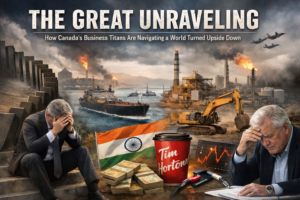
The Great Unraveling: How Canada’s Business Titans Are Navigating a World Turned Upside Down
When Certainty Collapses: A Week That Changed Everything
There’s something almost poetic about watching empires crumble—whether they’re built on bitumen, seafood, or pension funds. This past week in Canadian business felt less like the usual rhythm of quarterly earnings and stock tickers and more like watching a series of dominos, carefully arranged over decades, begin their inevitable tumble.
I’ve been covering Canadian business for long enough to recognize when something shifts beneath the surface. And this week, something shifted.
Let me tell you about Derek Dobson first, because his story is really the story of how power works—and how it fails—in this country.
The $1.6-Million Vacation That Broke a Pension Plan
Derek Dobson walked into CAAT Pension Plan in 2009, when the financial crisis was still fresh in everyone’s memory and defined-benefit pension plans were supposedly dinosaurs heading for extinction. Seventeen years later, he walked out with a $1.6-million vacation payout that would ultimately cost him his legacy.
The numbers are staggering, but they’re not really what this story is about. CAAT manages $23 billion for 125,000 members—Ontario college employees, yes, but also workers from more than 800 public and private sector employers. These are the people who clean college campuses, who teach evening classes, who process admissions paperwork. They trusted that their pensions were being managed by people who understood that retirement security isn’t a game.
What’s fascinating—and frankly, what should concern every Canadian with a pension—isn’t just that Dobson took the money. It’s that the board approved it. It’s that nobody stopped it until the outrage became impossible to ignore. It’s that a governance crisis erupted so severe that it’s triggered a complete management overhaul.
I spoke with a pension governance expert this week who told me something I can’t stop thinking about: “The problem with pension plans is that the people whose money is at risk have almost no visibility into how it’s being managed until something catastrophic happens.” By then, of course, it’s too late.
Dobson has now agreed to repay the money. But the question lingering in boardrooms across the country is simpler and more terrifying: How many other Derek Dobsons are out there, quietly accumulating vacation payouts and golden parachutes, while teachers and janitors and administrative assistants cross their fingers and hope?
The Oil Sands Pause That Speaks Volumes
About 2,700 kilometers west of Toronto, Canadian Natural Resources Ltd. made its own announcement this week, and it was arguably more consequential for the Canadian economy than any single executive’s downfall.
CNRL paused its $8.25-billion Jackpine oil sands expansion. The official reason? “Uncertainty over government policies.” The unofficial reason, whispered by people who work in Calgary’s energy sector, is that the economics simply stopped making sense.
Let me give you some context. CNRL produced 1.57 million barrels a day in 2025—roughly 15 percent more than the previous year. They’re not a struggling company. They’re a behemoth. And when a behemoth pauses an $8.25-billion project, it’s not because they’re worried about next quarter’s earnings. It’s because they’re worried about the next decade.
The November agreement between Alberta and Ottawa promised to raise the industrial carbon price to $130 a tonne. CNRL’s message this week was essentially: “Show us you mean it. Show us the policies won’t change again. Show us the regulatory environment is stable. Then we’ll talk.”
What’s lost in the political back-and-forth is the human reality. The Jackpine expansion would have meant thousands of construction jobs, then hundreds of permanent positions. It would have meant contracts for local businesses, housing starts in Fort McMurray, property tax revenue for municipalities struggling to diversify away from boom-and-bust cycles. It would have meant young families deciding to stay in northern Alberta instead of packing up for Toronto or Vancouver.
Those decisions are now on hold. And the people whose lives depend on them? They’re waiting. Again.
Chai, Timbits, and the India Mirage
Mark Carney was in New Delhi this week, shaking hands with Narendra Modi, talking about trade and investment and the future of Canada-India relations. The photo op was impeccable—two leaders in crisp suits, smiling against a backdrop of flags and potential.
But here’s what the photo doesn’t show: the 44 Tim Hortons locations scattered across India, representing almost the entirety of Canada’s consumer footprint in the world’s fastest-growing major economy.
Forty-four. In a country of 1.4 billion people.
Let that sink in for a moment.
The Indian economy is projected to grow at more than 7 percent this year. They need everything Canada produces—energy, minerals, agricultural products, education, financial services. And yet, Canadian companies have made remarkably little headway in what should be our most logical export market after the United States.
Carney wants to double bilateral trade to $70 billion by 2030. It’s an ambitious target, but ambition isn’t the problem. The problem is that Indian consumers don’t think about Canada the way they think about the United States, or the United Kingdom, or even Australia. We’re not on their mental map.
I talked this week with a Canadian executive who’s been trying to break into the Indian market for years. He told me something that’s stuck with me: “In India, relationships are everything. You can’t just show up with a product and expect people to buy it. You have to invest years in building trust before anyone will even consider doing business with you.”
Canadian companies, by and large, haven’t been willing to make that investment. We want the quick win, the easy deal, the low-hanging fruit. India doesn’t work that way. India requires patience, persistence, and a willingness to lose money for years before turning a profit.
The question Carney’s trip raises—and it’s a question that will outlast any single photo op or trade agreement—is whether Canada finally has the stomach for that kind of long game.
The Strait of Hormuz and the Price of Instability
About 20 percent of the world’s oil passes through the Strait of Hormuz. When that strait closes—as it did this week, amid the escalating U.S.-Israel conflict with Iran—the entire global energy system convulses.
Oil prices jumped 12 percent. Gasoline prices in Canada rose almost 11 cents per litre in a single week, to an average of $1.42. And here’s the cruel irony: Canada produces more oil than it consumes. We should be insulated from this kind of shock. We should be the ones benefiting from higher prices, not suffering from them.
Except that’s not how global commodity markets work. When the price of Brent crude spikes, Canadian gasoline prices spike with it. The refinery system is integrated across North America. The pricing mechanisms are global. And ordinary Canadians end up paying more at the pump regardless of how much oil sits in the ground beneath their feet.
What’s happening in the Strait of Hormuz is a reminder of something we’d rather forget: the global economy is fragile, interconnected, and profoundly vulnerable to events happening thousands of kilometers away. A single chokepoint in the Middle East can raise the cost of everything in Canada—not just gasoline, but food, manufactured goods, and anything else that requires transportation.
The war in Iran is tragic for countless reasons, most of them human. But for Canadian consumers, it’s also a brutal economics lesson about the costs of instability in a world we can’t control.
John Risley and the $2-Billion Disappearing Act
Of all the stories this week, the one that haunts me most is John Risley’s.
If you don’t know Risley, you should. He’s the kind of entrepreneur Canada celebrates—a self-made billionaire who built Clearwater Seafoods from nothing into a global powerhouse, then did it again with Columbus International and Ocean Nutrition. He was unstoppable, invincible, the personification of the Canadian dream.
Until he wasn’t.
This week, his primary holding company, CFFI Ventures Inc., sought court approval to restructure US$776 million in debt. The total liabilities now exceed $2 billion. And everyone in the business community is asking the same question: Where did all the money go?
Tim Kiladze’s investigation for The Globe pieces together the answer, and it’s not a simple story of bad investments or economic downturns. It’s a story about what happens when success becomes its own trap—when the deals get bigger, the risks get larger, and the margin for error shrinks to nothing.
Risley’s Clearwater deal in 2020 was supposed to be his crowning achievement. Instead, it may turn out to be the beginning of the end. The debt load was enormous. The timing was unlucky. The synergies never quite materialized. And suddenly, the man who could do no wrong was watching his empire crumble.
There’s a lesson here that goes beyond Risley himself. We love stories of entrepreneurial success in this country. We put founders on magazine covers and invite them to speak at conferences and hold them up as models for the next generation. But we rarely talk about what happens when the music stops—when the leverage works in reverse, when the personal guarantees come due, when the empire that took decades to build unravels in months.
Risley is 66 years old. He’s not going to start over. His legacy will be this complicated mix of extraordinary success and extraordinary failure, a reminder that in business—as in life—the line between triumph and tragedy is thinner than we’d like to believe.
The Bigger Picture: What This Week Actually Means
I’ve been doing this long enough to know that weeks like this one aren’t random. They’re symptoms of something larger—a moment when multiple systems, each strained in their own way, begin to show their fractures.
The CAAT pension story is about governance failures in institutions we trust with our retirement security.
The CNRL pause is about the growing tension between climate policy and energy development, and the human costs of that uncertainty.
The India trip is about Canada’s struggle to find its place in a world where the old certainties—the U.S. alliance, the Western trading bloc, the comfortable markets we’ve always relied on—are no longer enough.
The Strait of Hormuz closure is about the fragility of the global systems that underpin our daily lives.
And John Risley’s unraveling is about the personal costs of the risks we celebrate when they pay off and mourn when they don’t.
Taken together, these stories paint a picture of a country—and a business community—grappling with profound uncertainty. The old rules don’t apply the way they used to. The familiar landmarks are shifting. And the people who will thrive in this new environment aren’t necessarily the ones who succeeded in the old one.
They’re the ones who can adapt. Who can see around corners. Who understand that the world has changed, and that the strategies that worked yesterday won’t necessarily work tomorrow.
For the rest of us—the investors, the pension holders, the consumers filling our tanks at $1.42 a litre—the lesson is simpler and more sobering: Pay attention. Ask questions. And don’t assume that the institutions and individuals you’ve trusted with your financial future have everything under control.
Because this week, more than most, has shown that nobody has everything under control. Not Derek Dobson. Not CNRL. Not Mark Carney. Not even John Risley.
We’re all just figuring it out as we go along. And in times like these, that’s both the scariest and the most honest thing any of us can admit.
You must be logged in to post a comment.