
The Great Transition: Uttar Pradesh Braces for One Last Winter Shower Before an Early Summer Scorch
The Great Transition: Uttar Pradesh Braces for One Last Winter Shower Before an Early Summer Scorch
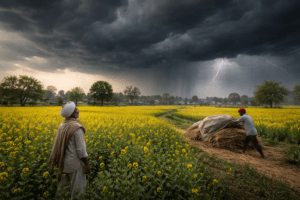
The duality of a North Indian winter is on full display across the vast plains of Uttar Pradesh. For a few hours each day, the sun hangs bright and warm in the sky, coaxing people out of their homes and offering a reprieve from the bone-chilling mornings. The woolen sweaters are gradually being folded and stored away, and the smell of mustard flowers blooming in the fields signals that spring is quietly knocking on the door. But just as the state settles into this comfort, the weather has decided to stage one final, dramatic performance.
The India Meteorological Department (IMD) has sounded a two-day alert for the state. On February 17 and 18, a reactivating Western Disturbance is poised to sweep across the region, bringing with it not just rain, but a reminder that winter, though retreating, is not yet ready to relinquish its grip entirely.
This isn’t just a routine weather update. It is a story of a state caught in a climatic tug-of-war—a story that involves anxious farmers staring at their golden crops, urban dwellers surprised by a sudden drop in mercury, and scientists who are watching the long-term patterns with a mixture of fascination and concern.
A Final Splash of Winter: The Immediate Forecast
According to Atul Singh, a scientist at the Lucknow Meteorological Department, the upcoming Western Disturbance is the primary driver of this change. “Due to this system,” Singh explains, “parts of the state are likely to receive rainfall on February 17 and 18.” But it won’t be a gentle drizzle. The system is expected to pack a punch, bringing with it gusty winds roaring at speeds of 30 to 40 kilometers per hour.
For the average person in cities like Lucknow, Kanpur, or Varanasi, this means a sudden shift in the evening atmosphere. The warm, pleasant afternoons will be replaced by overcast skies and a biting wind that cuts through light clothing. It is a classic pre-spring phenomenon in the Indo-Gangetic plains: a final hurrah of the Western Disturbance before the region tilts decisively toward the heat of the summer.
This comes on the heels of a remarkably warm spell. Just a day before the alert, on Sunday, the district of Banda recorded the state’s highest temperature at a summer-like 31.2°C, with Jhansi following closely at 30°C. These figures underscore the volatile nature of the season—a whiplash from near-summer heat to cold, rainy winds within 48 hours.
The Farmer’s Dilemma: Prosperity at Risk
While the city dweller might view the rain as an inconvenience or a romantic backdrop, for the millions of farmers across UP’s heartland, this forecast is a source of deep anxiety. The state’s fields are currently lush with Rabi crops. The wheat is in its critical grain-filling stage, and the mustard crops are standing tall, their yellow flowers a symbol of prosperity.
Professor P.K. Singh from the Agriculture Department at Banaras Hindu University (BHU) paints a worrying picture. “If heavy rain is accompanied by strong winds, it can be detrimental,” he warns. The primary threat is lodging, a phenomenon where mature crops are flattened by high winds and waterlogging. Once the stem of a wheat or mustard plant bends or breaks, the flow of nutrients is disrupted.
“The grains could weaken, affecting the yield significantly,” Professor Singh adds. For mustard, a sudden burst of moisture and wind can lead to shattering, where the ripe pods burst open prematurely, scattering the precious seeds onto the wet ground.
The Meteorological Department has issued an advisory urging farmers to be vigilant. They are advised to delay irrigation and, where possible, harvest any ripe produce immediately. The advice to “avoid keeping crops exposed in open areas” is a practical one, aimed at saving harvested yield from being soaked and ruined. For a farmer who has invested months of labor and capital, these 48 hours could determine whether the year is a success or a struggle.
The Vanishing Winter: A Statistical Anomaly
To understand the significance of this late February rain, one must look back at the winter that wasn’t. Mahesh Palawat, a veteran meteorologist at Skymet Weather in Noida, provides the context. “Compared to the past two years, winter was milder this time in UP,” he notes. The data is stark: maximum and minimum temperatures during December and January consistently stayed above average.
Between January 1 and February 11, the state witnessed a 36% decrease in cold wave spells. The usual bone-chilling days when the sun refuses to show its face were conspicuously absent. Palawat attributes this to the absence of a strong La Niña effect. La Niña, a climate pattern characterized by cooler Pacific Ocean waters, typically strengthens the winter in the Indian subcontinent. Its “inactivity” this year allowed the warm westerly winds to dominate, pushing the cold into the background.
Mohammed Danish of the Lucknow Meteorological Centre corroborates this, pointing to the lack of major Western Disturbances during the peak winter months, which led to below-normal rainfall during the cold season. This February rain, therefore, is not an extension of winter, but rather a last-gasp effort by the retreating season to make its presence felt.
The Science of Seasons: From Sisir to Grishma
In the Hindu calendar, the year is divided into six seasons (Ritus), each lasting roughly two months. We are currently transitioning out of Sisir Ritu (the late winter/dewy season) and entering Vasant Ritu (spring). Professor Manoj Shrivastava from BHU explains this natural progression: “The cold is now in its final phase. We are now in the spring season. For the next 2–3 weeks, the weather will remain relatively stable, with mild chill in mornings and nights, while afternoons will feel warm.”
This upcoming rain is a brief interruption in that stability. It is the atmosphere clearing the slate, so to speak, before the big transition. Once this disturbance passes, the stage is set for a rapid escalation in temperatures. The IMD has already forecast a 2–3°C rise in both day and night temperatures after February 18.
The Looming Crisis: A Scorching Summer Preview
If the mild winter was a surprise, the forecast for the coming months is downright alarming. The pleasant spring is expected to be brutally short. Professor Shrivastava warns, “From the first week of March, the weather will completely change and the heatwave period will begin.”
This is exceptionally early. Traditionally, March is a pleasant month, a time for festivals and the harvest. But the models suggest a different story for 2026. Day and night temperatures are projected to rise sharply. By the last week of March, several districts in UP could be baking in temperatures of 35–38°C.
The situation is predicted to worsen as the summer progresses. “In April, temperatures may hover around 40°C,” Shrivastava states. “In May–June, several districts could see maximum temperatures reaching 42–45°C.” Perhaps more concerning is the fact that nights will offer little respite, remaining “warm and humid.” This lack of cooling overnight is a hallmark of climate change and poses significant health risks, as the body gets no time to recover from the daytime heat.
The intensity of this heat, according to experts, hinges on the potential development of an El Niño event—the warmer counterpart to La Niña—which often correlates with hotter and drier conditions in India.
The Urban Heat Island: Cities Will Suffer More
The rising mercury will not impact everyone equally. Dhruvsen Singh, head of the Geology Department at Lucknow University, highlights the concept of the Urban Heat Island (UHI) effect. “In 2026, heat is arriving earlier than usual. Heatwave events may last longer and occur more frequently,” he says. “Urban heat island effects could worsen conditions in cities, pushing temperatures upward consistently.”
In metropolitan centers like Lucknow, Kanpur, and Noida, the proliferation of concrete, asphalt, and high-rises traps heat. Green cover is being replaced by infrastructure. This means that when the IMD announces a temperature of 44°C, the “feels like” temperature in a crowded city market or a dense residential colony could be significantly higher. The most vulnerable—the homeless, street vendors, and those working outdoors—will face the harshest conditions.
A Global Context: Part of a Warming World
This localized forecast for Uttar Pradesh is a microcosm of a global trend. The article references a startling fact: in February 2025, for the first time since 1901, average minimum temperatures in the region stayed above 15°C. January 2025 was ranked as one of the warmest months globally.
According to the World Meteorological Organization (WMO), 2024 was the hottest year on record, with the Earth’s average temperature soaring 1.55°C above pre-industrial levels. A report by Environment and Climate Data UK suggests that 2026 is on track to be among the four hottest years ever recorded.
These are not isolated statistics. They are the new reality. Experts point to the relentless rise in greenhouse gases, combined with natural phenomena like El Niño, as the drivers of this change. The impacts are tangible: they are felt in the weakened grains of a wheat crop, in the parched soil of a farmer’s field, in the strained power grids of cities running air conditioners, and in the health of the elderly and infirm struggling to cope with the heat.
Conclusion: Adapting to a New Normal
As Uttar Pradesh prepares for two days of unseasonal rain and gusty winds, the broader narrative is clear. This brief weather event is merely a comma in a sentence that ends with a period of extreme heat. The state is standing at the crossroads of seasons, witnessing a compressed spring and a rapidly intensifying summer.
For the farmer, it means a frantic few days of safeguarding his crop, followed by a stressful summer of managing water resources and watching for heat stress in his fields. For the urban planner, it is a warning to invest in green infrastructure and heat action plans. For the average citizen, it is a reminder that the predictable rhythms of nature are becoming increasingly erratic.
The rain on February 17 and 18 will come and go. It will cool the air for a moment and settle the dust. But it will also serve as the opening act for a summer that promises to be long, harsh, and early—a summer that will test the resilience of India’s most populous state. The cold has retreated, but the challenge of keeping cool is just about to begin.
You must be logged in to post a comment.