
The Great Seasonal Skip: Is Spring Permanently Disappearing from North India?
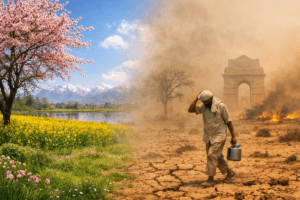
The Great Seasonal Skip: Is Spring Permanently Disappearing from North India?
The calendar reads February 12, 2026. In the traditional rhythm of the Indian subcontinent, this should be the heart of the Basant (spring) season—a time of mild, fluffy sun, gentle breezes, and the vibrant bloom of mustard flowers across the northern plains. It’s a period poetically described as the “king of seasons,” a fleeting, pleasant bridge between the harsh chill of winter and the scorching cruelty of summer.
But in Delhi-NCR and across much of North India, the air conditioning units are already whirring. The afternoon sun carries a sting more reminiscent of late March. Yesterday, maximum temperatures in the capital soared to 3°C to 5°C above normal, touching a balmy 29°C (84.2°F) in some areas. For the millions living in this vast, populous region, the question isn’t meteorological; it’s visceral: Where is spring?
For the second consecutive year, North India appears to be skipping its most cherished seasonal transition. According to data from the India Meteorological Department (IMD), we are not just experiencing a warm spell; we are witnessing a potential recalibration of the seasons themselves. The “trailer” for summer, as meteorologists call it, is playing earlier than ever, leaving a populace to wonder if the spring of their memories—a time of chai in the sun without a sweat, of cozy evenings without a shiver—is becoming a climatic ghost.
A Fever in February: The Data Behind the Discomfort
The statistics paint a stark picture. Over the last 48 hours, minimum temperatures across the northern plains have climbed by 1°C to 4°C, settling between 13°C and 14°C. While this might sound pleasant, it is the maximum temperatures—the daytime highs—that are causing the alarm. Ranging between 26°C and 29°C, these figures are 3°C to 5°C above the seasonal normal for the second week of February.
To put this in perspective, the average maximum temperature for Delhi in mid-February hovers around 24°C. A reading of 29°C is more typical of the run-up to the IPL cricket season in late March or early April. We are effectively living a month and a half ahead of schedule.
Meteorologists point to a combination of factors. Firstly, the lack of active Western Disturbances—the weather systems originating in the Mediterranean that bring winter rain to North India. While the IMD forecasts suggest these disturbances will bring rain and snow to the higher reaches of the Himalayas around February 16-17, their influence has been minimal over the plains. Without the cloud cover and rain, the sun’s radiation heats the ground unabated.
Secondly, there are clear global teleconnections. The World Meteorological Organisation (WMO) has already confirmed that 2025 was one of the hottest years on record, and the accumulated heat in the global climate system doesn’t simply reset on January 1. The baseline temperature has risen. As Dr. Anjali Sharma, a climate scientist at a Delhi-based policy think tank (not affiliated with IMD), explains, “We are no longer looking at anomalies. These temperatures are becoming the new normal. The ‘above normal’ of today is the ‘normal’ of tomorrow. The transition seasons are the first to be eroded because they are the most delicate.”
The Human Impact: Living Through a Vanishing Season
The statistics translate into a tangible shift in daily life. For 55-year-old Ramesh Gupta, a resident of east Delhi’s Mayur Vihar, the morning walk has lost its charm. “By 8:30 AM, the sun is so harsh I have to cut my walk short. It feels like I’m walking in March. This is the time we wait for all year—the short, sweet days—and now they are gone,” he laments, dabbing sweat from his brow with a handkerchief.
The impact ripples through society. Street vendors, who rely on the pleasant weather to attract customers, are suffering. Chai wallahs report a slight dip in daytime sales as people opt for cold drinks instead of hot tea. The city’s parks, usually thronged with families in the late afternoon, are seeing thinner crowds as people retreat to the shade or the cool confines of their homes.
For farmers on the fringes of the NCR, the worry is more profound. While the main wheat crop is still a few weeks from harvest, the unseasonal warmth can accelerate its growth cycle, potentially reducing grain size and yield—a phenomenon known as “terminal heat stress.” “The crop is thinking it’s time to ripen too fast,” says farmer Balbir Singh from a village in Ghaziabad. “If it gets too hot too soon, the grain won’t fill properly. We need a gradual warm-up, not this sudden blast.”
The implications for public health are equally concerning. Early heat means an early start to the heatwave season. It extends the period during which the vulnerable—the elderly, children, and those working outdoors—are exposed to dangerous levels of heat. Delhi’s famed air pollution, often mitigated by strong summer winds, might also interact with this early heat to create a prolonged period of poor air quality, as an anti-smog gun in the city struggles against a haze that is part pollution, part early-summer dust.
The Climate Context: A World Off-Kilter
This “missing spring” in North India is not an isolated event. It fits a global pattern of seasonal weirding. Across the world, traditional seasons are becoming less predictable. In parts of Europe and North America, winters are becoming shorter and warmer, with spring arriving earlier, only to be interrupted by sudden, unseasonal frosts that devastate vineyards and orchards.
The underlying cause is the warming planet. A warmer atmosphere holds more energy and more moisture, making the climate system more volatile. The jet streams—high-altitude rivers of air that steer weather systems—are becoming wavier and slower, leading to “blocking” patterns where weather, whether hot or cold, gets stuck in one place for longer.
In the context of North India, this volatility means the gradual transition from winter to summer is being compressed. The “pull” of the intensifying summer heat is strengthening, essentially swallowing the mild days of spring. The result is what we are seeing in February 2026: a direct leap from a mild winter into the anteroom of a ferocious summer.
Is This the New “Normal”?
The uncomfortable truth, echoed by climate projections for South Asia, is that this might be the case. The concept of a “normal” season is becoming obsolete. We are moving into an era of climate variability where extremes are the defining feature.
The IMD’s long-range forecast for the upcoming summer season (April-June) will be watched with bated breath. If February is this warm, and the pre-monsoon period (March-May) follows suit, 2026 could rival or surpass the brutal summers of recent memory. The absence of spring is not just a sentimental loss; it is a practical warning. It signals a faster-than-expected transition to the hot weather, giving the body less time to acclimatize and putting immense strain on power grids as air conditioners are switched on earlier than ever.
For the average person in Delhi-NCR, the feeling is one of resignation mixed with a tinge of nostalgia. The pinkish-red flowers of the Semal (Silk Cotton) tree, which usually herald the arrival of spring, are blooming alongside the withering leaves of winter. But the gentle air that should carry their petals is instead carrying the dry, dusty promise of an impending summer.
As we scroll past the headlines about temperature anomalies and IMD data, perhaps the most poignant takeaway is the cultural one. A land known for its six seasons (Vasant, Grishma, Varsha, Sharad, Hemant, Shishir) is beginning to lose one. The songs, the festivals, the foods, and the very feeling associated with spring—of renewal and gentle warmth—are being replaced by a singular, urgent question: “How hot will it be this year?”
The “trailer” for summer is here. And if this preview is anything to go by, the main feature is going to be a long, hard, and potentially dangerous one. The vanishing of spring is more than a weather story; it is a profound and unsettling sign of our times.
You must be logged in to post a comment.