
The Great Reset: Why Mark Carney’s India Gambit Signals a New World Order for Canada
In a dramatic geopolitical pivot driven by President Donald Trump’s protectionist policies and the need to reduce reliance on the U.S., Prime Minister Mark Carney is visiting India to reset a relationship that hit rock bottom just 16 months ago over Ottawa’s accusation that Indian diplomats were involved in the murder of a Canadian Sikh activist on Canadian soil. Despite the unresolved tensions surrounding the killing of Hardeep Singh Nijjar, Carney is launching free trade negotiations, finalizing a $2.8 billion uranium deal, and seeking defence and energy partnerships with the world’s fifth-largest economy—effectively prioritizing strategic realignment over past grievances as Canada scrambles to secure new markets and counter its vulnerability to an increasingly erratic American ally.
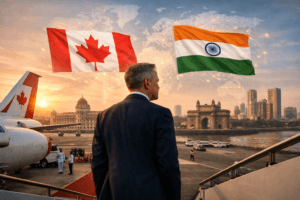
The Great Reset: Why Mark Carney’s India Gambit Signals a New World Order for Canada
When Mark Carney steps onto the tarmac in Mumbai this Friday, he’ll be walking into a diplomatic landscape that was, until recently, considered impassable. The last time a Canadian prime minister contemplated a state visit to India, the two countries were engaged in an escalating war of words—expelling diplomats, freezing negotiations, and trading accusations that cut to the heart of sovereignty itself.
That was 16 months ago. In diplomatic terms, that’s the blink of an eye.
Yet here we are, watching Canada’s new prime minister prepare to launch free trade negotiations with the world’s most populous nation, sign a defence cooperation agreement, and finalize a billion-dollar uranium deal. The whiplash is enough to make even seasoned foreign policy observers reach for something sturdy to hold onto.
But if you want to understand why this is happening—really understand it—you have to stop looking at New Delhi and start looking at Washington.
The Elephant in the Room (and It Wears a Red Tie)
Every single foreign policy reversal Canada has executed in the past year traces back to the same source: Donald Trump. The American president’s return to the White House has fundamentally rewired how middle powers like Canada calculate their place in the world.
For decades, Canada enjoyed the luxury of a predictable southern neighbour. Trade disputes happened within established frameworks. Alliances, however strained, held. The United States might throw the occasional tariff tantrum, but everyone knew the relationship would ultimately stabilize because the underlying architecture was sound.
That architecture no longer exists.
Trump’s approach toward traditional allies has been described as “mercurial,” but that word doesn’t capture the existential uncertainty it creates for countries like Canada. When you’ve built your entire economic model around seamless integration with the United States, and that partner suddenly starts treating you with the same suspicion it reserves for strategic adversaries, you don’t have the luxury of waiting things out. You adapt. Fast.
Canada is adapting. India is the adaptation.
The Uncomfortable Math of Realpolitik
Here’s the calculation that landed Carney on that government plane Thursday afternoon: Canada needs deep overseas markets, reliable trading partners, and foreign investors who see the country as something other than America’s attic. India, meanwhile, has a rising middle class larger than the entire population of the United States, an economy now ranked fifth in the world, and a strategic imperative to reduce its own dependence on China.
The math writes itself.
What makes this calculation uncomfortable—what makes it genuinely difficult for many Canadians to swallow—is that it requires setting aside some rather significant moral objections. The same Indian government now courting Canadian investment stands accused by Ottawa itself of orchestrating a campaign of violence, extortion, and intimidation against Canadians on Canadian soil. Those accusations haven’t been withdrawn. They haven’t been resolved. They’ve simply been… set aside.
Fen Hampson, the Carleton University international affairs professor quoted in the coverage of this trip, put it bluntly: “You can’t talk down to India. You have to talk up to India.”
Translation: Canada can no longer afford to lecture. The luxury of moral superiority is exactly that—a luxury. And luxuries are the first things to go when survival is on the line.
A Brief History of Blow-ups
To appreciate just how dramatic this turnaround is, you need to understand what preceded it. The relationship between Canada and India has never been what you’d call warm. It’s more accurate to describe it as a series of brief thaws punctuating long, cold winters.
The first major freeze came in 1974, when India used a Canadian-supplied nuclear reactor—given for peaceful purposes—to produce material for its first atomic bomb test. Canada responded by cutting off all nuclear cooperation and uranium exports. That rift lasted decades.
Then there’s the Khalistan question. India has long accused Canada of providing safe harbour to Sikh separatists advocating for an independent homeland carved out of Indian territory. Canadian governments have consistently responded by pointing to the Charter of Rights and Freedoms and explaining that freedom of expression has limits Canada is unwilling to cross.
The 1985 Air India bombing—the deadliest aviation terrorist attack in history before 9/11—hardened India’s conviction that Canada wasn’t taking the threat seriously. A Sikh separatist considered the mastermind, Talwinder Singh Parmar, was never convicted and died in Canada after fleeing authorities.
By the time Hardeep Singh Nijjar was shot dead in Surrey, British Columbia, in June 2023, the fault lines were already earthquake-deep. When Justin Trudeau stood in the House of Commons months later and publicly accused the Indian government of playing a role in the murder, he didn’t create the rupture—he simply acknowledged it existed.
India’s response was swift and brutal: expulsion of 41 Canadian diplomats, effectively crippling Canada’s diplomatic presence in the country. Trade negotiations, already fragile, were shelved entirely.
The Personal Cost of Diplomatic Thaw
What gets lost in these grand strategic calculations is the human dimension. The Sikh community in Canada—particularly in British Columbia, where Nijjar was killed—has been asked to absorb an extraordinary amount of cognitive dissonance over the past year.
Think about what it means to be a Sikh Canadian watching your prime minister fly to India to sign deals with a government your own security services have accused of murdering a member of your community on Canadian soil. Think about what it means to hear that your leader won’t be visiting the Golden Temple in Amritsar—the holiest site in your faith—because doing so might be seen as a “distraction” from the serious business of trade negotiations.
Goldy Hyder, president of the Business Council of Canada, defended the itinerary: “This is a serious time and warrants a serious visit. Prime Minister Carney is right not to get distracted by diaspora political events.”
That’s one way to frame it. Another way: diaspora political events are, for millions of Canadians, the very substance of their connection to the subcontinent. The decision to skip Punjab—the primary source of Sikh immigration to Canada—sends a message, whether intended or not, about whose concerns matter in this new relationship.
What’s Actually on the Table
Let’s set aside the geopolitics for a moment and look at what Carney hopes to bring home.
The uranium deal, reportedly worth US$2.8 billion over ten years, would be supplied by Saskatchewan’s Cameco Corporation. It’s the kind of agreement that matters less for its immediate dollar value than for what it signals: India is once again willing to buy Canadian nuclear materials, something that was unthinkable for decades after the 1974 breach of trust.
Then there’s liquefied natural gas. India has signaled interest in buying Canadian LNG as it gradually shifts energy imports away from Russia. Given the current geopolitical landscape—and the fact that India’s relationship with Vladimir Putin remains, in Narendra Modi’s words, “deep and unbreakable”—this represents a significant opportunity for Canada to insert itself into a market currently dominated by less friendly suppliers.
The trade agreement negotiations will aim to reduce Indian tariffs that currently hurt Canadian farmers. Saskatchewan’s yellow peas face a 30 percent tariff. Lentils carry a 10 percent levy. Saskatchewan Premier Scott Moe, who’s joining the delegation, has been pressing Ottawa to act as India considers potentially hiking those tariffs further for domestic political reasons.
And then there’s the defence cooperation agreement—perhaps the most symbolically significant element of the trip. Two years after Canada accused India of conducting extrajudicial violence on its soil, the two countries are preparing to sign a deal on military cooperation. If you’re looking for evidence that realpolitik has triumphed completely over moral outrage, you’ve just found it.
The Modi Question
There’s an elephant in every room where Canada-India relations are discussed, and his name is Narendra Modi.
The Indian prime minister is many things: a transformative economic reformer, a Hindu nationalist whose tenure has seen rising violence against religious minorities, and a strategic pragmatist who maintains warm relations with Vladimir Putin while simultaneously courting Western investment.
When Putin visited New Delhi this past December, Modi praised their “deep and unbreakable relationship” and compared it to the North Star—reliable, unchanging, always there. This is the same Putin whose invasion of Ukraine has cost Canada more than $25 billion in aid to Kyiv.
India’s high commissioner to Canada, Dinesh Patnaik, acknowledges the strategic differences but downplays their significance. “We may not agree on some strategic issues,” he told reporters. “We may not agree on the way to deal with Cuba or the way to deal with Iran or Ukraine. But we do not have a conflict on any strategic issue.”
The distinction matters. Having different positions on specific conflicts is one thing. Having fundamentally different alliances—with India maintaining its Russia relationship while Canada funds Ukraine’s defence—is quite another. The question is whether trade and investment can flourish in the space between those contradictions.
The Trust Deficit
Perhaps the most revealing moment in the entire pre-trip coverage came when Patnaik addressed the trust question directly.
“A lot of people ask me this question, ‘How can Canada trust you?'” he said. “I don’t need them to trust me. I need them to understand if they want this relationship or not.”
It’s a striking formulation—one that cuts through the usual diplomatic niceties. Patnaik isn’t asking Canada to believe in India’s good intentions. He’s asking Canada to make a cold calculation about its own interests. Do you want this relationship? If yes, then proceed. If no, then don’t. But don’t waste time demanding reassurances that, in international relations, rarely mean much anyway.
The reference to “Caesar’s wife” is equally telling. The aphorism—that Caesar’s wife must be above suspicion—is usually invoked by those seeking to prove their innocence. Patnaik turns it on its head: he’s not here to prove anything. He’s here to do business.
That’s not trust. That’s something harder and more durable: mutual self-interest.
What This Means for Canadians
For ordinary Canadians, this trip represents something that’s been in short supply lately: a sense that the country is actively shaping its future rather than merely reacting to events. Carney’s government is making a bet—a significant one—that the post-American world order requires Canada to build relationships that don’t run through Washington.
It’s a bet that carries risks. The diplomatic thaw with India could freeze again at any moment, particularly if new information emerges about the Nijjar case or if Khalistan-related tensions flare in Canada. The trade negotiations could founder on the same rocks that have sunk previous attempts. And there’s always the possibility that the United States, recognizing what’s happening, could take steps to pull Canada back into its orbit.
But the alternative—doing nothing, waiting for the Trump administration to stabilize, hoping that the old certainties return—isn’t really an option. The old certainties are gone. They’re not coming back.
The Golden Temple Question
The decision to skip Punjab and the Golden Temple is worth lingering on, because it reveals something important about how this government views the relationship.
When Stephen Harper visited the Golden Temple in 2009, it was widely seen as a gesture of respect toward Canada’s Sikh community—an acknowledgment that their spiritual and cultural connections to India mattered, and that those connections could coexist with the business of state visits. Justin Trudeau did the same in 2018, despite his trip being otherwise plagued by gaffes and criticisms.
Carney is choosing a different path. No Punjab. No Golden Temple. Just Mumbai, New Delhi, and the serious work of deal-making.
The message is clear: this government intends to deal with India as a state, not as the ancestral homeland of a significant portion of the Canadian electorate. Whether that approach succeeds—and whether it alienates voters who expected their prime minister to pay respects at their holiest site—remains to be seen.
Goldy Hyder supports the approach. But Hyder is an Indo-Canadian business leader, not a Sikh community representative. The distinction matters.
The Bigger Picture
Stand back from the details of this particular trip, and a larger pattern emerges. Canada is engaged in a wholesale reorientation of its foreign policy—away from reflexive reliance on the United States and toward a more diversified portfolio of relationships.
The Indo-Pacific Strategy, unveiled in 2022, identified India as a major driver of future economic growth. The strategy looked prescient then; it looks essential now. With the United States increasingly unreliable, Canada needs partners in Asia. India, for all its complications, is the obvious choice.
The question is whether Canada can sustain this reorientation through the inevitable ups and downs that characterize any international relationship. India will continue to buy Russian oil. India will continue to face criticism over its human rights record. India will continue to harbor suspicions about Canadian tolerance for Sikh separatist activity. None of that changes overnight.
What can change is Canada’s willingness to look past those frictions in pursuit of larger goals. That’s what this trip represents: a conscious decision that the potential benefits of closer ties outweigh the known costs and risks.
The Human Element
It’s easy, when writing about geopolitics and trade deals and diplomatic strategy, to lose sight of the humans involved. So let’s end with them.
Mark Carney, boarding that government plane Thursday, carrying the hopes of Canadian exporters and the skepticism of those who remember what happened the last time we tried this. Diana Fox Carney beside him, beginning a trip that will test whether the prime ministerial spouse can help humanize a relationship that badly needs it.
Narendra Modi, preparing to host a leader whose predecessor accused his government of murder. The Indian prime minister has been here before—welcoming Western leaders while maintaining his relationships with Russia and China, balancing competing demands with the skill of a man who’s spent a decade navigating international politics at the highest level.
Hardeep Singh Nijjar’s family, watching this diplomatic thaw from Surrey, British Columbia, wondering what it means for the pursuit of justice in his killing. Their loss hasn’t been resolved. Their questions haven’t been answered. Their loved one’s name has, for now, receded from the headlines.
And millions of Sikh Canadians, watching to see whether their prime minister will acknowledge the spiritual heart of their faith during his visit. He won’t. That decision, made for sound strategic reasons, will be felt in communities across the country for years to come.
The Bottom Line
Sixteen months ago, Canada-India relations hit bottom. Today, a Canadian prime minister is flying to Mumbai to begin the long climb back.
The speed of this turnaround is startling. The reasons for it are clear. The costs—to Canada’s moral standing, to its relationship with the Sikh community, to the pursuit of justice in an unresolved murder—are real and should not be dismissed.
But the alternative, in a world upended by American unpredictability, was never really an option. Canada needs friends. India needs partners. The math, however uncomfortable, is what it is.
Mark Carney’s trip won’t resolve the contradictions at the heart of this relationship. It won’t make Sikh Canadians forget that their government is cozying up to a regime it recently accused of murder. It won’t transform India into a reliable democratic ally on the model of the United Kingdom or Germany.
What it might do—what it must do, if it’s to succeed—is begin the slow, painstaking work of building something durable enough to survive the next crisis. Because there will be a next crisis. There always is.
The question is whether the relationship can weather it. This trip is Canada’s answer to that question. We’ll find out, in the years ahead, whether it was the right one.
You must be logged in to post a comment.