
The Great Oil Chessboard: How a Trump Waiver on Iran Could Reshape India’s Energy Strategy
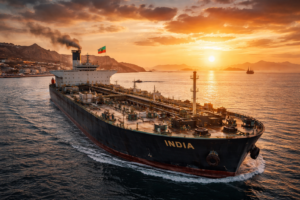
The Great Oil Chessboard: How a Trump Waiver on Iran Could Reshape India’s Energy Strategy
The global energy market is currently trapped in a whirlwind of geopolitical violence, strategic brinkmanship, and economic anxiety. As the conflict between the US-Israel alliance and Iran escalates—spilling from missile strikes into the strategic waters of the Strait of Hormuz—a dramatic plot twist has emerged from Washington. The Trump administration is signaling a potential lifeline that seems paradoxical at first glance: the possibility of temporarily “unsanctioning” Iranian crude oil.
For India, the world’s third-largest oil importer and consumer, this is not merely a headline in a financial daily. It represents a potential pivot point in a struggle for energy security that has defined its foreign policy for decades. As Brent crude flirted with the psychologically daunting $120 per barrel mark, and as the Strait of Hormuz—the artery through which nearly 20% of the world’s oil flows—became a war zone, New Delhi found itself in a precarious position. The question echoing through the corridors of the Ministry of Petroleum and the trading floors of Mumbai is this: Will India once again be able to buy Iranian oil?
To understand the significance, one must look beyond the immediate news cycle of missile barrages and diplomatic posturing. This is a story about the fragility of global supply chains, the resilience of Indian refineries, and the high-stakes game of geopolitical poker where crude oil is the ultimate currency.
The Anatomy of a “Shock” Waiver
The proposal floated by US Treasury Secretary Scott Bessent is as audacious as it is pragmatic. The administration is considering lifting sanctions on approximately 140 to 170 million barrels of Iranian oil currently “on the water”—cargoes that are either in transit or sitting in floating storage. In a market spooked by the closure of the Strait of Hormuz and Iran’s recent strike on Qatar’s massive LNG facility, this volume represents a significant buffer: roughly 10 to 14 days of global supply.
This move mirrors a similar waiver granted for Russian crude earlier in the conflict with Ukraine. In both cases, the logic is cold and utilitarian. When sanctions cause a supply shock that drives inflation and hurts the global economy—including the American consumer—the US has shown a willingness to temporarily sacrifice long-term foreign policy goals for short-term economic stability.
However, calling this a “waiver” is a misnomer. As Bessent bluntly put it, the US would be “using the Iranian barrels against the Iranians.” The idea is to flood the market with oil to keep prices down, depriving Tehran of the windfall profits that high prices would otherwise bring, even if the barrels themselves are technically Iranian. It is a cynical but effective strategy to stabilize the market while maintaining military and economic pressure on the Islamic Republic.
India’s Longing for a Lost Supplier
For India, the potential return of Iranian oil is akin to an old flame reappearing just when the current relationship is facing turbulence. Historically, India was one of Iran’s most reliable customers. Before the imposition of strict US sanctions in 2019—following the Trump administration’s withdrawal from the JCPOA (Iran nuclear deal)—Iran supplied about 11.5% of India’s total crude imports.
Iranian oil was not just another barrel in the mix. It offered specific advantages that Indian refiners, such as Reliance Industries, Nayara Energy, and state-owned refiners, had optimized for. Iranian Light and Heavy grades were particularly compatible with India’s refinery configurations. Moreover, Tehran offered favorable commercial terms, including extended credit periods and discounted freight, which made it economically superior to many alternatives.
When those imports stopped in May 2019, India had to scramble. It replaced Iranian barrels with a patchwork of supplies from the Middle East (Saudi Arabia, Iraq, UAE), the United States, and eventually, following the Ukraine war, massive volumes of discounted Russian crude. In fact, in recent weeks, as the Middle East conflict intensified, India aggressively purchased 30 million barrels of Russian crude in just seven days, according to Bloomberg.
But relying heavily on Russia comes with its own set of risks. While Russia has become India’s top supplier, the logistics are complicated by a growing shadow fleet of aging tankers, sanctions compliance issues, and the volatile nature of the Black Sea region. Furthermore, as European sanctions tighten, the price discount on Russian crude is not as steep as it once was.
This is where Iranian crude offers a compelling alternative. If the US grants a temporary waiver—or even turns a blind eye to the volumes currently at sea—India could step in immediately. The infrastructure, the banking channels, the insurance mechanisms, and the refining expertise are still largely in place. As Sumit Ritolia of Kpler notes, Indian refiners retain the ability to re-integrate these barrels with minimal operational adjustments. It is a matter of flipping a switch.
The Strait of Hormuz: The Elephant in the Room
However, there is a critical variable that no amount of US waivers can solve: logistics. The ongoing war has effectively disrupted commercial shipping through the Strait of Hormuz. Iran has threatened to close the strait multiple times in the past; now, with actual kinetic warfare involving missile strikes on energy infrastructure in Qatar and the UAE, the risk is no longer theoretical.
For India, this is an existential threat. A significant portion of its oil imports—traditionally from Iraq and Saudi Arabia—transit through these waters. Even if India secures Iranian cargoes, those ships must still exit the Persian Gulf. If the Strait is a war zone, the price of insurance for a single tanker journey could skyrocket, and the safety of the crew becomes a paramount concern.
India has historically relied on its naval power to project presence in the region. The Indian Navy has deployed warships in the Gulf of Oman and the Arabian Sea to escort Indian-flagged vessels. But a full-scale closure of the strait would strain even the most robust naval capabilities. In this sense, the US waiver is only half the solution; the other half is ensuring safe passage through waters that have become a shooting gallery.
A Balancing Act: Washington, Tehran, and Moscow
The development places India in a complex geopolitical triad. Since the Ukraine war began, India has successfully walked a tightrope—maintaining its strategic autonomy, deepening ties with the US through forums like the Quad, while simultaneously becoming the largest buyer of discounted Russian oil.
If Iranian oil re-enters the market, India’s energy basket will become more diversified, reducing its dependence on any single supplier. This is a strategic win for New Delhi. However, it also risks complicating its relationship with Washington. While the current proposal is a US-led initiative to ease prices, it is a temporary measure. India will need to gauge the durability of this relief. Is it a one-off to cover a two-week supply gap, or is it the beginning of a broader thaw in sanctions?
Moreover, the Iranian option adds a new layer to India’s diplomatic calculus regarding the INSTC (International North-South Transport Corridor) and the Chabahar Port project. India has invested heavily in Chabahar as a counterpoint to the China-backed Gwadar port in Pakistan. Being able to process Iranian crude would not only bolster India’s energy security but also validate its long-term investments in Iranian infrastructure.
The Human Insight: Beyond the Barrel Price
For the average Indian, the implications of this potential waiver are deeply personal. The Indian economy is acutely sensitive to oil prices. When crude oil rises to $120 per barrel, it doesn’t just increase the cost of filling a car’s gas tank; it inflates the price of everything—from the vegetables transported by diesel trucks to the plastics used in household goods. It widens the fiscal deficit, weakens the rupee, and can derail the growth trajectory of the nation.
This is why the news from Washington is being watched so closely in New Delhi. It’s not about geopolitics for the sake of politics; it’s about inflation management. India has already been using its strategic relationship with Russia to keep prices in check. Being able to add Iranian crude to the mix—even temporarily—gives the government a powerful tool to negotiate better pricing from traditional Middle Eastern suppliers like Saudi Arabia and Iraq, who often use the threat of supply cuts to influence prices.
The Road Ahead
As the war between Israel and Iran continues to evolve, the energy markets will remain volatile. The “unsanctioning” of floating Iranian oil is a short-term shock absorber, not a permanent solution. For India, the next few weeks will be critical.
The country’s refiners are likely already running the numbers, preparing for the possibility of lifting Iranian cargoes. But they will wait for clarity. The key considerations, as analysts point out, are not just technical but commercial and legal. How will the payments be structured? Will the US provide a “comfort letter” to insurance companies? Will the waiver extend to shipping?
If these conditions align, India could see a rapid ramp-up in imports, reminiscent of the swift pivot to Russian oil after the Ukraine invasion. It would be a masterclass in supply chain agility.
Ultimately, the story of India, Iran, and the US waiver is a testament to the interconnectedness of the modern world. A missile launched at an LNG facility in Qatar sends ripples that force a Treasury Secretary in Washington to reconsider sanctions, which in turn offers a potential lifeline to refiners in India, who ultimately determine the price stability for 1.4 billion people. In this high-stakes game, India is not just a passive observer; it is a critical player ensuring that the wheels of its economy keep turning, regardless of who is firing missiles in the Persian Gulf.
You must be logged in to post a comment.