
The Great LPG Crunch: War, Panic, and the Return of Kerosene to India’s Kitchens
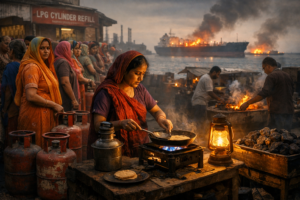
The Great LPG Crunch: War, Panic, and the Return of Kerosene to India’s Kitchens
The rumble of war in West Asia has sent shockwaves through the global energy market, but for the first time in a generation, its most visceral impact is being felt not at the pump, but in the kitchens of millions of Indians. As the Strait of Hormuz goes quiet, the government is battling a perfect storm of supply disruption and consumer panic, forcing a drastic pivot back to fuels of the past.
For the better part of a decade, the image of a modern India was encapsulated by the clean blue flame of an LPG stove. The Ujjwala scheme, launched in 2016, was a landmark social welfare program that sought to free crores of women, particularly in rural India, from the health hazards of smoke-filled kitchens. It replaced wood, dung cakes, and yes, kerosene, with a subsidized cooking gas connection. It was a shift that signified progress, dignity, and a break from the sooty past.
Today, that narrative has been violently interrupted.
On March 13, 2026, a headline from The Indian Express cut through the political noise of a Parliament session to reveal a startling reality: “LPG imports hit, Govt pushes kerosene, coal as options.” The news was not just about a supply chain glitch; it was a stark admission that a conflict thousands of miles away—the escalating Israel-US-Iran war—has the power to turn back the clock on India’s developmental milestones.
The Chokepoint Economics: Why Hormuz Matters
To understand the gravity of the situation, one must look at a map. The Strait of Hormuz, a narrow passageway between Oman and Iran, is the world’s most critical oil transit chokepoint. Through this slender waterway flows about a fifth of the world’s total petroleum consumption.
For India, the numbers are staggering. The country imports roughly 60% of its LPG needs. Of that, a whopping 90% traditionally comes from West Asian nations like Qatar, Saudi Arabia, and the UAE, with the vast majority of it sailing through the Strait. When maritime traffic through the Strait effectively grinds to a halt due to the escalating conflict, it doesn’t just create a ripple; it creates a vacuum. As Union Petroleum Minister Hardeep Singh Puri informed the Lok Sabha, this disruption has made roughly 55% of India’s typical LPG consumption volumes temporarily unavailable.
This is not a problem that can be solved overnight. Unlike crude oil, which can be stored in massive strategic reserves, LPG supply chains are leaner and more complex. The gas is transported in specialized ships and stored in pressurized spheres before being bottled into cylinders. A sudden, prolonged disruption at the source creates a domino effect that travels from the high seas to the local distributor’s godown, and finally, to the anxious housewife standing in a serpentine queue in Jaipur, as captured in the haunting image accompanying the report.
The Human Factor: From ‘Ujjwala’ to Uncertainty
The photograph in the Indian Express shows residents waiting for hours in Jaipur. It is a scene that has become distressingly familiar across the country in recent weeks. But behind the long lines lies a more complex human emotion: panic.
According to government data cited by Joint Secretary Sujata Sharma, bookings for LPG cylinders have shot up multifold. This surge is not entirely due to increased consumption; it is driven by fear. In the age of instant messaging, misinformation travels faster than any tanker. The image of an empty cylinder, coupled with news of a faraway war, triggers a primal instinct to hoard.
This “demand distortion,” as Minister Puri termed it, is perhaps more dangerous than the actual supply shortage. It creates a self-fulfilling prophecy. When every household books a cylinder even if they have a month’s supply left, the system buckles under the artificial load. The government’s response has been to attempt to manage this psychology while simultaneously fixing the physical supply chain. The minimum gap between subsidized cylinder bookings has been increased—to 25 days in cities and 45 days in rural and remote areas. It is a digital speed bump designed to slow down the rush.
The Return of the Past: Kerosene and Coal
The most jarring aspect of the government’s response, however, is the resurrection of fuels that policy had long sought to bury. In a move that underscores the severity of the crisis, the Ministry of Petroleum is “activating other fuel options.”
- Kerosene: Once the primary cooking fuel for the poor, kerosene has been systematically phased out under the Ujjwala scheme due to its health hazards, fire risks, and propensity for black-marketing (where it was often diverted to adulterate diesel). Yet, the government has now released an additional 48,000 kilolitres of kerosene to state governments, on top of the standard quarterly allocation. This fuel will be made available through Public Distribution System (PDS) channels and retail outlets.
- Coal and Biomass: In an even more drastic measure, the Ministry of Environment, Forest and Climate Change (MoEFCC) has advised State Pollution Control Boards to permit, for the duration of the crisis, the use of biomass, RDF (Refuse-derived fuel) pellets, and coal as alternate fuels for the hospitality sector. For at least a month, restaurants and hotels—the commercial backbone of urban India—are being pushed toward the very fuels that LPG was supposed to replace.
This is not merely a logistical adjustment; it is a socio-economic regression. For the street vendor who relied on a quick LPG flame to boil tea, the switch to a coal or kerosene stove means slower service, higher costs, and the stigma of a “backward” technology. It raises questions about the resilience of a development model so heavily dependent on a single, geopolitically volatile fuel source.
The Battle for the Commercial Cylinder
While the government insists that domestic kitchens are its “foremost priority,” the commercial sector is bearing the brunt of the rationing. Restaurants, hotels, and canteens operate on a completely deregulated market for commercial LPG. Unlike the subsidized domestic cylinders, commercial ones are bought at market price with no government control—normally.
In a crisis, this deregulation becomes a vulnerability. The government fears that unrestricted commercial sales could lead to hoarding and diversion of cylinders to the grey market, where they could be resold to desperate households at inflated prices, bypassing the subsidized system entirely.
To combat this, the government has invoked the Essential Commodities Act to prioritize supply. A three-member committee from the oil marketing companies (IOCL, HPCL, BPCL) has been formed to allocate 20% of the average monthly commercial requirement in coordination with state governments. Hospitals and educational institutions have been granted “uninterrupted priority supply,” but for the average eatery, the future is uncertain.
The Political Fray: Energy Security vs. Geopolitical Allegiance
The crisis has inevitably spilled onto the floor of Parliament, transforming a logistical challenge into a political firestorm. Leader of Opposition Rahul Gandhi seized the opportunity to link the current predicament to a broader failure of foreign policy, suggesting that India had “bartered” its energy sovereignty by allowing the US to dictate its oil purchases, particularly regarding Russian supplies.
“The pain has just started,” Gandhi warned, pointing to closing restaurants and affected street vendors.
Minister Puri’s response was a robust defense of the government’s diplomatic agility. He credited the Prime Minister’s “outstanding diplomatic outreach” for allowing India to secure crude volumes exceeding those lost through the Strait. He highlighted a strategic pivot: non-Hormuz sourcing has risen to approximately 70% of crude imports, up from 55% before the conflict. India now buys oil from 40 countries, compared to 27 two decades ago.
This exchange highlights the central tension of India’s energy policy in a multipolar world. As a major economy with minimal domestic oil reserves, India cannot afford to pick sides. It must navigate between the US-led West and resource-rich pariah states like Iran and Russia. The current war, pitting Israel and the US against Iran, places India in an impossible spot, squeezed between a vital strategic partner (the US) and a historically friendly energy supplier (Iran).
The Bottom Line: A Test of Resilience
As the nation watches the situation in West Asia with bated breath, the government’s immediate task is triage.
On the supply side, domestic refineries have been ordered to maximize LPG production. Propane and butane streams from petrochemical plants are being diverted to cooking gas. Production has reportedly increased by 28% compared to pre-conflict levels. Two oil tankers that recently transited the Strait of Hormuz and arrived in India offer a glimmer of hope, suggesting that the route is not entirely sealed, merely perilous and unpredictable.
On the demand side, the message is clear: Do not panic. District-level committees are being formed to monitor hoarding. The government is fighting a war on two fronts—one against a physical supply disruption, and another against a wave of misinformation.
For the average citizen, this crisis is a stark reminder of the fragility of modern comfort. The journey from the oil fields of West Asia to the kitchen in a Mumbai chawl or a Lucknow karkhana is long and tenuous, vulnerable to the whims of geopolitics. As the government pushes kerosene and coal as “options,” it is a temporary fix, a Band-Aid on a wound that requires a fundamental rethinking of strategic energy reserves and fuel diversification.
The blue flame might flicker, but for now, the priority is to ensure it doesn’t go out entirely. The true cost of this war will be measured not just in barrels of oil, but in the patience of a nation waiting for its cylinder to arrive.
You must be logged in to post a comment.