
The Great LPG Crisis of 2026: How India’s Cooking Gas Shortage Is Burning Through Daily Life
An LPG cylinder shortage across India, particularly impacting the peak wedding season in Chandigarh where caterers are resorting to firewood, has led to long queues at gas agencies in cities like Ahmedabad and Lucknow, with consumers facing delivery failures and suspected black marketing; while the government assures that 50 lakh cylinders are being delivered daily and urges calm, the ground reality shows panic-booking has tripled demand in some areas, affecting school lunch programs, mall restaurants, and daily household cooking amid rising temperatures and supply chain disruptions.
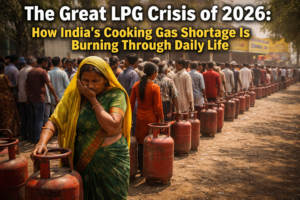
The Great LPG Crisis of 2026: How India’s Cooking Gas Shortage Is Burning Through Daily Life
From Wedding Kitchens to Urban Apartments, the Flame Flickers Unevenly Across India
The afternoon sun beats down mercilessly on Sarkhej, Ahmedabad, where temperatures have already touched 41°C. Yet, under this punishing heat, a line of patient consumers stretches outside the Bharat Gas agency, each person clutching an empty LPG cylinder like a pilgrim holding an offering. They’ve been here since 6 AM.
“I’ve been trying for four days,” says an elderly woman who gives her name as Geetaben, her dupatta pulled over her head to shield against the sun. “At home, we’re down to our last cylinder. My daughter-in-law is rationing cooking—making only what’s absolutely necessary.”
This scene, unfolding on March 13, 2026, represents just one frame in a much larger picture of disruption sweeping across India’s domestic and commercial sectors. What began as isolated reports of supply constraints has evolved into a full-blown crisis touching schools, restaurants, wedding celebrations, and ordinary households.
The Marriage of Necessity: When Punjabi Weddings Meet Firewood
In Chandigarh, where the wedding season typically means non-stop revelry from late February through March, an unexpected guest has arrived at the party: the LPG shortage.
Kamaljit Sandhu, reporting for India Today, describes a surreal scene at marriage palaces across the tricity area. Caterers who once prided themselves on efficiency and modern cooking methods are being forced to revisit culinary techniques from centuries past.
“One wedding for 1,500 guests would comfortably consume 15-20 commercial cylinders,” explains Harpreet Singh, a caterer who has been in business for over two decades. “Now, I’m lucky if I get eight. We’ve had to split cooking operations—some dishes on gas, the bulk on firewood and coal.”
The irony isn’t lost on anyone. Punjab, the land of five rivers, known for its lavish hospitality and butter-laden delicacies, is now witnessing caterers scrambling for firewood supplies. The traditional tandoor—usually reserved for breads and appetizers—has become the primary cooking apparatus for entire wedding feasts.
“It affects the taste,” admits Singh, wiping sweat from his forehead at a wedding venue on the outskirts of Chandigarh. “You can cook dal makhani on gas in two hours. On firewood, it takes four, and you need someone constantly monitoring the flame. We’ve hired extra helpers just to manage the wood fires.”
For families hosting weddings, the situation has added unexpected stress to what is already an emotionally and financially draining experience. “We booked this palace six months ago,” says Manjeet Kaur, whose son’s wedding is scheduled for March 15. “Now the caterer tells us we might need to adjust the menu because of cylinder shortages. My son is getting married—I want everything perfect, not compromised.”
The Numbers Game: 50 Lakh Cylinders and Counting
As panic spreads, official voices have attempted to calm nerves. C Senthil Rajan, Joint Secretary in the Ministry of Information and Broadcasting, addressed concerns with data: oil companies are delivering approximately 50 lakh LPG cylinders daily, maintaining supply levels consistent with pre-crisis periods.
But statistics and lived experiences often tell different stories. In Zirakpur, Punjab, gas agency manager Swaranjit Singh provides ground-level reality that complicates the official narrative.
“Our daily bookings have nearly tripled,” Singh explains, gesturing toward a crowded office where consumers jostle for attention. “Earlier, we’d receive around 500 bookings daily. Now it’s almost 1,500. People are booking cylinders whether they need them immediately or not. The fear of shortage is creating the shortage.”
This behavioral economics lesson—where perceived scarcity triggers hoarding, which then creates actual scarcity—explains part of the crisis. But not all.
Agency owners point to supply chain disruptions that have reduced their daily receipts from distributors. “We’re getting maybe 60% of our usual supply,” one official admits on condition of anonymity. “Combine reduced supply with panic booking, and you have long queues and empty hands.”
The Digital Mirage: When Confirmation Messages Lie
In Lucknow, a more troubling dimension has emerged. Consumers who successfully booked cylinders online received confirmation messages, followed by delivery notifications. There was just one problem: the cylinders never arrived.
“We have screenshots—booking confirmation, delivery update, everything,” says Rajesh Kumar, standing outside his local gas agency with a folder full of printouts. “The system shows my cylinder was delivered yesterday at 4:30 PM. I was home all day. No one came.”
The gap between digital records and physical reality has fueled suspicions of black market diversion. With commercial cylinder prices significantly higher than subsidized domestic ones, the incentive for diversion exists. When a cylinder officially marked “delivered” never reaches its intended recipient, the math suggests someone else received it—and likely at a premium.
Agency staff, overwhelmed and defensive, offer little explanation. “The system shows what it shows,” one employee tells waiting consumers, shrugging helplessly. “Talk to the company, not us.”
This digital discrepancy has eroded trust precisely when transparent communication matters most. For consumers who followed rules—booking online, waiting patiently—being told the system claims delivery feels like bureaucratic gaslighting.
School Lunches and Mall Kitchens: The Ripple Effects
The crisis has moved beyond homes into institutional kitchens. Top private schools in Delhi have issued warnings to parents: if LPG supplies tighten further, midday meal services may be affected.
“Feeding 2,000 children requires reliable gas supply,” explains a school administrator who requests anonymity. “We can’t improvise with firewood in an urban school setting. If cylinders don’t come, children either bring packed lunches or we suspend the service.”
In Delhi’s bustling malls, restaurant owners have received informal requests to operate conservatively. “We’ve been told to manage with about 80% of our normal gas usage,” says a restaurant manager in Saket. “That means shorter menus, fewer specials, and explaining to customers why certain dishes aren’t available.”
For restaurants already operating on thin margins, this represents another blow. “We recovered from COVID, dealt with inflation, managed staffing challenges—now this,” the manager adds. “At some point, you wonder what’s next.”
The Subsidy Question and Its Unintended Consequences
Behind the immediate crisis lies a longer-term policy tension. India’s LPG subsidy system, designed to make cooking gas affordable for households, creates market distortions that periodically surface as shortages.
Domestic cylinders, available at subsidized rates to eligible households, exist alongside commercial cylinders priced at market rates. The gap between these prices—often hundreds of rupees—creates arbitrage opportunities. When supply tightens, the incentive to divert domestic cylinders to commercial users intensifies.
“The economics are simple,” explains a former oil company executive who worked in LPG distribution. “If you can buy a domestic cylinder at subsidy and sell it to a restaurant for just 100 rupees more than you paid, everyone involved makes money—except the intended beneficiary and the system.”
This doesn’t excuse black marketing, but it explains its persistence. Until the subsidy gap narrows or enforcement tightens dramatically, the incentive structure remains unchanged.
Summer’s Double Blow: Heat and Hunger
Back in Ahmedabad, the queue outside the Bharat Gas agency hasn’t shortened. As temperatures climb toward 43°C, those waiting face not just frustration but genuine health risks.
“Look at these children,” says a young mother, gesturing toward two kids fanning themselves with old newspapers. “We can’t leave them home alone, so they stand here with me. The water we brought is finished. The cylinder hasn’t come.”
Agency owner Hitesh Solanki attempts damage control, moving through the crowd with explanations. “People are scared,” he acknowledges. “For four days, this has been the scene. We explain, we try to calm them, but until the truck arrives, words don’t fill cylinders.”
When asked when the truck might arrive, Solanki’s answer reveals the uncertainty at every level: “Today. Maybe in an hour. Maybe two. It’s on its way.”
State Response: Vigilance, Not Solutions
Police in several states have intensified vigilance, targeting rumormongers, hoarders, and illegal cylinder traders. In some cities, patrols have increased near gas agencies. Checkpoints monitor suspicious vehicle movements.
But enforcement addresses symptoms, not causes. As one senior police officer in Uttar Pradesh puts it privately: “We can catch someone selling cylinders illegally, but if the underlying shortage continues, another will replace them. The market finds a way.”
The government’s messaging emphasizes calm and highlights normal supply levels. Yet for those waiting in queues, holding empty cylinders under the March sun, “don’t panic” feels disconnected from their reality.
What Comes Next: Adaptation or Escalation?
As the crisis enters its second week, those most affected are developing coping mechanisms. Caterers are investing in larger firewood stocks. Restaurants are redesigning menus around dishes requiring less gas. Households are sharing cylinders with neighbors, creating informal support networks.
Some caterers in Chandigarh have begun warning clients: if the situation continues, new wedding bookings may be declined. “I can’t promise what I can’t deliver,” one caterer states bluntly. “Better to say no now than fail later.”
For consumers, the experience has revived memories of past shortages—kerosene queues from previous decades, diesel lines from more recent memory. The return of such scenes in 2026, for a fuel that has been presented as a success story of universal access, feels particularly jarring.
The Human Cost Beyond Headlines
Statistics capture bookings and deliveries. They don’t capture the elderly woman in Ahmedabad who almost fainted in the queue. The children skipping meals because their mother is conserving gas. The caterer explaining to a bride’s family why the menu must change. The small restaurant owner calculating how much longer he can stay open.
These human dimensions transform a supply story into something more profound—a reminder of how fragile the systems we take for granted can be. LPG cylinders, invisible in daily life until they’re missing, become suddenly central when the flame flickers.
As India navigates this crisis, the contrast between official reassurances and ground-level reality will determine public trust. For now, in queues across cities, trust is measured simply: by the arrival of trucks, the exchange of cylinders, and the ability to cook another meal.
You must be logged in to post a comment.