
The Great Indian Wardrobe Upgrade: How Budget Fashion Brands Conquered the Heartland
The Great Indian Wardrobe Upgrade: How Budget Fashion Brands Conquered the Heartland
The afternoon sun beats down on the bustling Mahadwar Road in Sangli, a city in western India known for its turmeric trade and sweet laddu. The air is thick with the sounds of honking rickshaws and the chatter of crowds navigating the narrow lanes of the traditional market. For generations, this is where people from Sangli and its surrounding villages came to dress themselves—haggling with shopkeepers over piles of unbranded jeans, examining the stitch of a ready-made kurta under a flickering tube light.
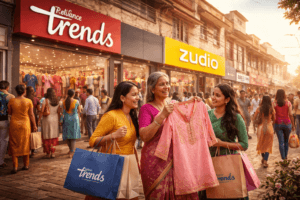
But just a few kilometers away, in a modern shopping arcade, a quiet revolution is underway. Alka, a geriatric care worker in her late 50s, stands under the bright, air-conditioned glow of a Reliance Trends store. She isn’t here for a bargain-bin rummage. She’s on a specific mission: to find a kurta in a particular shade of baby pink with a dull gold paisley motif—a design she spotted and admired on a colleague.
“I saw someone wearing it at my workplace and I loved it so much, I immediately wanted to buy one for my daughter,” she explains, carefully sifting through a neatly folded stack on a clean, white shelf. The contrast between the chaotic sensory overload of the street bazaar and the sanitized, aspirational calm of the branded outlet couldn’t be starker. And it is this contrast that is fueling an extraordinary economic shift, as budget fast fashion takes small-town India by storm.
The ‘Bazaar’ Experience Gets a Brand Makeover
For decades, the equation for the Indian middle and lower-middle class was simple: affordable clothing came from the local bazaar. It was a world of “first copy” goods, unbranded fabrics, and a shopping experience that required patience, a keen eye for quality, and the nerve to bargain. While it had its own charm, it also came with compromises—dubious quality, limited sizes, no trial rooms, and a “no-return, no-exchange” policy that was practically gospel.
What brands like Trends (part of Mukesh Ambani’s Reliance Retail empire, helmed by his daughter Isha Ambani) and Tata’s Zudio have done is simple in theory but monumental in execution: they have taken the price point of the bazaar and wrapped it in the experience of a mall.
“We call it the ‘premiumisation’ of the value shopper,” explains Arjun Mehta, a retail consultant based in Pune who has tracked the expansion of fast-fashion chains into western Maharashtra. “For years, organized retail in India was obsessed with the upwardly mobile urban consumer. They were building flashy stores for the top of the pyramid. But the real volume, the real weight of Indian consumption, has always been at the bottom and in the tier-2 and tier-3 cities. These brands are the first to truly cater to that mass market with dignity.”
In stores like Trends and Zudio, the vast majority of merchandise is priced between $4 and $15. A trendy t-shirt, a pair of jeans, a summer dress—all available at price points that directly compete with the local bazaar. But the customer gets infinitely more: well-lit aisles, organized racks by size and style, functioning trial rooms, multiple payment options, and the psychological reassurance of a “brand.”
For Alka, who has spent a lifetime shopping in the bazaars of Sangli, this is a revelation. “There is no taan-khana (haggling). The price is the price. But you can touch the fabric, you can try it on, and if there’s a problem, you know you can come back. That peace of mind is new for us,” she says.
The Rise of ‘Zudio Economics’: Speed, Scale, and Style
While Trends has been a steady player, the true disruptor has been Zudio. Its growth trajectory reads like a startup fairy tale, but it is grounded in ruthless operational efficiency. In 2018, Zudio was a minor player with just seven stores and $12 million in revenue. By mid-2025, it had exploded to over 765 stores, with revenues crossing the billion-dollar mark. In comparison, Tata’s Westside, a more premium brand, took decades to build a fraction of that scale.
What explains this meteoric rise? It’s a combination of factors that analysts call the “Zudio playbook.”
First, there is hyper-local penetration. While global giants like Zara and H&M are content with prime real estate in the upscale malls of Mumbai and Delhi, Zudio went straight to the heartland. It set up shop in the Sanglis, the Kolhapurs, the Nagpurs, and the Guwahatis of India. It understood that a consumer in a smaller city has the same aspirational desire to wear trendy clothes as someone in a metro, but has far fewer options to fulfill it.
Second, there is the ‘trendification’ of fast fashion. These brands are no longer selling just basic white vests and plain grey trousers. They are trawling the same global runways and Instagram feeds as their high-street counterparts. They are translating the trends from Paris, Milan, and Seoul into affordable, wearable styles for the Indian market at lightning speed.
“A lot of people underestimate the visual hunger of the small-town consumer,” says Mehta. “Thanks to social media and streaming services, a college student in Sangli knows what people are wearing in New York. They want that same look. They don’t want to feel pindwaasi (from the village). Zudio and Max give them that passport to global style without requiring a global budget.”
Third, and most critically, is inventory velocity. This is a lesson learned from the global leader in fast fashion, Zara. Trent, Zudio’s parent company, had a formative partnership with Zara in India, and it learned the secrets of its supply chain. Zudio refreshes its store inventory every 15 days, compared to the 45-60 days of its rivals.
“Speed is everything in fashion,” notes Pankaj Kumar, a retail analyst at Kotak Securities. “When a new style hits the shelves quickly, it creates a sense of urgency. The customer knows that if she doesn’t buy it today, it might be gone tomorrow. This ‘fear of missing out’ drives frequent store visits and faster inventory turns, which is the lifeblood of this business.”
The ‘Wallet Shift’ and the Pressure on the Local Kirana
This surge in organized retail, however, presents a complex picture of the Indian economy. It is happening against a backdrop of tepid job growth, stagnant wages, and patchy private consumption. If people aren’t earning significantly more, where is the money for all this new clothing coming from?
“It’s very clearly a wallet-shift,” explains Kushal Bhatnagar of Redseer Strategy Consultants. “The overall size of the pie isn’t growing at an explosive rate, but the slices are being redistributed. Consumers are not buying ten shirts instead of five. They are buying the same number of shirts, but they are buying them from Zudio instead of from the corner store.”
This shift is putting immense pressure on the traditional mom-and-pop garment shops that have been the backbone of India’s high streets for generations. On one side, they are squeezed by the superior experience and brand appeal of physical chains like Trends and Zudio. On the other, they are being attacked by hyper-aggressive e-commerce platforms like Meesho.
Meesho has mastered the art of aggregating small sellers and shipping ultra-cheap goods directly to consumers, even in the most remote locations, with an annual growth rate of 35-40%. For the local retailer, it’s a pincer movement. The customer who once had no choice but to visit their shop now has two compelling alternatives: the shiny new store with the air conditioning and trial rooms, and the infinite digital mall in their pocket.
In the lanes of Sangli’s old market, the sentiment is one of resigned adaptation. “The young generation, they want to go there,” says Prakash Joshi, a third-generation cloth seller, gesturing vaguely towards the outskirts of town where the new arcades are located. “They like the AC, the bags, the bill. We have to work harder. We have to offer better service, better credit, or very unique items they don’t have. It’s not just about the cloth anymore; it’s about the whole package.”
The Hidden Stitch: The Environmental Cost of a Trendy T-Shirt
As the shopping bags multiply, so do the concerns. The business model of fast fashion is built on disposability. A $4 t-shirt is not designed to last a decade. It is designed to be worn for a season and then discarded when the next trend arrives. In a country like India, which is already struggling with a monumental waste management crisis, this has severe implications.
A recent report highlighted that the textile industry is the third-largest contributor to dry municipal solid waste in India, trailing only plastics and paper. The mountains of discarded synthetic fabrics, often non-biodegradable blends, are piling up in landfills or being burned in illegal dumps, choking rivers and poisoning the air. Currently, less than 1% of used clothing is recycled into new garments.
“While some brands are embedding sustainability into their supply chains, true large-scale change remains distant,” according to a report by Deloitte. The economics of recycling are challenging, and the infrastructure is virtually non-existent. For the budget fashion giants, the primary focus remains on growth, scale, and speed—not on the afterlife of their products.
This creates a moral paradox. The very industry that is democratizing fashion and providing affordable dignity to millions is also contributing to an environmental debt that future generations will have to pay. The stylish, affordable kurta that Alka buys for her daughter today will, in all likelihood, end up as a piece of non-biodegradable waste in a few years.
The Future of Fashion in the Heartland
For now, the euphoria of choice and accessibility is drowning out the whispers of environmentalism. For the Alkas of small-town India, the fast-fashion revolution is an unqualified good. It represents progress, modernity, and a long-overdue upgrade in their quality of life. It is a tangible symbol of India’s economic ascent, even if that ascent is uneven.
The challenge for the industry—and for India—will be to reconcile this democratization of aspiration with the principles of sustainability. Can the Zudios and Trends of the world build a circular economy where clothes are recycled and reused? Can they slow down the trend cycle just enough to make it less wasteful? Or will the relentless pursuit of growth and the intoxicating lure of the next big thing continue to trump all other concerns?
As Alka walks out of the store, her precious pink kurta safely enclosed in a branded plastic bag, she isn’t thinking about landfills. She’s thinking about her daughter’s smile. And in that moment, for millions of Indians just like her, the joy of finally being able to participate in the world of fashion is a far more powerful force than the distant threat of its consequences. The storm of budget fast fashion has arrived in the heartland, and it is only just beginning to gather strength.
You must be logged in to post a comment.