
The Great Indian Urban Paradox: Shiny Airports, Broken Roads, and the Crisis of City Governance
India’s major cities are becoming increasingly unliveable due to toxic air, crumbling infrastructure, and overwhelming waste—a paradox given the nation’s massive investments in highways, airports, and metros. This crisis stems not from a lack of resources but from a deep-rooted failure in urban governance, where city mayors and local bodies remain powerless, revenue-starved, and overshadowed by state politicians, unlike the empowered, performance-driven municipal models seen in countries like China. Compounded by a lack of current urban data and weakened grassroots democracy, the situation reaches boiling points each year through protests and health emergencies, suggesting that systemic change will only come when urban decay becomes an inescapable political priority, forcing the constitutional empowerment and structural reform that Indian cities desperately need.
The Great Indian Urban Paradox: Shiny Airports, Broken Roads, and the Crisis of City Governance
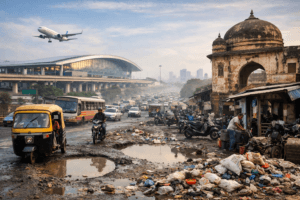
Beneath the gleaming facades of India’s new airports and the smooth expanse of its national highways lies a stark urban reality. In cities from Jaipur to Bengaluru, a quiet crisis unfolds daily: historic monuments stand defaced beside mechanic workshops, commuters inch through clouds of toxic smog, and monsoon rains transform streets into garbage-clogged rivers. This is the great Indian urban paradox—a nation pouring billions into infrastructure while its major cities become increasingly unlivable.
Beyond Postcards: The Reality of Urban Decay
The taxi driver in Jaipur captured the collective urban resignation perfectly. “Want the royal charm? Just buy a postcard.” His cynicism points to a deeper disconnect between India’s global aspirations and its local lived experience. Cities once celebrated for their cultural heritage and economic promise are now defined by a trilogy of dysfunction: lethal air quality, crumbling civic infrastructure, and systemic waste management failure.
The symptoms are impossible to ignore. In Bengaluru, the “Silicon Valley of India,” tech billionaires and residents alike protest unprecedented traffic paralysis and garbage mountains. Mumbai’s citizens, weary of monsoon flooding exacerbated by clogged sewage, stage public demonstrations over potholes that resemble small craters. Delhi’s winter air becomes a visible, palpable health emergency, forcing doctors to advise vulnerable residents to flee. Even global icon Lionel Messi’s visit was soundtracked not by cheers alone, but by chants against the capital’s poisonous atmosphere.
The Governance Vacuum: Where India’s Cities Lose Their Way
The core issue, experts argue, is not a lack of funds or vision, but a fundamental flaw in urban governance. “Our cities don’t have a credible governance model,” says infrastructure veteran Vinayak Chatterjee. When India’s constitution was framed, it envisioned power shared between central and state governments, failing to anticipate the rise of massive, complex megacities needing autonomous, empowered local bodies.
The 74th Constitutional Amendment Act of 1992 was a landmark attempt to correct this, granting urban local bodies constitutional status and aiming to decentralize power. Yet, decades later, its provisions remain largely unimplemented. City mayors and municipal corporations are, in the words of author Ankur Bisen, “the weakest organs of the state.” They possess limited authority to raise revenue, make key appointments, or allocate meaningful budgets. Instead, state chief ministers operate as “super mayors,” often prioritizing political gains over long-term urban health.
This stands in dramatic contrast to the Chinese model, frequently cited as a comparative benchmark. There, city mayors wield substantial executive power over planning, infrastructure, and investment, with performance directly tied to career progression within the Communist Party’s centralized system. As Ramanath Jha of the Observer Research Foundation notes, Chinese cities operate under strong national mandates with clear targets, coupled with local implementation freedom and rigorous central monitoring. The result? During its comparable growth phase, China managed to pair economic explosion with significant urban regeneration.
Data Darkness and Democratic Erosion
Compounding the governance crisis is a startling lack of data. India’s last census was in 2011, recording 31% urbanisation. Informal estimates now suggest nearly half the population lives in urbanized areas, but the next census is delayed until 2026. “How do you even begin to solve a problem if you don’t have data on the extent and nature of urbanisation?” asks Bisen. Planning happens in an informational vacuum, making effective policy formulation akin to navigating a complex maze blindfolded.
This data deficit reflects a broader, more troubling trend: the weakening of India’s grassroots democratic institutions. The non-implementation of the 74th Amendment signifies a failure to empower the tier of government closest to the people. Citizens, overwhelmed by daily struggles, often direct their grievances toward distant state or national leaders, bypassing the emaciated local bodies that should be their first point of accountability. The vibrant, localized democratic engagement needed to drive urban transformation is missing.
Glimmers of Hope and the “Great Stink” Moment
Despite the bleak panorama, exceptions offer a blueprint for possibility. Surat’s transformation after the 1994 plague outbreak is legendary. A determined municipal commissioner, empowered by political backing, overhauled the city’s sanitation and public health systems in months, turning a health disaster into a catalyst for enduring change. Similarly, Indore has been consistently ranked India’s cleanest city, a title won through robust waste segregation, efficient processing, and sustained civic engagement.
These successes, however, relied on “individual brilliance rather than a system,” laments Bisen. They prove change is possible but highlight that it remains personality-dependent, not institutionalized.
The question then becomes: what will it take for systemic change to occur? Bisen draws a historical parallel to London’s “Great Stink” of 1858, when the pollution of the River Thames became so unbearable that Parliament was forced to act, leading to a revolutionary new sewer system that ended cholera outbreaks. India’s cities, he suggests, may need to reach a similar boiling point—a crisis of such magnitude that urban livability becomes an unavoidable political priority, transcending short-term electoral cycles.
Reimagining the Indian City: A Path Forward
Solving India’s urban crisis requires a multi-pronged approach that moves beyond isolated infrastructure projects:
- Constitutional Empowerment: Fully implementing the 74th Amendment is non-negotiable. Cities need mayors with real executive power, multi-year tenures, and clear accountability. Municipal bodies require broader taxation powers and freedom to hire expertise.
- Metropolitan Governance Models: Megacities like Mumbai, Delhi, and Bengaluru need unified metropolitan authorities that can coordinate across multiple municipal jurisdictions, transport systems, and utilities—transcending political fragmentation.
- Data-Driven Planning: Accelerating the census and investing in real-time urban data dashboards (on air quality, traffic, waste, water) is critical for evidence-based policy and transparent public monitoring.
- Public-Civic Partnerships: The state cannot do it alone. Sustainable change requires partnering with resident welfare associations, citizen groups, and private sector innovators, fostering a shared sense of ownership.
- Reframing the Narrative: Urban development must be seen not just as building roads, but as building healthy, equitable, and resilient communities. Public health, environmental sustainability, and cultural heritage preservation need to be central to the urban mission.
Conclusion: The Choice Ahead
India stands at a critical urban crossroads. The current path leads to cities that are economic powerhouses on paper but toxic, stressful, and degrading to inhabit—a scenario where GDP growth becomes divorced from human well-being.
The alternative path is harder. It demands difficult political choices to decentralize power, invest in unglamorous but vital systems like sewage and waste management, and foster a culture of civic responsibility. It requires viewing citizens not as passive recipients of services but as active stewards of their urban homes.
The taxi driver’s resigned joke about the postcard need not be India’s urban epitaph. The nation has the resources, the talent, and the historical examples of urban excellence within its own past. What it needs now is the political will to empower its cities, not just with concrete and steel, but with the authority, resources, and democratic vitality to breathe again. The future of half a billion Indians depends on that choice.
You must be logged in to post a comment.