
The Great Indian Pour: Decoding Pernod Ricard’s Potential IPO and the Spirits Market Shake-Up
Pernod Ricard, the French parent company of iconic brands like Absolut Vodka and Chivas Regal, is reportedly in early-stage discussions to list its Indian subsidiary as an IPO, a move that would capitalize on the skyrocketing valuation of India’s consumption story and follow a similar exploration by competitor Carlsberg. While the company frames this as a routine strategic review, a listing would unlock significant shareholder value by offering pure-play access to India’s premiumisation trend, leveraging its massive distribution network of 24 bottling units and decades of market dominance. However, the potential IPO is shadowed by ongoing regulatory hurdles and litigations, though going public could also serve to “localize” the company, creating a powerful base of domestic institutional stakeholders and potentially paving the way for a resolution of its legal challenges.
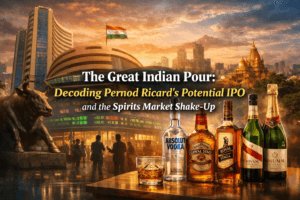
The Great Indian Pour: Decoding Pernod Ricard’s Potential IPO and the Spirits Market Shake-Up
For decades, the Indian tippler’s relationship with premium alcohol has been silently curated by French multinationals. Now, one of the biggest names in the business is considering a move that could fundamentally alter the landscape of the Indian stock market and the country’s consumption economy.
A recent report by Bloomberg, covered by financial outlets like Upstox, has sent ripples through the Dalal Street community: Pernod Ricard SA, the French giant behind the iconic Absolut Vodka and Chivas Regal whisky, is exploring the possibility of listing its Indian arm. While the company has officially stated that it “regularly reviews its strategic options” and that deliberations are at an early stage, the mere possibility of an Initial Public Offering (IPO) raises a glass full of intriguing questions.
This isn’t just another IPO story. It is a narrative about the maturing of the Indian consumer, the complexities of operating in one of the world’s toughest regulatory environments for alcohol, and a potential shift in how global conglomerates view the Indian market. Coming hot on the heels of Carlsberg’s similar announcement, it signals a potential “Great Indian Listing” trend for FMCG giants.
Let’s uncork this story and analyze what a Pernod Ricard India IPO would mean for the company, the market, and the average Indian investor.
The House of Brands: Pernod Ricard’s Deep Roots in India
To understand the weight of this potential IPO, one must first appreciate the sheer scale of Pernod Ricard’s operations in India. The company isn’t a new entrant trying to find its footing. With over three decades of presence, it has become synonymous with the “premiumisation” of the Indian alcohol market.
If you’ve been to a wedding, a high-end party, or even a slightly upscale bar in any Indian metro, you’ve likely consumed a Pernod product. Their portfolio is a veritable who’s who of the spirits world:
- Whiskies: Chivas Regal, Ballantine’s, Royal Stag, Blenders Pride
- Gin: Beefeater
- Vodka: Absolut
- Rum: Havana Club
- Champagne & Wines: Mumm, Perrier-Jouët
The company’s strategy in India has been masterful. While they own global luxury brands, they successfully localized with products like Royal Stag and Blenders Pride, which compete fiercely in the popular and semi-premium segments—the true volume drivers of the Indian market. This dual strategy of luxury aspiration (Chivas) and mass-market reach (Royal Stag) has allowed them to build an empire.
Operationally, the numbers are staggering. The company’s single distillery in Nashik, Maharashtra, acts as the nerve center, supported by a network of 24 bottling units spread across the country. This extensive supply chain is not just a logistical feat; it’s a moat. Navigating India’s complex excise laws, where each state has its own taxation and distribution policies, is a nightmare for newcomers. Pernod has not only navigated this labyrinth but has built a fortress within it.
Why Now? Decoding the Strategic Pivot
The news of a potential listing didn’t emerge from a vacuum. It is the result of a confluence of macroeconomic factors, corporate strategy shifts, and peer pressure. Here’s a look at the strategic calculus likely happening in the boardrooms of Paris and Mumbai.
1. The India Valuation Premium
Globally, the consumer goods sector is facing headwinds—inflation in Western markets, supply chain disruptions, and market saturation. India, however, remains a bright spot. The “India consumption story” is the hottest ticket in town.
International investors are desperate for pure-play exposure to the Indian middle class. By listing locally, Pernod Ricard India can command a valuation multiple that is significantly higher than what the parent company might receive as a small part of a conglomerate trading on the Euronext Paris. Think of it as the “HUL Effect”—Hindustan Unilever often trades at a premium to its parent, Unilever, because it offers direct access to the unique Indian market dynamics. Pernod is likely eyeing a similar valuation bump.
2. The Carlsberg Catalyst
The article mentions Carlsberg’s intention to explore an IPO for its India business. In the corporate world, few things accelerate decision-making like a competitor making the first move. If Carlsberg lists successfully and unlocks massive shareholder value, Pernod risks being left behind. The Indian market has limited “deep-pocket” institutional capital allocated to the alcohol sector. The first-mover advantage in the public markets is crucial. Carlsberg’s Group CEO explicitly stated the move is “purely driven from a shareholder value perspective.” Pernod cannot afford to ignore that siren call.
3. Unlocking Value vs. Unlocking Headaches
This is the most nuanced reason. Pernod Ricard India has been embroiled in regulatory battles for years, most notably regarding alleged violations of drug laws in Delhi and ongoing disputes over import duties. Being a private, wholly-owned subsidiary means these battles are fully shouldered by the parent company.
However, a public listing changes the game. Once Indian public shareholders and institutional investors are on the cap table, the company gains a layer of “local insulation.” It becomes a truly Indian entity with Indian stakeholders, including powerful domestic mutual funds. This doesn’t make legal problems disappear, but it creates a powerful lobby of local investors who have a vested interest in the company’s smooth functioning.
The Elephant in the Room: The Regulatory Hurdles
It is impossible to discuss Pernod Ricard India without addressing the massive regulatory elephant in the room. The company has been fighting a protracted legal battle, particularly regarding the now-scrapped Delhi excise policy and allegations of wrongdoing.
Any IPO prospectus (or Draft Red Herring Prospectus – DRHP) will have to meticulously detail these litigations. This is a significant risk factor. However, seasoned market analysts argue that the market has a short memory for risk if the numbers are good.
- Resilience: Despite the legal heat, Pernod’s sales in India haven’t collapsed. This shows the strength of their brands. Consumers don’t stop buying Blenders Pride because of a corporate tax dispute.
- Resolution Pathways: There is a general feeling in the corporate legal community that these long-standing disputes are reaching a resolution phase. An IPO might actually serve as a catalyst for the company to “clean the slate,” settling past dues and committing to a more transparent compliance structure expected of a listed entity.
The “Sin” versus “Growth” Debate for Investors
For the retail investor scanning the headlines, the question is simple: Should I buy this stock if it lists?
Alcohol stocks in India have traditionally been a tricky bet. They are considered “sin stocks,” often excluded from ESG (Environmental, Social, and Governance) funds. However, they are also cash flow machines. Look at the performance of United Spirits (Diageo) or Radico Khaitan; they have delivered stellar returns over the long term.
What would make Pernod Ricard India a compelling bet:
- Unparalleled Portfolio: No other company in India has the mix of ultra-premium (Chivas, Absolut) and mass-premium (Royal Stag) that Pernod does. As Indians upgrade from “country liquor” to “Indian Made Foreign Liquor” (IMFL) and then to premium imported brands, Pernod captures value at every step.
- Distribution Muscle: Their 24 bottling units and pan-India presence mean they can reach a bottle to a remote corner of Bihar or a high-end bar in Bangalore with equal efficiency.
- The “Premiumisation” Trend: Post-COVID, Indians are drinking less but better. The growth is in the premium segment, which is Pernod’s backyard.
The risks are clear: regulatory overhang, high taxation, and state-wise prohibition policies. But for an investor with a high-risk appetite and a long-term horizon, a Pernod Ricard India IPO would be a must-watch.
What About the Indian Consumer?
Beyond the stock market jargon, this IPO is a reflection of the Indian consumer’s evolution. Thirty years ago, “foreign liquor” was a rarity. Today, a young professional in Pune knows the difference between a single malt and a blend, and a millennial in Gurgaon specifies their brand of gin. Pernod Ricard nurtured this culture.
If the company lists, it is essentially betting that this evolution is permanent and accelerating. It is betting that the 24 bottling units won’t be enough in ten years, that the demand for Chivas will outstrip supply, and that the Indian middle class will continue to see value in the brands they offer.
Conclusion: A Toast to the Future
The potential listing of Pernod Ricard India is more than just a financial transaction; it is a cultural milestone. It signifies that the Indian market has matured enough to host the IPO of a global luxury goods giant in the beverage space. It signals a shift from viewing India merely as a “manufacturing base” or a “sales outlet” to viewing it as a “shareholder hub.”
While the report stresses that talks are at an early stage and there is “no certainty,” the genie is out of the bottle. The combination of Carlsberg’s parallel move, the insatiable investor hunger for consumption stories, and Pernod’s need to solidify its legacy in India makes this a logical step.
For now, investors, competitors, and consumers alike will watch the space with bated breath. Will Pernod Ricard India pour its fortunes onto Dalal Street? If it does, it might just be the strongest drink the Indian IPO market has seen in a long time.
You must be logged in to post a comment.