
The Great Indian IT Reckoning: Ranking TCS, Infosys, Wipro, and HCLTech for the AI Era
The Great Indian IT Reckoning: Ranking TCS, Infosys, Wipro, and HCLTech for the AI Era
For over two decades, the narrative of Indian IT was one of unstoppable ascent. Companies like Tata Consultancy Services (TCS), Infosys, Wipro, and HCLTech weren’t just participants in the global digital economy; they were its backstage architects. They built the scaffolding for the world’s banks, retailers, and airlines, operating on a simple, immensely profitable premise: renting out brilliant engineering talent by the hour.
Then, the rules of the game changed overnight.
When Anthropic launched Claude, the market’s reaction was swift and brutal. Indian IT stocks bled over ₹2 lakh crore in market capitalization in just four days. It was a stark, real-time vote from the markets on a terrifying question: What happens to a business model built on billing for hours when artificial intelligence can do the same work in minutes?
This isn’t just another tech cycle, like the shift to the cloud or the advent of mobile. This is an existential pivot. We are moving from a world of labor arbitrage (cheaper hours) to one of intellectual arbitrage (faster outcomes). In this new landscape, not all giants are created equal. Some are built to pivot; others are built to protect.
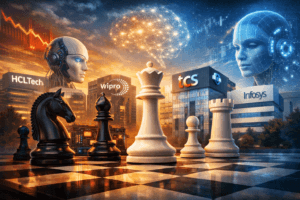
By applying a strategic lens—borrowing insights from industry veterans and analysts—we can rank the “Big Four” Indian IT services companies. This isn’t about their revenue this quarter, but their positioning on the chessboard for the decade to come. Who is the Queen, making powerful moves in every direction? Who is the Knight, leaping over disruption? And who is the Bishop, stuck moving diagonally on a board that has become a free-for-all?
Here is our ranking, from the best positioned to the most vulnerable in the AI era.
The New Axis of Competition: From Headcount to Value
Before we lay out the pieces, we must understand the board. The traditional IT services model is facing a deflationary spiral. If a task that took 100 engineers a month can now be done by 10 engineers with AI tools in a week, the client will not pay the same price. The “per head” billing model is dying.
The survivors will be those who can:
- Monetize Productivity: Find new ways to charge for outcomes and value, not just time.
- Retrain the Army: Reskill a massive workforce to work with AI, not be replaced by it.
- Own the IP: Move up the value chain from “bodyshopping” to owning software platforms and intellectual property.
With these criteria in mind, let’s look at the contenders.
- The Bishop: Wipro Limited
The State of Play: Stuck in a diagonal move, struggling to find the right square.
Wipro enters the AI era with the most baggage and the most potential energy. For years, it has been plagued by leadership churn and stagnant revenue growth in its core IT business. The company has changed strategy—and CEOs—more frequently than any of its peers, creating a culture of uncertainty.
In chess, the Bishop is powerful but confined to squares of a single color. Wipro’s “color” has historically been its heterogeneous mix of legacy IT, energy, and a splash of consulting. But it lacks the deep, vertical-specific dominance of an Infosys in banking or the unique annuity models of an HCL.
The Challenge: The churn at the top has created a void in the middle. A company cannot pivot to an AI-first future if its second and third lines of leadership are constantly looking over their shoulders, unsure of who will be steering the ship next year. This instability trickles down to the engineers. When your manager changes every 18 months, long-term reskilling initiatives become an afterthought.
The Opportunity (and why they aren’t last): Paradoxically, Wipro might be the most interesting “underdog” story. As one analyst noted, they have the least to lose. Their current valuation reflects deep skepticism, which gives new leadership—if they can stick around—the freedom to make radical, painful changes without the fear of spooking the market too much. They could, in theory, aggressively sunset legacy service lines, go all-in on AI partnerships, and acquire niche AI product companies. They have the balance sheet to make bold bets. The question is whether they have the cultural stability to see those bets through.
AI Era Verdict: Wipro is the wildcard. They could either be the piece that gets swept off the board early or the one that pulls off a surprise checkmate. But given the current trajectory, they are playing catch-up.
- The Rook: Infosys Limited
The State of Play: Powerful in straight lines, but struggles with the diagonal chaos of AI.
Infosys has always been the strategic one. While TCS was the elephant that could dance, Infosys was the cheetah, sleek, fast, and focused. They built a reputation for best-in-class management practices and early investments in automation (with platforms like McCamish and Panaya). They have deep, enviable domain expertise in financial services and healthcare—verticals with high barriers to entry and deep pockets.
The Rook moves in straight lines, and Infosys excels here. If the future was a straight line from A to B—more cloud, more digital, more automation—Infosys would be a top contender. They have the consulting muscle (acquired over years) to sit at the strategy table with Fortune 500 CIOs.
The Challenge: The AI era is not a straight line; it is a 3D chess game. The Rook’s weakness is its inability to move diagonally or jump over pieces. Infosys’s biggest diagonal obstacle is its leadership structure. The company has had a history of professional management, but the bench strength is a growing concern. With CEO Salil Parekh having served a significant tenure, the lack of a visible, groomed internal successor creates uncertainty. In a time demanding radical transformation, a leadership vacuum at the top can paralyze decision-making.
Furthermore, its strength in financial services is a double-edged sword. Banks and insurance companies are heavily regulated and move slowly. They are also the most likely to be disrupted by AI, and their caution might prevent Infosys from deploying cutting-edge, riskier solutions as fast as a tech-native company might.
AI Era Verdict: Infosys is built for a world of linear progress. The AI shift is non-linear. They have the strategic depth to navigate it, but they risk being outmaneuvered by more agile competitors if they cannot solve the leadership puzzle and help their conservative clients embrace a faster pace of change.
- The Knight: HCLTech
The State of Play: The disruptor, moving in unexpected “L-shapes” that confuse the competition.
HCLTech has often been the overlooked sibling in the Indian IT family. While TCS and Infosys grabbed headlines with mega-deals, HCL was quietly building a moat in the most unlikely place: infrastructure managed services and “tech debt.”
About 25% of their business comes from managing clients’ messy, legacy IT infrastructure on long-term, fixed-price contracts. Here’s the genius of it: When AI automates a task in this space, the value of that efficiency doesn’t go back to the client in a traditional hourly model—it is retained by HCL because the contract is fixed-price. They literally profit from their own efficiency. Vivek Kant, a former Tech Mahindra executive, pointed out this exact dynamic: “When AI disrupts this, the value is retained by HCL.”
The Knight is the only piece that can jump over others. HCL did exactly that with its $1.8 billion acquisition of IBM’s legacy software portfolio. They bought a suite of products that the market deemed obsolete, turned them around, and created a steady stream of annuity revenue. This product-IP mindset is rare in Indian IT and positions them perfectly for an era where clients want to buy outcomes, not just hours.
The Challenge: Can they scale this model? Their Knight-like moves are brilliant, but they are not the Queen. They dominate specific niches, but they lack the sheer breadth of TCS. To thrive, they must ensure that their fixed-price infrastructure deals don’t become a trap if clients demand to renegotiate based on massive AI-driven savings.
AI Era Verdict: HCLTech is the dark horse. Their business model is structurally aligned with the incentives of the AI era. They win by being more efficient, not just billing more hours. If they can continue to find and jump over the right obstacles, they could emerge as the most profitable of the lot.
- The Queen: Tata Consultancy Services (TCS)
The State of Play: The most powerful piece on the board, with moves in every direction.
There is a reason TCS is the 600-pound gorilla. With over 600,000 employees and the full backing of the Tata Group, it is a force of nature. Its diversification is its superpower. It isn’t just writing code; it’s running data centers, processing insurance claims, and even managing India’s Passport Seva project. This breadth allows it to move in any direction—hardware, software, consulting, BPO—to capture value.
When a client asks, “How can AI help my entire business?”, TCS is the only vendor that can credibly answer across the entire enterprise stack. The personal involvement of Tata Sons Chairman N. Chandrasekaran ensures that the company is not complacent; the mandate to pivot is coming from the very top.
The One Flaw in the Queen’s Armor: But the Queen has a vulnerability. Its power is its size, but size breeds inertia. The organizational culture of a 600,000-person company is built on process, compliance, and following orders.
As Krishnakumar Natarajan, co-founder of Mindtree, noted, the AI disruption requires “people who have curiosity.” He suggested that in a behemoth like TCS, the sheer weight of the management structure can curtail that curiosity. An engineer with a radical idea might have to climb seven layers of management to get it heard. By the time they get approval, the startup they were trying to emulate has already eaten their lunch.
AI Era Verdict: TCS has the best strategic position. They have the clients, the cash, and the brand to dominate the AI services market. They will win the big deals. Their survival is not in question. But to thrive in the truest sense—to innovate at the pace of AI—they must fight their own culture. They need to create “startup-like” bubbles within the giant where curiosity is not just allowed, but rewarded. If they can do that, the game is theirs. If they can’t, they will remain the safe, reliable choice—which in a disruptive era, is a dangerous place to be.
The Ghost at the Table: Cognizant’s Identity Crisis
No analysis of Indian IT is complete without mentioning the ghost at the feast: Cognizant. It doesn’t fit neatly into the “Indian IT” bucket—it’s NASDAQ-listed with a massive Indian delivery presence. It’s a hybrid, and in a world demanding clarity of purpose, that hybrid identity is becoming a liability.
Vivek Kant, a Cognizant alum, pointed out that the company, despite new leadership, lacks a stable second line of command. More importantly, it lacks a home. For American clients, it’s not quite a local partner. For Indian talent, it’s not quite an Indian company with the cultural familiarity of a TCS or Infosys. In the AI era, where trust and deep integration are paramount, being “stuck between two identities” is a dangerous place to be.
The Final Move: Who Thrives?
In chess, the opening and middle game are about positioning. The endgame is about execution.
- TCS is positioned to control the center of the board. Their success hinges on whether they can unleash the latent creativity within their ranks.
- HCLTech is positioned to capture key strategic squares. Their success hinges on whether their niche expertise can become a blueprint for the entire industry.
- Infosys is positioned to defend its territory. Their success hinges on finding a leader to navigate the chaotic, non-linear path ahead.
- Wipro is positioned to… well, that’s the point. They need to choose a position and move decisively before they are pinned.
The AI era will not be kind to the slow or the bureaucratic. It will reward the curious and the agile. The four giants of Indian IT have the resources to survive. But thriving will require them to accept a painful truth: the model that made them giants is the very thing that could now hold them back. The question isn’t whether they can adapt—it’s whether they can adapt faster than the technology is evolving. And in a race against AI, speed is the only metric that matters.
You must be logged in to post a comment.