
The Great Indian Balancing Act: How New Delhi Is Trading Soybeans for Semiconductors
The interim India-U.S. trade deal reflects a calculated strategic shift: New Delhi shields politically sensitive farm sectors like dairy, poultry, and rice through an “Exclusion Category,” while securing preferential access to advanced semiconductors, server components, and critical technologies that underpin its Digital India and semiconductor manufacturing ambitions. By lowering average U.S. tariffs on Indian goods to 18% and removing Section 232 duties on aircraft parts and auto components, the agreement balances concessions—such as reduced duties on American soybean oil and DDGS—with protections for key domestic agriculture. More than a narrow tariff pact, it signals India’s pragmatic bet that long-term gains from becoming a player in the AI-driven global semiconductor market outweigh short-term disruptions in select agricultural segments, positioning technology access as the centerpiece of its economic future.
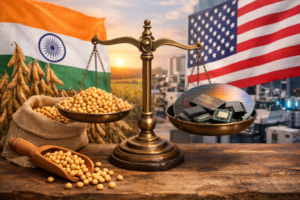
The Great Indian Balancing Act: How New Delhi Is Trading Soybeans for Semiconductors
A Deal Beyond the Headlines
When diplomats from New Delhi and Washington shook hands on an interim trade deal in the early hours of March 24, the official statements celebrated “enhanced cooperation” and “mutually beneficial outcomes.” But beneath the polished diplomatic language lies a far more interesting story—one about a developing economy making calculated bets on its technological future while carefully shielding the agricultural sector that still employs nearly half its population.
This isn’t simply another trade agreement. It represents a strategic pivot that reveals how India sees its economic trajectory over the next decade: a future where access to cutting-edge semiconductor technology matters more than protecting every domestic industry from foreign competition.
The Semiconductor Gambit
Let’s start with what India is actually getting from this deal, because it’s far more significant than most headlines suggest.
The agreement provides India with preferential access to advanced semiconductor chips, server components, and critical technologies that form the backbone of modern digital infrastructure. For a country that has spent the last decade building its “Digital India” ambitions, this is akin to securing the engine before building the car.
Consider the numbers driving this strategy. The global semiconductor market is projected to surpass $670 billion by 2026, with artificial intelligence and high-performance computing accounting for an increasingly large slice of that pie. Taiwan Semiconductor Manufacturing Company (TSMC) alone controls over 50 percent of the global foundry market, giving geopolitically sensitive Taiwan outsized influence over who gets chips and who doesn’t.
India’s India Semiconductor Mission (ISM) entered its 2.0 phase with ambitious goals: establish the country as a legitimate player in global chip manufacturing, reduce dependence on concentrated supply chains, and capture value in a market that shows no signs of slowing. But ISM always faced a fundamental constraint—even if India built fabrication plants tomorrow, it still needed reliable access to the most advanced chips and technologies that only a handful of companies, most of them American or American-allied, produce.
This trade deal addresses precisely that constraint. By tying technology access to broader trade concessions, India has essentially purchased a more reliable seat at the semiconductor table.
The removal of Section 232 tariffs on Indian aircraft parts and automotive components shouldn’t be overlooked either. These tariffs, originally imposed by the U.S. under national security grounds that many trade experts considered questionable at best, had become a persistent irritant in bilateral trade relations. Their removal signals that both sides are willing to clear away old grievances to focus on future opportunities.
For Indian automotive component manufacturers—a sector that employs over five million people and contributes roughly 2.3 percent to India’s GDP—the preferential tariff rate offers breathing room at a time when global competition has never been fiercer.
The Farm Sector: What Wasn’t Given Away
If you want to understand why this deal took so long to finalize, look at the agriculture section.
India successfully negotiated an “Exclusion Category” that shields key domestic products—rice, wheat, poultry, dairy, and genetically modified crops—from tariff changes. These aren’t random selections. Each represents a politically sensitive sector where domestic producers would face existential threats from American competition.
Consider dairy. India is the world’s largest milk producer, with over 80 million households depending on dairy farming for their livelihoods. Opening the market to American dairy products, which benefit from economies of scale and government subsidies that Indian farmers cannot match, would devastate rural communities across states like Gujarat, Uttar Pradesh, and Punjab. The political fallout would be immediate and severe.
The same logic applies to poultry, where American producers operate at scales that make Indian operations look artisanal by comparison. Protecting domestic poultry wasn’t just about shielding farmers—it was about preserving a protein source that remains the most affordable option for millions of Indian families.
However, the deal wasn’t entirely protective on agriculture. India gained duty-free access for some exports including spices, tea, and coffee—sectors where Indian products compete effectively on quality and brand recognition. But the real story is what India conceded: lower duties on American soybean oil and Dried Distillers Grains with Solubles (DDGS).
This is where the trade-off becomes visible. Soybean farmers in Maharashtra and Madhya Pradesh—two states that account for over 60 percent of India’s soybean production—now face increased competition from American imports. The poultry sector, which uses DDGS as feed, might benefit from cheaper inputs, but those savings come at the expense of domestic soybean farmers.
The numbers tell an interesting story here. Despite these concessions, India still maintained a $1.3 billion trade surplus in agricultural trade with the U.S. in 2024. In other words, even after opening certain doors, Indian agriculture remains a net winner in bilateral trade.
The Tariff Equation
The deal’s tariff provisions reveal something important about how both countries view trade relationships in an increasingly fractured global economy.
India’s average tariff rate on U.S. goods will drop to 18 percent, down from peaks of 50 percent during the trade tensions of 2025. That’s a significant reduction, but context matters. The U.S. had previously used Section 232 tariffs—measures justified on national security grounds—that many economists viewed as thinly disguised protectionism. Their removal suggests a mutual recognition that trade wars ultimately hurt both sides.
More broadly, this deal occurs against a backdrop of U.S. trade policy becoming increasingly transactional. The Trump administration’s approach (and its echoes in subsequent policy) prioritized bilateral deals over multilateral frameworks, creating both opportunities and risks for partners like India. Opportunities because bilateral deals can be tailored to specific national interests. Risks because transactional relationships can be rewritten as easily as they’re written.
India’s total bilateral trade with the U.S. reached approximately $212 billion in 2024, making the U.S. India’s largest trading partner. For perspective, that’s nearly twice India’s trade with China, reflecting a deliberate diversification away from Beijing amid ongoing border tensions and broader strategic realignment.
What This Deal Really Says About India’s Strategy
Step back from the specific provisions, and this deal reveals something deeper about how India is navigating its economic development.
For decades, India approached trade negotiations with a defensive posture, protecting domestic industries across the board and offering concessions grudgingly. This deal suggests a shift toward selective openness—protecting sectors where domestic vulnerability is highest while exposing others to competition in exchange for access to technologies that enable future growth.
It’s a calculated gamble. The bet is that gains from faster technological development will outweigh losses from increased agricultural competition. That the semiconductor fab being built in Gujarat, or the electronics manufacturing cluster in Tamil Nadu, will generate more long-term value than the soybean fields of Madhya Pradesh might temporarily lose.
This isn’t an unreasonable bet. Manufacturing in general, and advanced manufacturing in particular, creates jobs that pay significantly better than agriculture. It builds supply chains that attract further investment. It positions India to capture value in industries that will define the global economy for decades.
But it’s a bet that requires careful management. The transition from an agricultural economy to a manufacturing and services economy is never smooth, and it leaves communities behind. India’s political system, with its federal structure and regional parties, is particularly sensitive to these disruptions. The dairy farmers of Gujarat vote. The poultry producers of Tamil Nadu have political clout. Their interests cannot be dismissed, and this deal acknowledges that by protecting precisely those sectors where political sensitivity is highest.
The Competition India Can’t Ignore
India’s semiconductor ambitions face significant competition from established players. Taiwan dominates global foundry revenue, and countries from the United States to Japan to Germany are all investing heavily in domestic chip manufacturing capabilities.
What India offers—and what this trade deal enhances—is scale and stability. The world’s largest democracy, with its massive domestic market and growing middle class, represents a hedge against concentration risk. Companies looking to diversify their supply chains beyond Taiwan and China increasingly see India as a viable alternative.
The deal’s technology provisions signal to global investors that India can secure the inputs needed for advanced manufacturing. Semiconductor fabrication requires not just capital and labor, but reliable supply chains for equipment, chemicals, and intellectual property. By securing U.S. cooperation on these fronts, India makes its domestic manufacturing ambitions more credible.
The Geopolitical Dimension
No analysis of India-U.S. trade relations would be complete without acknowledging the elephant in the room: China.
The strategic alignment between India and the United States has deepened significantly over the past decade, driven by shared concerns about Chinese assertiveness in the Indo-Pacific region. This deal reflects that alignment, offering India preferential access to American technology in exchange for trade concessions that strengthen economic ties.
But it’s worth noting what this deal is not. It’s not an alliance. It’s not a free trade agreement. It’s an interim deal, explicitly described as a stepping stone toward a broader bilateral agreement. Both sides have kept their options open, and both sides have structured the deal to be reversible if circumstances change.
For India, this flexibility matters. While current strategic calculations favor closer ties with Washington, India’s tradition of strategic autonomy—non-alignment updated for the 21st century—means retaining the ability to pivot if necessary. The deal’s interim nature serves this purpose well.
Looking Forward: The Real Test Begins Now
Interim trade deals are easy to announce and difficult to implement. The real test of this agreement will come in the details that haven’t been written yet.
How will India balance agricultural protections with the need to maintain U.S. interest in further negotiations? How will the promised technology access actually work in practice—will Indian companies truly get the chips they need, or will export controls and licensing requirements create new barriers? How will domestic politics in both countries respond as the deal’s effects become visible?
The global semiconductor industry is projected to grow at a compound annual rate of 8-10 percent over the next five years, driven by AI, automotive electronics, and high-performance computing. India’s ability to capture a meaningful share of this growth depends on execution, not just agreements.
The India Semiconductor Mission’s success or failure will determine whether this deal is remembered as a strategic masterstroke or a missed opportunity. The fabrication plants being planned, the workforce being trained, the supply chains being built—these will matter more than any tariff reduction.
Similarly, the agricultural protections in this deal will face ongoing pressure. As U.S. farm interests lobby for greater access, as WTO disputes continue, as domestic Indian agriculture modernizes or fails to modernize, the exclusion categories may prove harder to maintain than they were to negotiate.
A Pragmatic Path Forward
What makes this deal worth watching isn’t its scale—interim deals rarely change economic trajectories overnight. It’s what it reveals about how India thinks about its economic future.
The old model of development, which prioritized self-sufficiency and protected domestic industries from foreign competition, served India well during its early decades of independence. But it also produced the “Hindu rate of growth”—slow, steady, and insufficient to lift hundreds of millions out of poverty.
The new model, visible in this deal, is more pragmatic. Protect what absolutely must be protected. Open what can be opened. Use access to global markets and technologies to accelerate development, even if that means accepting competition in some sectors. And above all, place strategic bets on industries—like semiconductors—that will define the future.
This isn’t neoliberal shock therapy. It’s not wholesale deregulation or mindless opening to foreign competition. It’s targeted, strategic, and politically aware. The dairy farmers are protected. The semiconductor manufacturers are supported. The trade surplus in agriculture is maintained, even as some doors open.
Whether this approach works will depend on execution. India has a history of ambitious plans that stumble in implementation. Bureaucratic hurdles, infrastructure gaps, and political resistance have derailed many well-intentioned initiatives.
But the direction is clear. India is betting that its future lies in advanced manufacturing and digital services, and that securing access to critical technologies is worth making selective concessions in traditional sectors. It’s a bet on growth, on transformation, and on the idea that a country can protect its most vulnerable sectors while still racing toward the industries of tomorrow.
The interim trade deal with the United States is one step in that journey. Not the final destination, not a revolution in economic policy, but a signpost pointing the way forward. Whether India reaches that destination—whether the semiconductor fabs get built, whether the digital economy transforms livelihoods, whether the agricultural sector adapts and survives—will depend on what happens after the press releases fade and the real work begins.
You must be logged in to post a comment.