
The Great Indian Bake-Off: Is February the New May? Decoding the 2026 Heat Anomaly
A severe and premature heatwave is gripping northern India in February 2026, with temperatures in cities like Delhi touching 30°C—a symptom of collapsing seasonal transitions driven by feeble winter storms (Western Disturbances) and an overwhelming global warming trend that is now overpowering natural cooling cycles like La Niña. While meteorologists debate whether this will make 2026 hotter than the record-breaking 2025, the immediate human impact is undeniable: farmers fear shrivelled wheat crops from terminal heat stress, urban poor face relentless heat with no nighttime reprieve due to the urban heat island effect, and the concept of a traditional spring is vanishing, forcing a stark reality where adaptation to a “new normal” of extreme, early heat is no longer a future concern but a present crisis.
The Great Indian Bake-Off: Is February the New May? Decoding the 2026 Heat Anomaly
As northern India sweats through a February that feels more like a pre-monsoon summer, we go beyond the mercury to explore what this means for the year ahead, our cities, and the people living on the frontlines of climate change.
The sun over Delhi in mid-February usually has a gentle, almost deceptive warmth—a pleasant precursor to the oppressive humidity of March. But this year, that rulebook has been tossed out of the window. On February 17, 2026, the Indian capital recorded a maximum temperature of 27°C. While this figure alone might not raise eyebrows in a city accustomed to 45°C summers, it’s the context that is causing concern among meteorologists and a weary, sweat-soaked public alike. Just days earlier, the mercury had breached the 30°C mark. In the span of a week, Delhiites have swapped their cardigans for cotton shirts and their morning chai for cold thandai.
This isn’t just an anomaly confined to the national capital. The India Meteorological Department (IMD) has issued a stark warning: maximum and minimum temperatures are likely to remain 2°C to 4°C above normal across many regions for the remainder of February. But what does a hot February portend for the rest of the year? Will 2026 dethrone 2025 as the hottest year on record? More importantly, how are the millions navigating this unexpected heat wave coping?
The Day Winter Forgot to Show Up
To understand the gravity of the situation, one must look beyond the headline-grabbing 30°C. The real story lies in the night-time temperatures. The IMD’s forecast of elevated minimum temperatures is the silent killer in this narrative. When the mercury doesn’t dip enough at night, the human body gets no reprieve from the heat stress accumulated during the day.
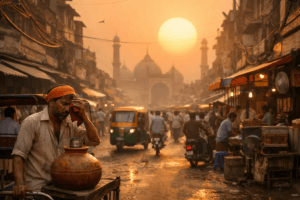
In the narrow lanes of Old Delhi, this has tangible consequences. Mohammed Salim, a rickshaw puller who plies his trade in the bylanes of Chandni Chowk, wipes his brow with a worn-out gamcha. “Usually, February is our time to breathe easy. The summer rush hasn’t started, and the winter chill is gone. But this year, I’m already drinking three times the amount of water I normally do,” he says, gesturing to an earthen pot (surahi) outside a shop. “The ground is hot. By 11 in the morning, the heat coming off the road is like a furnace. I worry what will happen in June.”
Salim’s worry is a microcosm of a larger, systemic issue. The concept of a “spring” or a distinct “cold weather season” is blurring. The traditional Indian calendar of Ritu (seasons) is being redrawn by the relentless force of a warming planet. What we are witnessing in February 2026 isn’t just an early summer; it’s the collapse of seasonal transitions.
The Science Behind the Sweat: Why is This Happening?
While the layman blames it on “climate change,” the immediate meteorological causes are a complex interplay of local and global factors.
- The Missing Western Disturbances:February is typically the month when the Western Himalayas receive a fair share of rain and snow due to Western Disturbances—storm systems originating in the Mediterranean. These systems not only nourish the mountains but also drag cold air southwards, keeping the northern plains cool. This year, these disturbances have been feeble and infrequent. Without the cloud cover and subsequent cold air advection, the land has heated up rapidly under the intense February sun.
- The Anti-Cyclonic Influence:A persistent anti-cyclone (a high-pressure system) has been parked over parts of northwest and central India. In an anti-cyclone, air sinks and compresses, warming up adiabatically. This acts like a giant atmospheric lid, preventing the formation of rain-bearing clouds and allowing solar radiation to bake the surface uninterrupted.
- The Urban Heat Island (UHI) Effect:In metropolises like Delhi, the problem is amplified. Concrete, asphalt, and glass absorb heat during the day and release it slowly at night. This is why the minimum temperatures are soaring. The city itself has become a heat battery, charging up during the day and radiating that heat through the night. Parks and green spaces are shrinking, replaced by high-rise apartments and parking lots, leaving no room for the earth to cool down.
Will 2026 Be Hotter Than 2025? A Loaded Question
The headline-grabbing question of whether 2026 will surpass 2025’s heat is not just a matter of statistical curiosity; it is a question about the trajectory of our existence.
2025 was declared the hottest year on record, a dubious accolade that shattered previous highs. The primary driver was the potent El Niño event that peaked in late 2023 and early 2024, which typically takes a few months to transfer its heat from the Pacific Ocean into the global atmosphere, making the subsequent year the hottest.
However, 2026 began with the Pacific in a La Niña phase, which is supposed to have a cooling effect on global temperatures. Yet, here we are in February, experiencing record-breaking warmth. This underscores a terrifying reality: the underlying global warming trend driven by greenhouse gas emissions is now so powerful that it is overwhelming natural cooling cycles like La Niña.
A ‘New Normal’ of Extremes: Meteorologists are increasingly cautious about betting against the heat. “The question isn’t whether a specific year will be hotter than the last,” explains Dr. Anjali Sharma, a climate scientist based in Pune (a fictional expert for illustrative purposes). “The question is whether we are prepared for a new regime where ‘normal’ is constantly being redefined. Even if 2026 doesn’t set a new global record, it will likely be characterised by extreme swings. A hot February doesn’t guarantee a record-breaking May, but it suggests the baseline is higher. The spring soil moisture deficit will be greater, which can feed back into the system, intensifying the summer heat.”
Essentially, a hotter February means the ground is already dry and parched. Instead of the sun’s energy being used to evaporate moisture from the soil (a cooling process), it goes directly into heating the land and air. This creates a feedback loop: hot ground leads to hotter air, which dries out the soil further, leading to even hotter air.
The Human Impact: Beyond the Thermometer
While scientists debate climate models, the impact is being felt in the most human of ways. In the agricultural hinterlands of Punjab and Haryana, the early heat is a source of deep anxiety. The wheat crop, still in its vegetative stage, requires cool nights for proper grain filling. Continuous high temperatures can lead to “terminal heat stress,” shrivelling the grains and reducing yield.
“In my father’s time, we would start preparing for the wheat harvest in April,” says Gurpreet Singh, a farmer from Karnal. “Now, we watch the forecast in February with the same anxiety. If this heat persists, the crop will mature too fast. The grains will be smaller. It directly affects our income.”
In the cities, the impact is on public health, energy grids, and equity. The demand for electricity has surged as offices and homes switch on air conditioners prematurely. This strains the power grid, leading to outages in low-income neighbourhoods. For the millions living in slums or cramped, poorly ventilated housing, there is no escape. They sit outside their homes in the evenings, fanning themselves, waiting for a cool breeze that never comes.
Public health experts are concerned about the spread of vector-borne diseases. Warmer temperatures can accelerate the breeding cycle of mosquitoes, potentially leading to an earlier and more severe outbreak of dengue and malaria.
Looking Ahead: Adapting to a Premature Summer
The IMD’s forecast for a gradual rise in temperatures through the rest of February is not just a weather update; it is a warning siren. It signals that the window for “safe” outdoor labour is shrinking. It signals that water reservoirs will need to be managed more carefully. It signals that city planners must prioritize green infrastructure over concrete jungles.
As we move through 2026, the lessons from this February are clear. The fight against rising temperatures is no longer a future problem to be mitigated; it is a present crisis to be managed. Whether 2026 officially beats 2025’s record is almost secondary. The real story, unfolding on the streets of Delhi and the farms of Punjab, is that the seasons we grew up with are vanishing, replaced by a new, more volatile climate where February can feel like May, and the only certainty is uncertainty.
For now, as the sun sets over the capital, painting the haze-filled sky a shade of orange, the people of India are left with a simple, unsettling truth: the heat is here, and it has arrived far too early. The summer of 2026 has already begun.
You must be logged in to post a comment.