
The Great Ice Cream Unlock: Why Kwality Wall’s Shares Melted on Debut and What Lies Ahead
The demerged ice cream entity Kwality Wall’s made a disappointing stock market debut on February 16, 2026, listing at a 25.87% discount and closing 27.36% lower than its indicative price, primarily due to a parent company open offer at Rs 21.33 per share that acted as a price ceiling and triggered selling pressure from investors viewing the shares as a demerger freebie. While the weak listing reflected concerns over valuation, forced selling, and the challenges of a pure-play ice cream business outside HUL’s umbrella, the long-term outlook hinges on the company’s ability to leverage its strong brand portfolio (Kwality Wall’s, Cornetto, Magnum) and operational agility to capitalize on India’s growing consumption, potentially making the current dip a value entry point despite the rocky start.
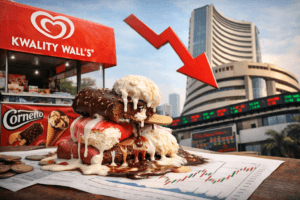
The Great Ice Cream Unlock: Why Kwality Wall’s Shares Melted on Debut and What Lies Ahead
The demerger of Kwality Wall’s from Hindustan Unilever (HUL) was one of the most anticipated corporate actions in recent Indian market history. But when the newly independent ice cream giant finally rang the bell on February 16, 2026, the celebration was muted—overshadowed by a frigid reception from Dalal Street.
The shares of Kwality Wall’s (India) listed at a staggering 25.87% discount on the National Stock Exchange, closing the day even lower at Rs 29.20—a 27.36% fall from its indicative price. For the millions of HUL shareholders who received one share of Kwality Wall’s for every HUL share they owned, the debut felt less like a sweet bonus and more like a bitter surprise.
But was this lukewarm listing a sign of underlying issues, or does it represent a classic case of short-term market myopia creating a long-term opportunity? To understand the deep-freeze on day one, we must look beyond the ticker tape and into the complex mechanics of the demerger, the strategic calculus of the new owners, and the unique challenges of the ice cream business in India.
The Demerger: A Strategic Unraveling
To understand the present, we must revisit the past. In November 2024, FMCG behemoth HUL made a monumental decision to hive off its ice cream business. For decades, brands like Kwality Wall’s, Cornetto, and Magnum were integral parts of HUL’s vast portfolio. However, the logic for the split was rooted in the fundamental principle of business management: focus.
HUL is a machine of efficiency, operating in categories with massive scale—soaps, detergents, shampoos, and packaged foods. These are typically “stock and sell” models with long shelf lives, predictable supply chains, and high distribution density. Ice cream, by contrast, is a beast of a different nature.
The Ice Cream Conundrum:
- The Cold Chain: Ice cream requires a parallel, investment-heavy supply chain. It necessitates cold storages, refrigerated trucks (reefers), and deep freezers at every retail touchpoint. This “cold chain” is exponentially more expensive and complex to manage than FMCG’s standard distribution.
- Seasonality: In India, ice cream is still a highly seasonal product, with the bulk of sales concentrated in the summer months. This creates cash flow lumpiness and requires dynamic resource allocation that doesn’t align with the steady, year-round cadence of detergent or soap sales.
- Distinct Retail Dynamics: Ice cream is often an impulse buy. It requires visibility in freezers at kirana stores, pan shops, and tourist spots—a different relationship with the retailer compared to stacking a shelf with shampoo sachets.
By demerging the unit, HUL allowed itself to streamline its operations and improve margins, while simultaneously giving the ice cream business—which contributed roughly Rs 1,800 crore (3% of HUL’s turnover)—the freedom to chart its own course, raise its own capital, and aggressively pursue growth in a specialized market.
The Listing Day Fiasco: Reading the Market’s Mind
When the stock opened at Rs 29.80 against an indicative price of Rs 40.20, the market effectively shaved off over a quarter of the company’s value. By the close, the market capitalization settled around Rs 6,800 crore, a far cry from the Rs 9,500–11,900 crore valuation range analysts at ICICI Securities had projected.
So, what went wrong? Why did the “value unlock” feel like a value lock-in?
- The Magnum Overhang (Pun Intended):The most immediate catalyst for the price drop was the announcement from The Magnum Ice Cream Company—the India parent entity—regarding an open offer to acquire a 26% stake at Rs 21.33 per share. This price was a staggering 28% discount to the already discounted opening price. Open offers are typically designed to provide an exit opportunity to minority shareholders at a premium. Here, the parent signaled that it valued the company at a much lower price than the market had anticipated. This created a massive “price anchor” in the minds of investors. If the parent itself isn’t willing to pay more than Rs 21.33, why should a retail investor hold at Rs 29? The open offer acted as a ceiling, not a floor.
- The Pressure of Forced Selling (The Dummy Symbol Hangover):The demerger process led to a technical quirk. When the stock was added to the Nifty 50 index on December 5, 2024, it was done using a dummy symbol at a zero price to facilitate index adjustments. While index funds eventually had to buy the stock to reflect its weightage, many active investors and speculators who were holding HUL purely for the demerger play had no interest in holding a pure-play ice cream company. The moment the shares hit their demat accounts, a wave of selling pressure emerged from those who viewed it as a “freebie” to be dumped for cash. This supply-demand mismatch on the very first day exacerbated the price decline.
- Valuation Reality Check:The “indicative price” of Rs 40.20 was derived from the HUL share price adjustment on the ex-date (December 5, 2024), when HUL shares fell by roughly that amount. However, the broader market sentiment and the macroeconomic environment have shifted since December. Furthermore, a pure-play ice cream company in India is a rarity. Valuing it is difficult. Unlike HUL, which offers stability through diversification, Kwality Wall’s is now exposed to the vagaries of the monsoon, the intensity of summer, and the volatility of milk and sugar prices. Investors likely demanded a “pure-play discount” for this heightened risk profile, re-pricing the stock closer to the parent’s open offer than the analyst’s bullish projections.
The Road Ahead: A Battle of Taste and Logistics
Despite the rocky start, the narrative for Kwality Wall’s is far from over. As a standalone entity, it has advantages it never had as a subsidiary.
- Strategic Agility:Under HUL, the ice cream division had to compete for marketing budgets and management mindshare with giants like Lifebuoy and Dove. Now, as an independent entity, the entire focus of the C-suite is on freezing the competition. We can expect more aggressive marketing campaigns, faster launches of hyper-local flavors, and targeted distribution drives.
- Portfolio Power:Kwality Wall’s isn’t just a single brand; it’s a portfolio of powerhouses.
- Kwality Wall’s is the mass-market staple, the treat for the common man.
- Cornetto dominates the indulgence cone category, appealing to youth and Gen Z.
- Magnum sits at the premium end, competing against artisanal and international gelato brands. This tiered portfolio allows the company to capture value across the entire socio-economic spectrum. The challenge will be to expand the consumption occasions for Magnum to justify its premium pricing, while using Kwality Wall’s to penetrate deeper into rural India.
- The “Open Offer” Mystery:The open offer by The Magnum Ice Cream Company at Rs 21.33 is puzzling to many. Is it a signal of conservatism, or a shrewd move to consolidate ownership cheaply? It is plausible that the parent company sees immense value in the long term but is playing hardball to acquire a larger stake at a bargain price before infusing fresh capital for expansion. If the stock languishes around the Rs 28-30 mark, the open offer is unlikely to see massive subscription (since it is lower), but it successfully reset investor expectations downward. Once the open offer period closes, the absence of this “price cap” could allow the stock to find its true equilibrium.
What This Means for the Indian Investor
For the average HUL shareholder who received these shares, the debut was a lesson in the unpredictability of corporate actions. A “bonus” is only a bonus if the market values it as such.
For those who still hold Kwality Wall’s shares, the decision tree looks like this:
- The Value Trap vs. Value Play: If you believe the Indian ice cream market is saturated, and that the company cannot handle the logistics without HUL’s muscle, the current price might still be too high. The Magnum offer suggests the “insiders” see a price closer to Rs 21.
- The Long-Term Freeze: If you believe in the structural growth story of India—rising disposable incomes, hotter summers due to climate change, and increasing westernization of diets—then Kwality Wall’s is a direct play on that theme. It is a pure-play consumer staple with pricing power and strong brand equity. The current dip could be a generational entry point.
The Human Element: More Than Just Numbers
Beyond the stock price, the demerger of Kwality Wall’s is a story about the changing palate of India. It’s about the kirana store owner in a Tier-2 city deciding how much freezer space to allocate to Cornetto versus a local brand. It’s about the logistics entrepreneur who will now bid for Kwality Wall’s transportation contract, knowing the volumes justify investment in better cold-chain tech. It’s about the consumer who now sees a standalone brand advertising with a budget and creativity that was previously capped by HUL’s corporate priorities.
The listing day discount of 27% is a harsh reality, but it is not the final verdict. The ice cream business is one of the few FMCG sectors where impulse, experience, and emotion drive purchase as much as price and need. As Kwality Wall‘s navigates its first summer as an independent entity, its performance in the real world—getting ice cream into the hands of a thirsty nation—will ultimately matter far more than its performance on the stock screen.
The shares have melted on day one, but the real test is whether the company can stop the drip and start growing in the sun.
You must be logged in to post a comment.