
The Great Himalayan Thaw: How Himachal Pradesh is Losing Its Winter
This feature article explores the alarming disappearance of winter in Himachal Pradesh, India, where a combination of record-high March temperatures, a decades-long decline in snowfall, and persistent dry weather is signaling a profound climate shift. Through the lived experiences of longtime residents and corroborating meteorological data, the piece illustrates how the lack of snow is not just an aesthetic loss but an economic threat, jeopardizing the state’s crucial agriculture and horticulture by disrupting crop cycles, depleting natural water reservoirs, and increasing pest pressure. The immediate cause is a meteorological setup involving anticyclonic activity and warm air advection blocking traditional winter storms, but experts warn this is a harbinger of a broader, long-term transformation for the Himalayan region, with potentially severe consequences for downstream water security and livelihoods across northern India.
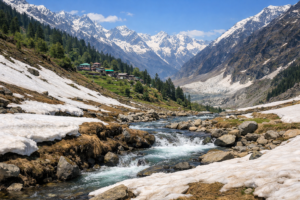
The Great Himalayan Thaw: How Himachal Pradesh is Losing Its Winter
For 79-year-old Deshbandhu Sood, the changing seasons in Shimla are not a matter of data or scientific reports; they are written in the very fabric of his memory. He remembers a time when the British legacy of choosing this hill station as their summer capital made perfect sense. The air was perpetually cool, and winters were a defining, months-long affair. “Snow would arrive with a dependable certainty,” he recalls, his voice carrying the weight of seven decades of observation. “We’d wear heavy woollens well into April. Now, by the second week of March, people are in light shirts. The cold just… leaves.”
Mr. Sood’s lived experience is a microcosm of a dramatic shift sweeping across the Himalayan state of Himachal Pradesh. The winter of 2026 is shaping up to be another chapter in a worrying new story: the slow but steady disappearance of the region’s defining season. What was once a landscape buried under snow for months, a place where life slowed to a halt in the face of nature’s power, is now facing bare mountains, rising temperatures, and a creeping sense of climatic uncertainty.
A Winter Without a Whitewash
The evidence is stark, visible not just to the elderly who hold long memories, but to anyone with eyes on the ground. Theog, a town once so reliably snowy in February and March that it was a local byword for a classic Himalayan winter, now sits dry and brown. Its slopes, which should be a playground for late-season snow, are exposed to the sun. Sudesh Kumari, 70, another lifelong Shimla resident, paints a picture of a winter that has lost its bite. “It used to be harsh,” she says, describing an era when freezing water, week-long road closures due to snow, and frequent power cuts were the norm. “Many people would escape to the plains just to get away from the severity of it. This year, it has snowed only once. The weather we are having right now in March feels like what we used to experience in May or June, thirty years ago.”
This isn’t just anecdotal wistfulness. The numbers from the Meteorological Centre in Shimla are jarring. Between March 1 and 12, 2026, maximum temperatures hit their highest levels in over a decade. The typically cool, post-winter month of March, where the mercury rarely climbs past 20 degrees Celsius (°C), saw it consistently soar between 20°C and 25°C. By March 1, the maximum temperature had already hit 18.5°C, climbing rapidly in the days that followed. The India Meteorological Department (IMD) was forced to issue a heatwave warning for the region—a phrase almost unheard of for the hills in early March.
This year’s deficit is not an anomaly but a data point in a relentless downward trend. Since 2010, January has recorded below-normal rainfall in 11 separate years. The winter rainfall deficit has swung violently, from 46% below normal in 2010 to a devastating 71% below in 2018. The pattern has continued into the 2020s with deficits of 70% (2021), 38% (2023), 42% (2024), and 26% (2025). By the end of January 2026, the state was already 11% in the red. Each dry winter is a hammer blow to the region’s hydrological cycle, its agriculture, and its very identity.
The Science of a Dry Sky
So, why is the sky refusing to yield its winter bounty? While climate change is the overarching culprit, the immediate meteorological mechanics are a specific and punishing combination. Shobhit Katiyar, chief scientist at the Shimla meteorological centre, explains that a persistent “anticyclonic activity” has established itself over northwest India. In simple terms, an anticyclone is a large-scale circulation of winds around a central region of high atmospheric pressure. This system pushes air down, and as it descends, it warms up. This warming inhibits the formation of clouds and effectively acts as a lid, preventing the moisture-laden systems needed for rain and snow from developing.
Simultaneously, a stream of warm air has been flowing into the region from the west, particularly from arid zones in neighbouring Pakistan. This “warm air advection,” as it’s known, has been sweeping across the Himalayas, further elevating temperatures and ensuring that any precipitation that does manage to form falls as rain, even at altitudes that historically would have received snow.
Sandeep Sharma, a meteorologist at the centre, puts the current anomaly into perspective: temperatures in Shimla are hovering around 7°C above normal, and in higher altitude areas, the spike is a staggering 5°C to 7°C above what is expected. “Such spikes are not entirely unprecedented—we saw something similar in 2021—but the persistence and the timing are concerning,” he notes. While a late western disturbance is forecast, offering a sliver of hope for some precipitation, the long-term forecast is grim. Sharma warns that summer temperatures are projected to be significantly above normal, potentially by as much as 45% in some areas, setting the stage for water scarcity and extreme heat in a region utterly unprepared for it.
The Brown Hills and Broken Livelihoods
For the people of Himachal, this isn’t an abstract climate debate. It is an economic and existential crisis unfolding in their orchards and fields. The winter dry spell is a direct assault on the state’s two economic pillars: agriculture and horticulture.
Dr. Ravindra Singh Jasrotia, director of the state’s agriculture department, confirms that crop losses have already crossed an estimated Rs 11 crore this year. The damage is widespread, affecting everything from winter wheat to vegetables. The lack of snow cover, which acts as an insulating blanket for the soil, exposes crops to wider temperature fluctuations. Moisture stress is setting in earlier in the year, stunting growth and reducing yields.
But the deepest worry is reserved for the state’s famed orchards. Himachal’s apples, cherries, plums, and pears are a multi-crore industry and a source of pride. Horticulture experts explain that while the full extent of the damage won’t be known until harvest, the current conditions are a perfect storm of stress for fruit trees.
- Chilling Hours: Deciduous fruit trees like apples have a crucial biological requirement: they need a certain number of “chilling hours” (temperatures between 0°C and 7°C) during their winter dormancy to bud properly and flower uniformly in spring. Warmer winters mean these chilling requirements are not being met. The result can be erratic, staggered flowering, poor fruit set, and misshapen fruit.
- Water Stress: The snowpack in the higher reaches serves as a natural water reservoir. As it melts slowly in the spring and summer, it feeds the streams and provides critical irrigation for orchards. With little to no snow, this “water bank” is empty. Farmers will be forced to rely on groundwater and overburdened streams, leading to conflicts and shortages just when the trees need it most.
- Pest Pressure: Warmer, drier conditions create a favorable environment for pests and diseases that were previously kept in check by the harsh cold. This could lead to increased use of pesticides, raising costs and impacting the organic reputation of some Himalayan produce.
For a farmer tending a century-old apple orchard in the Kullu Valley, the implications are personal. The predictable rhythm of the seasons that his grandfather relied on is gone. He is now faced with difficult choices: invest in costly irrigation, switch to different, less profitable crops, or watch his livelihood wither.
A Harbinger of a Broader Shift
Sushil Kumar Singla, secretary of the state’s Department of Environment and Climate Change, acknowledges the gravity of the situation. “The government is taking this climate trend with the utmost seriousness,” he states, outlining efforts to increase green cover and promote sustainable development to mitigate carbon emissions. But mitigation is a long game, and the adaptation challenge is immediate and immense.
The drying and warming of Himachal Pradesh is a bellwether for the entire Himalayan ecosystem. These mountains are often called the “Third Pole” because they hold the largest store of freshwater outside the polar ice caps. The snow and glaciers of the Himalayas feed major river systems like the Indus, Ganga, and Yamuna, upon which hundreds of millions of people depend for drinking water, irrigation, and power.
A decline in winter snow in one part of the range is a warning signal for the entire system. It points to a disruption in the Western Disturbances—the very weather systems that bring life-giving moisture to the region during the winter months. If this pattern becomes the new normal, the consequences will cascade far beyond the borders of Himachal Pradesh. It means reduced river flows in the summer, threatening agriculture in the fertile plains of North India. It means hydroelectric power projects, the backbone of the region’s clean energy push, will face uncertain and diminished water supplies. It means a potential water security crisis for a subcontinent.
Back in Shimla, the conversations in the bazaars and on the ridge are no longer just about the price of vegetables or the latest Bollywood film. They are about the strange warmth of the sun, the dust on the deodar trees, and the worry for the future. The winter that once defined life in these hills—a time of hardship, but also of beauty, rest, and renewal—is slipping away. And with its passing, it is taking with it a sense of permanence, leaving behind a landscape and a people facing a future that is hotter, drier, and profoundly uncertain. The “Queen of the Hills” is losing her crown of snow, and the entire kingdom is feeling the heat.
You must be logged in to post a comment.