
The Great Decoupling: How AI and Austerity Are Redefining India’s IT Hiring Engine
India’s top five IT companies, in a stark reversal from their traditional growth model, added a mere 17 net employees in the first nine months of FY25-26—a dramatic drop from nearly 18,000 the previous year—signaling a profound, structural shift where revenue growth is permanently decoupling from headcount expansion. This hiring freeze stems from a convergence of AI-driven automation reducing routine tasks, intense client pressure on costs and productivity, and a strategic internal rebalancing away from the legacy “pyramid model.” The industry is now prioritizing efficiency metrics like revenue per employee and digital labor over mass recruitment, moving toward a “low-hire, low-fire” reality that demands highly specialized skills and permanently alters career pathways for graduates and existing professionals alike.
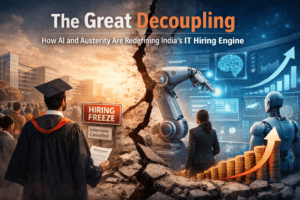
The Great Decoupling: How AI and Austerity Are Redefining India’s IT Hiring Engine
For decades, the narrative of India’s IT sector was written in employment numbers. The annual campus hiring sprees, the lakhs of offers, the predictable quarter-on-quarter headcount growth—these were the visible metrics of a booming industry. That script has been decisively torn up. The stark reality of just 17 net hires across India’s top five IT giants in the first three quarters of FY 2025-26 isn’t merely a slowdown; it is the loudest signal yet of a fundamental, irreversible structural shift. Compared to the 17,764 net additions a year prior, this figure represents more than caution—it heralds the great decoupling of revenue from headcount, powered by artificial intelligence and a new era of fiscal discipline.
Beyond the Cyclical Pause: A Structural Earthquake
To dismiss this as a cyclical downturn, a repeat of past recessions, is to misunderstand the moment. As Phil Fersht of HfS Research notes, this is a “structural shift rather than a cyclical pause.” The industry’s historic “pyramid model”—where growth was fuelled by hiring vast numbers of fresh graduates at the base, overseen by smaller layers of mid and senior-level executives—is being dismantled. Three converging forces are acting as the wrecking ball:
- The AI-Driven Productivity Imperative: AI and automation are no longer futuristic concepts; they are active participants in delivery metrics. While large-scale AI revenue streams are still building, the efficiency gains are already tangible. Tasks that once required teams of junior engineers—code generation, testing, routine maintenance, data entry—are being augmented or automated. This is creating a “low-hire, low-fire” environment, as Constellation Research’s Ray Wang observes, where companies maintain core talent but drastically reduce incremental hiring. The need for “digital labour” is being met not by human hires, but by algorithms.
- The Client Mindset: “Sweating the Assets”: Post-pandemic exuberance has given way to intense scrutiny of discretionary spending. Clients are no longer signing large blank-check transformation deals. Instead, they are demanding that their existing IT “assets”—both software and the teams managing them—work harder, smarter, and cheaper. This translates to relentless pressure on pricing, higher productivity commitments in contracts, and a preference for outcome-based models over time-and-materials. IT firms, in response, must deliver more value per employee, making pure headcount expansion a liability, not an asset.
- The Internal Great Rebalancing: The staggering reduction of 25,816 employees at TCS is a case study in this internal reset. This isn’t just about cost-cutting; it’s a deliberate re-architecting of the workforce. Mid-level and senior roles, often bloated through years of linear growth, are being consolidated. The focus is sharply pivoting to utilization rates and revenue per employee. Firms are asking: do we have the right skills for an AI-first future, or just a large number of legacy skills? The silence from TCS on its customary announcement of 40,000 campus hires is a deafening answer.
The Diverging Tales Within the Numbers
Averages can deceive. A closer look at the quarterly data reveals a nuanced picture:
- The Consolidators (TCS): TCS’s sharp reductions point to a aggressive, front-footed strategy to reshape its pyramid. By taking the pain of restructuring now, it aims to emerge leaner, with a higher mix of billable, future-ready talent.
- The Selective Growers (Infosys, Wipro): Their positive net additions suggest continued growth in specific niches—cloud, cybersecurity, ER&D—but even this hiring is highly targeted. It is skill-specific, likely filling gaps that automation cannot yet address, rather than bulk onboarding.
- The Flat Liners: The fact that acquisitions are propping up headcounts at some firms reveals a grim truth: organic growth is anemic. Without these purchases, net numbers would be flat or negative, underscoring that the market is not creating enough natural demand for new human resources.
The Human Impact and the Campus Conundrum
The most immediate fallout is in India’s engineering colleges and B-Schools. For a generation, a placement in a top IT firm was a secure career launchpad. That safety net is fraying. The message to students is brutal: volume-based hiring is over. The new paradigm values specificity over general aptitude. A foundation in computer science is no longer enough; proficiency in AI/ML tools, cloud architecture, data engineering, or cybersecurity is the new entry ticket.
This creates a massive skilling challenge, not just for graduates but for the millions already employed. The industry is moving from a “just-in-time hiring” model to a “just-in-time skilling” one, where continuous upskilling is the only job security.
The New Metrics of Success: $100,000 Per Employee and Digital Labour
Ray Wang’s insight defines the future benchmark: leading firms will be those exceeding $100,000 in revenue per employee with about 25% digital labour. This metric crystalizes the new reality. Success is no longer measured by how many people you employ, but by how much value each unit of human and digital labour generates.
This has profound implications:
- Margin Pressure & New Models: Competitive intensity will squeeze margins on traditional large deals. Winners will differentiate through IP-led, AI-embedded offerings and platform-based services that scale without linear headcount growth.
- The GCC Wildcard: While Global Capability Centres (GCCs) continue to hire, they too are becoming more selective. They are in-house centers of excellence, competing for the same niche talent pool, further driving specialization and wage inflation for in-demand skills.
- The End of Linear Growth Celebration: The market is now cheering single-digit, efficient growth over double-digit, headcount-heavy growth. Investor sentiment has aligned with the new efficiency doctrine.
Conclusion: Navigating the Permashift
The Indian IT industry is not dying; it is maturing and transforming under immense pressure. The age of arbitrage—throwing more people at a problem—is closing. The age of intelligence arbitrage—solving complex problems with smarter technology and highly specialized talent—is here.
For companies, the path forward involves painful reskilling, portfolio transformation, and a cultural shift from being “people integrators” to “value integrators.” For professionals, it demands lifelong learning and niche expertise. For the economy, it means the end of IT as a mass employment sponge, potentially pushing the challenge of job creation onto other sectors.
The headline of 17 hires is not an anomaly; it is the new baseline. The decoupling is permanent. The industry that built its fortune on the power of human capital must now learn to thrive where capital is increasingly intelligent, and human talent is relentlessly focused. The throttle hasn’t just been eased—it’s been connected to a completely new engine.
You must be logged in to post a comment.