
The Great Consumer Power Shift: Why Gen Z Isn’t Just a Demographic, It’s a Business Strategy
The modern consumer landscape has been fundamentally reshaped by Gen Z’s shift from active “searching” to passive “scrolling,” which has effectively rewired the rules of brand building by replacing traditional distribution and celebrity endorsements with “algorithm availability” and sideways trust in peer creators; this generational behavior has handed new, agile brands a winning blueprint—not by directly confronting legacy giants, but by first capturing Gen Z through authentic, ingredient-first products discovered in the feed, thereby using this cohort as both a beachhead and a shield to eventually command the broader market, exposing how incumbent brands slowly eroded their own value over decades while consumers had no alternatives.
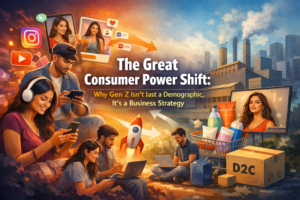
The Great Consumer Power Shift: Why Gen Z Isn’t Just a Demographic, It’s a Business Strategy
For decades, the path to building a consumer brand was a well-paved highway. You secured a strong manufacturing partner, blanketed the market with distribution, and hired a Bollywood celebrity to sell your shampoo, your tea, or your soap. The message was simple, the reach was wide, and the consumer had little choice but to listen. The giants of Hindustan Unilever, P&G, and Colgate-Palmolive didn’t just play the game; they owned the board.
Then, something strange happened. The highway became a ghost town. The traffic, it seems, has moved to a series of winding, hyper-specific dirt paths, and the cartographers are no longer the corporate CEOs in Mumbai or Gurugram high-rises. They are 25-year-old founders in Bangalore, college students on Instagram, and a generation that has fundamentally rewritten the rules of brand building.
As the recent Two by Two newsletter from The Ken aptly questions: Did Gen Z hand consumer brands a blueprint to beat the giants? The answer is more profound than a simple yes or no. Gen Z didn’t just hand over a blueprint; they became the architects, the construction workers, and the first residents of a new kind of brand universe. To understand this shift is to understand the future of consumerism itself.
From the Search Bar to the Scroll: The Death of Intent
The most seismic shift in consumer behavior can be summed up in a single, devastating line from the newsletter: “Gen Z certainly don’t search as much as scroll.”
For the legacy giants, this is an extinction-level event. Their entire operational model was built on capturing “intent.” A consumer runs out of toothpaste, goes to the store (or types it into a search bar), and is met with a wall of familiar options. The battle was won or lost on that final shelf. It was a game of last-mile visibility and top-of-mind recall, hammered home by years of television commercials.
Gen Z doesn’t operate that way. They don’t wake up with a problem and a pre-determined list of solutions. They wake up and scroll. They scroll through Instagram Reels, YouTube Shorts, and TikTok. In this endless feed, they don’t find products; they find identities, communities, and solutions to problems they didn’t even know they had.
A 20-year-old doesn’t search for “anti-dandruff shampoo.” They scroll past a video of someone with their exact hair type showing off their “wash day routine” with a brand called Fix My Curls. The intent isn’t the starting point; it’s the conclusion. The brand finds them before they even know they need to be looking.
Adarsh Menon, Partner at Fireside Ventures, calls this “losing the algorithm.” For a century, distribution excellence meant dominating the physical shelf. Today, distribution excellence means dominating the feed. The giants built empires on retail supply chains. The new brands are building them on code and content. If you are not in the scroll, you are invisible. And for a generation that lives in the scroll, invisibility is indistinguishable from non-existence.
The Sideward Shift: Why Celebrities Lost Their Magic
There is a poignant moment in the newsletter where the author recalls being 11 years old and buying Boost because MS Dhoni told her to. It sounds quaint now, almost unbelievable.
This isn’t just youthful rebellion; it’s a structural change in how trust is built. Adarsh Menon articulates this perfectly by describing a “sideward shift” in role models. Previous generations looked upward—to film stars, cricketers, and industry titans. Their endorsement was a signal of quality and aspiration. If a big star used it, it must be good enough for you.
Gen Z looks sideways. Their role models are people who look, speak, and live like them. They are micro-influencers with 10,000 followers, a distinct aesthetic, and a perceived authenticity that a million-dollar ad campaign can’t buy. They trust a stranger on Reddit reviewing a niche skincare product more than they trust a billboard of a Bollywood actress with flawless, airbrushed skin.
Why? Because the sideways peer feels like they have nothing to lose. They are not being paid a crores to say it; they are sharing it because it worked for them. This peer-to-peer validation loop is the new marketing engine. It’s why a brand like Bare Anatomy can launch and thrive without a single celebrity face. Their “celebrities” are their customers, whose before-and-after photos and honest reviews populate their Instagram page.
The Myth of the Rebellious Youth
However, to chalk all of this up to generational whim would be a mistake. Ajai Thandi, co-founder of Sleepy Owl Coffee, throws a bucket of cold water on that simplistic notion, suggesting that the difference between Gen Z and millennials is mostly aesthetic—”they just dress differently.”
This pushback is crucial. While Gen Z is the accelerant, the fire was lit long ago by a fundamental breakdown in the value proposition of legacy brands.
Thandi points to a more insidious culprit: the slow erosion of product integrity in the pursuit of margin. He asks us to consider the founder of a legacy brand. Was the original recipe built around a primary ingredient, a specific taste, or a genuine solution? Or did it happen ten, twenty, thirty years later, when a corporate CEO, far removed from the original kitchen table where the product was born, decided to replace sugar with corn syrup to save a few rupees?
The product changed, slowly, imperceptibly, over decades. And for years, no one noticed because there were no alternatives. The consumer was a captive audience.
Gen Z isn’t rejecting their parents’ brands out of spite; they are rejecting them because they have the tools to see that the emperor has no clothes. They have ingredient lists at their fingertips. They have YouTube channels dedicated to comparing formulations. They have the collective memory of the internet to know what a product used to taste like.
The new brands aren’t just winning because they have better marketing. They are winning because they are offering a return to the original promise: a product made for a specific need, with transparent ingredients, and by people who seem to genuinely care about it. They are selling what the giants stopped selling years ago: authenticity.
The Tip of the Spear and the Shield
The strategy for these new-age brands is remarkably consistent and ruthlessly clever. They don’t try to win a war on two fronts. They don’t launch with a massive television campaign to take on the giants directly. Instead, they follow the advice encapsulated in the newsletter: “You hook them early, you build the habit, and then you can use them to crack the rest of the market wide open.”
Gen Z is the entry point. They are the early adopters, the vocal critics, and the free marketing army. They are the ones willing to try a new coffee brand from a co-founder they follow on LinkedIn (Sleepy Owl), or a quick-commerce app that promises delivery in 10 minutes (Zepto), or a fashion brand that offers Zara-like styles at a fraction of the cost (Zudio).
Winning Gen Z is not about capturing a demographic; it’s about building a beachhead. They are the “tip of the spear,” as the newsletter puts it, that pierces the market. Their loyalty, their content creation, and their word-of-mouth recommendations become the “shield” that protects the new brand from the inevitable counterattack from the incumbents.
When a legacy giant finally wakes up and tries to copy the strategy—launching a D2C brand, hiring a Gen Z influencer, or reformulating a product—it’s often too late. The new brand is already embedded in the culture. It’s the subject of memes. It’s the brand mentioned in the comments section when someone asks, “What’s a good sulphate-free shampoo?”
The New Corporate Ladder
What does this mean for the future? It means the corporate ladder has been turned on its side. For decades, a young person’s ambition was to climb the ranks of a Tata, an ITC, or an HUL. That was the pinnacle of success. Today, the brightest minds are starting their own D2C brands or joining a Fireside Ventures-backed startup.
They see that the giants are slow, bureaucratic, and terrified of cannibalizing their own cash cows. They see an opportunity not just to compete, but to make the giants irrelevant by building brands from the ground up, with the consumer as a co-creator, not just a target.
The giants are not stupid. They see this coming. They are acquiring successful D2C brands, launching their own digital-first labels, and trying desperately to understand the algorithm. But they are playing a game whose rules were written by a generation that doesn’t trust them.
In the end, the blueprint to beat the giants isn’t a secret marketing hack or a viral TikTok trend. It’s a return to first principles: make a great product for a specific person, be transparent about what’s in it, and talk to them like a human being, not a target audience. Gen Z didn’t invent this blueprint. They just became the first generation with the tools to demand it. And in doing so, they have become the ultimate arbiters of who gets to be a brand and who gets left behind in the scroll.
You must be logged in to post a comment.