
The Great Climate Shift: How Ranchi Lost Its Hill Station Weather to the Urban Heat Island Effect
Ranchi, once celebrated for its hill station-like climate, is experiencing a dramatic shift as February temperatures now reach nearly 30°C, winters shorten, and the cooling influence of its plateau geography diminishes—a transformation experts attribute to the urban heat island effect driven by decades of deforestation, extensive mining, illegal brick kilns, unchecked construction, and the loss of traditional water bodies that once moderated the local climate. The changing weather patterns, including delayed monsoons and declining rainfall, have left the city’s residents mourning the loss of their famous cool winters while pushing Jharkhand’s predominantly rain-dependent farmers into greater vulnerability, with the region now facing the paradox of more intense heat waves and frequent droughts despite its historical identity as a pleasant highland retreat.
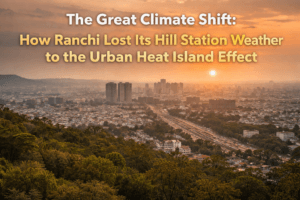
The Great Climate Shift: How Ranchi Lost Its Hill Station Weather to the Urban Heat Island Effect
Once compared to Shimla for its pleasant year-round climate, Jharkhand’s capital now grapples with shrinking winters and summer temperatures that rival the plains. Residents and experts alike are asking: what happened to the Ranchi we once knew?
The winter of 2026 will not be remembered fondly in Ranchi—not because it was harsh, but because it barely arrived at all.
On a recent February morning, Sheela Devi sat on the veranda of her home in Ranchi’s old quarter, fanning herself with the edge of her saree. At 78, she has witnessed seven decades of the city’s transformation, and what she sees now disturbs her deeply.
“In our time, we wouldn’t even hear the word ‘heat’ in Phagun (February-March),” she says, her voice carrying the weight of lived experience. “Now it starts feeling hot in Magh (January-February) itself. People from outside used to visit and say Ranchi feels like Shimla. They’d bring woolen clothes they never needed back home.”
This February, maximum temperatures in the city have already touched 29.5°C—nearly three degrees higher than what older residents remember as normal for this time of year. Night temperatures, which once routinely dropped to 10°C or lower, now hover several degrees warmer. The winter chill that historically lingered until March has retreated, leaving behind a disoriented city and an unsettling question: is this the new normal?
The Vanishing Winter: By the Numbers
According to data from the India Meteorological Department (IMD), between February 10 and 19, 2026, Ranchi’s maximum temperature ranged from 26°C to 29.5°C, with an average around 28°C. Twenty years ago, February afternoons rarely crossed 27°C, and mornings demanded woolen sweaters.
The change becomes starker when viewed through a longer lens. Between 1951 and 2000, Ranchi’s normal rainfall stood at 1091.9 mm. By the 1971-2020 period, that figure had dropped to 1022.9 mm—a decline of nearly 70 mm over five decades. The monsoon, which historically arrived between June 1 and June 10, now typically reaches the city between June 10 and 15.
These aren’t abstract statistics for people like Subhangi Singh, who lives in McCluskieganj, the picturesque Anglo-Indian settlement in Ranchi district often called “Mini London.” She recalls a film shoot there in February 2016 when actors shivered in the cold. “This year, we’ve had warm days since early February. The change over just ten years is alarming,” she says.
The Urban Heat Island Effect Comes Home
Professor Nitish Priyadarshi, an environmental scientist at Ranchi University, doesn’t mince words when describing what’s happened to his city. “Ranchi has entered the urban heat island zone,” he states flatly.
The urban heat island effect occurs when cities replace natural land cover with dense concentrations of pavement, buildings, and other surfaces that absorb and retain heat. It’s a phenomenon typically associated with megacities, not medium-sized capitals like Ranchi. But Priyadarshi explains that the city’s post-2000 growth spurt—following Jharkhand’s creation as a separate state in 2000—has created the perfect conditions for localized warming.
“Unplanned population growth, reckless forest clearing, disappearing green cover, pollution, greenhouse gas effects—all these have combined to fundamentally alter Ranchi’s microclimate,” he says.
The data supports his concern. Between 2008 and 2023, India approved forest land diversion of 58,282 hectares for mining alone nationwide. Jharkhand contributed 15,691 hectares to that total—more than a quarter of all forest land lost to mining across the country. A CAG report cited in media investigations suggests illegal mining may have led to tree cutting across 350 square kilometers in the state.
A Plateau Under Pressure
Ranchi sits on the Chotanagpur Plateau, a geological formation that historically moderated temperatures through elevation and forest cover. The plateau’s natural advantages—cooler air, abundant vegetation, numerous water bodies—made it a favored retreat during British rule and earned it comparisons to more famous hill stations.
But plateaus are also ecologically fragile. Their thin soils and dependence on local water cycles make them particularly vulnerable to disturbance. When forests disappear, when ponds are filled for construction, when mining scars the landscape, the entire system begins to unravel.
The traditional water infrastructure of Ranchi—its network of ponds, wells, and tanks—has been particularly hard hit. These water bodies once played a crucial role in the local climate through evaporation, which fed cloud formation and moderated temperatures. As they’ve been replaced by concrete, that natural cooling mechanism has shut down.
“How will evaporation happen when ponds, wells and rivers are disappearing?” Priyadarshi asks. “That evaporation was essential for rainfall and cooling.”
Farmers Feel the Heat First
For Jharkhand’s farmers, climate change isn’t a theoretical future concern—it’s a present reality that determines whether their families eat or go hungry.
The state’s plateau geography has always made agriculture challenging. Only about 20 percent of agricultural land has irrigation access, meaning the vast majority of farmers depend entirely on rainfall. When the monsoon shifts, when rains become erratic, when droughts become frequent, there are no backup systems to fall back on.
Over the past 25 years, Jharkhand has faced drought more than ten times—roughly every other year. According to the Meteorological Department, these repeated droughts are linked to climate change driven by mining, deforestation, and ecological disturbance.
The monsoon’s gradual shift has been documented statistically. From 1961-2010, the arrival date moved from June 1-10 to June 10-15. Normal rainfall declined from 1091.9 mm (1951-2000) to 1022.9 mm (1971-2020). For farmers whose planting schedules, crop choices, and harvest expectations are calibrated to a system that no longer exists, these numbers represent lost livelihoods and mounting debt.
The Mining Question
Jharkhand possesses India’s richest mineral deposits—coal, iron ore, bauxite, mica, limestone—and mining has long been the state’s economic backbone. But the environmental cost of extraction has been staggering.
Between 2008 and 2022-23, India approved diversion of 305,000 hectares of forest land for 17,301 projects. Mining accounted for nearly one-fifth of that total—58,282 hectares. Jharkhand alone contributed 15,691 hectares to that mining footprint.
The impact extends beyond the cleared land itself. Mining operations generate dust that settles on surrounding vegetation, blocking photosynthesis and reducing plant health. They consume enormous quantities of water, lowering water tables. They alter local topography and drainage patterns. And they replace carbon-absorbing forests with bare rock and soil that radiates heat.
The Meteorological Department explicitly identifies large-scale mining as a major driver of Jharkhand’s rapid environmental transformation. When combined with deforestation, illegal brick kilns (which Singh notes have proliferated around McCluskieganj), and vehicular emissions from Ranchi’s growing fleet of cars and motorcycles, the cumulative effect is a climate system pushed beyond its breaking point.
The 2022 Precedent—and 2026’s Warning
February 2026 is reminding many residents of 2022, when Ranchi experienced its hottest February in decades. That year, for the first time in 23 years, the city received no rainfall in April. Temperatures in several Jharkhand districts touched 46°C—the highest ever recorded.
What made 2022 particularly alarming was that it followed a pattern, not an anomaly. Ranchi’s summer maximums, which historically stayed between 38-40°C, had begun regularly touching 42-43°C. Even the plateau areas of Latehar and Gumla, where temperatures once maxed out around 30°C, were now seeing 38°C.
Abhishek Anand, Director of the IMD in Ranchi, offers a nuanced prediction for 2026. “Last year was unusually cold—an exception because of La Niña,” he explains. “Now La Niña is weakening, and El Niño may develop. If it becomes an El Niño year, heat will increase and monsoon distribution will be disturbed. But I don’t think we’ll see a historic heat like 2022.”
The distinction between an exceptional year and a concerning trend matters, but for residents experiencing warm February afternoons, the nuance is cold comfort. They don’t need statistical comparisons to know something fundamental has changed.
Memory as Evidence
What makes Ranchi’s climate story compelling isn’t just the scientific data—it’s the accumulated observations of people who’ve watched their world transform.
Sheela Devi remembers when Magh (January-February) brought hail storms that would drum against tin roofs and leave courtyards white. She remembers when Phagun (February-March) meant pulling out quilts at night, not switching on fans. She remembers when visitors from the plains would marvel at Ranchi’s air—cool, clean, and distinctly un-tropical.
“Now people come and ask why we call it a hill station,” she says with a rueful laugh. “They don’t believe us when we tell them how it used to be.”
This intergenerational memory gap—between what older residents know and younger ones take as normal—represents a kind of cultural loss that doesn’t appear in temperature records. When a city’s identity is bound up with its climate, changing that climate means changing something fundamental about the place itself.
What Lies Ahead
Priyadarshi projects that by 2050, Ranchi’s temperature could rise by 1.5 to 2.5 degrees Celsius. Hot days will increase in frequency, nights will warm further, and summer maximums that once peaked at 40°C may regularly reach 43°C.
“Occasionally Ranchi still experiences pleasant weather because global climate patterns fluctuate,” he notes. “Last year, western disturbances brought good rainfall. But February remaining this warm is a dangerous signal.”
The trajectory isn’t inevitable—but reversing it would require interventions on a scale that seems politically difficult. Protecting remaining forests, restoring water bodies, regulating mining, controlling urban expansion, and reducing emissions all demand coordinated action across multiple government departments and economic sectors.
In McCluskieganj, Subhangi Singh watches the warm afternoons with concern. “The intense cold has begun to decline,” she says. “Ten years ago, actors were shivering during shoots here. Now we wonder if that kind of cold will ever return.”
Her question hangs in the warming February air—not just about weather, but about identity, memory, and what it means when a place loses the very qualities that made it special.
The Real Question
As the article’s original author noted, the question is no longer whether Ranchi’s climate has changed. Residents can feel it in their daily lives, farmers see it in their fields, and scientists measure it in their instruments. The vanishing winter is an established fact, not a future projection.
The real question—the one that remains unanswered as February temperatures climb toward March levels—is whether anything will be done before the Ranchi that once felt like a hill station exists only in photographs and memories.
For Sheela Devi, sitting on her veranda in the unseasonable warmth, that question has a personal dimension. She has watched her city change over 70 years, from something people compared to Shimla to what she now calls “an urban heat wave zone.” She has seen forests replaced by buildings, ponds filled for construction, and winters shrink from four months to barely two.
“I won’t be here much longer to see what happens next,” she says quietly. “But my grandchildren will. What kind of Ranchi will they know?”
It’s a question that 29.5°C in February doesn’t answer—but urgently demands we ask.
You must be logged in to post a comment.