
The Global Workforce Shift: How Indian Workers Are Finding New Frontiers as Western Doors Close
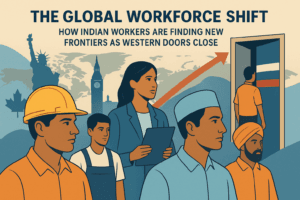
The Global Workforce Shift: How Indian Workers Are Finding New Frontiers as Western Doors Close
Amid tightening immigration policies in traditional Western destinations, a significant transformation is reshaping global labor mobility. While countries like the United States, Canada, and the United Kingdom implement more restrictive visa regimes, a demographic and economic mismatch is creating unprecedented opportunities elsewhere. Nations facing severe workforce shortages—most notably Russia and Japan—are increasingly turning to India’s vast pool of skilled and semi-skilled workers. This shift is not merely a change in destination but represents a fundamental restructuring of global migration pathways, powered by bilateral agreements and forward-looking national policies like India’s proposed Overseas Mobility Bill.
The Driving Forces: A World of Shortages and Surpluses
The global labor market is defined by a stark contrast. Advanced economies are grappling with ageing populations, declining birth rates, and shrinking working-age cohorts, creating critical gaps in sectors from healthcare to construction. In 2023 alone, the OECD admitted over 600,000 Indian nationals, making India the top origin country for new migrants to advanced economies for the fourth consecutive year.
Conversely, India adds millions of young workers to its job market annually, a domestic supply that robust employment growth cannot fully absorb. This imbalance is the engine of the new mobility. The shift is further accelerated by geopolitical factors and policy changes in the West, where rising nativism and political pressures are reshaping entry pathways. The result is a redirection of the world’s largest flow of migrant labor toward new destinations eager to fill their demographic deficits.
Where Indian Migrants Are Going: A Changing Landscape
| Destination | Key Sectors of Demand | Nature of Opportunity |
| Russia | Construction, IT, Engineering, Manufacturing | Addressing an acute workforce shortage of 3.1M projected by 2030. |
| Japan | Healthcare, Manufacturing, Caregiving, Hospitality | Part of a plan to facilitate 500,000 people exchanges with India over five years. |
| OECD Nations (UK, Canada, Germany, etc.) | Healthcare, Aged Care, Technology, Construction | India remains the top source of migrant doctors and a leading source of nurses. |
| Southern Europe (Greece, Italy) | Construction, Agriculture, Hospitality | New bilateral partnerships to recruit skilled and seasonal labor. |
Russia: An Emerging Epicenter for Indian Labor
Russia’s labor crisis is profound. Its workforce shortage was estimated at 1.5 million in 2024 and is projected to worsen to 3.1 million by 2030. This crisis stems from a perfect storm of demographic decline, losses from the war in Ukraine, and a significant exodus of workers from traditional source countries like Uzbekistan and Tajikistan. In response, Russia has pivoted decisively toward India.
The data reveals a staggering surge. The number of work permits issued to Indian nationals skyrocketed from 5,480 in 2021 to 36,208 in 2024. Visa statistics tell a similar story, with applications for Russian employment visas from Indians leaping from 2,876 in 2021 to 22,631 in 2024. Recent high-level diplomacy has cemented this trend. The December 2025 Modi-Putin summit yielded two pivotal pacts designed to create legal pathways for up to 70,000 Indian workers in construction, agriculture, IT, and manufacturing, while combating irregular migration.
For Indian workers like Abid Qureshi, a 49-year-old from Rajasthan with years of experience in Saudi Arabia, Russia represents a tangible upgrade. Promised a monthly wage of approximately Rs 1 lakh (significantly higher than his previous earnings), he represents the blue-collar workforce that is increasingly looking north. “Europe and Russia are more relaxed about age,” he noted. “They don’t close the door”.
Japan: A Strategic Opening for Skilled Partnerships
Japan’s demographic challenge is long-term and structural, with nearly 38% of its population expected to be 65 or older by 2050. Traditionally cautious about immigration, Japan’s stance has softened out of necessity. The August 2025 India-Japan Action Plan on Human Resources is a landmark, committing to facilitate the movement of 500,000 people between the two nations over five years, including 50,000 skilled and semi-skilled Indian workers.
The primary vehicle for this migration is Japan’s Specified Skilled Worker (SSW) program, which covers 14 sectors facing severe shortages, including nursing care, construction, manufacturing, and food service. This represents a shift from Japan’s past insularity. “Tokyo can no longer afford such hefty barriers to becoming globally flexible,” one analysis notes.
The collaboration extends beyond mere recruitment. There are already over 300 Japanese language institutes in India, and Japanese manufacturing practices like Kaizen are being integrated into Indian training programs. This points to a deeper, mutually beneficial partnership aimed at creating a sustainable pipeline of talent that is culturally and technically prepared.
India’s Policy Architecture: From Reactive to Strategic
Recognizing these shifting global dynamics, India is overhauling its decades-old framework for managing overseas employment. The proposed Overseas Mobility (Facilitation and Welfare) Bill, 2025, slated to replace the Emigration Act of 1983, marks a paradigm shift.
The bill aims to transform India from a passive exporter of labor into an active architect of global human resource networks. Its key features include establishing an Overseas Mobility and Welfare Council for better inter-ministerial coordination, creating mechanisms to implement international migration agreements, and instituting a data-driven policy framework for emigration management. This legislative update is designed not only to protect workers but to strategically leverage India’s demographic dividend to strengthen economic and diplomatic ties worldwide.
The Human Dimension: Training for a New World
Behind the high-level agreements and macro-statistics lies an intricate, human machinery of preparation. Recruitment agencies across India are now running sophisticated training ecosystems to prepare workers for these new destinations.
At centers like Dynamic Staffing Services in Delhi, aspiring migrants undergo rigorous preparation. Training modules extend beyond technical skill upgrades to include:
- Language training in Greek, Russian, or Japanese.
- Digital literacy, teaching the use of tools like Google Maps, Translate, and even ChatGPT for daily tasks abroad.
- Cultural adaptation and workplace safety protocols.
For Mohammad Shahban, a tile mason from Gonda preparing to work in Greece, this process culminated in a triumphant moment at his visa interview. “When the interviewer asked me my name and purpose of visit, I answered in English… I came out trembling, but soon after, I had a visa in hand”.
Navigating Challenges and Looking Ahead
This redirection of global labor flows is not without its significant challenges. For India, there is the persistent risk of “brain drain” and skill shortages in critical domestic sectors like healthcare, a concern flagged by the OECD. For workers, the dangers of exploitation, fraudulent recruitment, and difficulties with remittances—especially in a sanctioned economy like Russia’s—remain real.
Furthermore, the geopolitical implications are complex. Deepening people-to-people ties with nations like Russia occurs within a contentious international context, requiring careful diplomatic navigation.
Yet, the underlying drivers are powerful and likely to persist. As long as demographic asymmetries define the global economy, Indian workers will remain in high demand. With a proactive policy framework and an expanding network of bilateral partnerships, India is poised to ensure that its workforce navigates this new global map not as passive labor, but as valued contributors to the world’s economic fabric. The closing of some Western doors has, undeniably, prompted the opening of many others, charting a new and diverse course for the next generation of Indian global professionals.
You must be logged in to post a comment.