
The Ghostwriters of Gaza: How a Hamas-Linked Group Is Battling for Wikipedia’s Soul
A recent report reveals that Euro-Med Human Rights Monitor, an organization with documented ties to Hamas, has launched the third phase of its “WikiRights” project in Gaza, training 12 young Palestinians in professional Wikipedia editing to systematically shape the online narrative of the Israeli-Palestinian conflict. While the group frames the initiative as a humanitarian effort to document “genocide” and give voice to victims, its deep connections to Hamas—including board members identified by Israel as Hamas operatives—transform the project from simple historical preservation into a sophisticated information warfare campaign. By teaching participants to professionally navigate Wikipedia’s neutrality guidelines while feeding them curated, partisan content, the program weaponizes genuine human suffering to cement a specific political narrative into the world’s most influential encyclopedia, turning the platform’s quest for neutral truth into a digital battlefield where the war for historical memory continues long after the physical fighting ends.
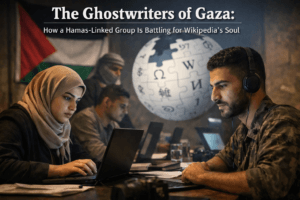
The Ghostwriters of Gaza: How a Hamas-Linked Group Is Battling for Wikipedia’s Soul
In the sprawling, chaotic digital bazaar of the 21st century, Wikipedia stands as a modern Library of Alexandria. It is the first draft of history, the go-to source for billions seeking a quick, neutral overview of any topic imaginable. But what happens when the very neutrality of that repository becomes a battlefield? A recent announcement by the Geneva-based Euro-Med Human Rights Monitor suggests that the front lines of the Israeli-Palestinian conflict have now firmly entrenched themselves within the world’s largest encyclopedia.
The organization’s launch of the third edition of its “WikiRights” project in the Gaza Strip, training a dozen young Palestinians in the art of Wikipedia editing, is far more than a simple educational workshop. It is a sophisticated maneuver in a long-standing information war, one where footnotes are ammunition and talk pages are trenches. While Euro-Med frames the initiative as a noble pursuit to “document human rights violations” and give voice to “victims of genocide,” the organization’s own documented ties to Hamas cast a long, dark shadow over the project, transforming it from an act of historical preservation into a potential exercise in organized propaganda.
The Project: Empowerment or Indoctrination?
On its surface, the WikiRights project sounds laudable. According to Euro-Med’s announcement, it aims to provide 12 young Palestinian men and women with “in-depth training in human rights research and documentation, as well as professional editing on Wikipedia.” The stated goal is to create and update content, bridging “knowledge gaps concerning human rights violations in Palestine.” In a media landscape where misinformation is rampant, the idea of empowering local voices to share their stories seems, at first glance, like a democratic ideal in action.
Anas Jerjawi, Euro-Med’s Chief Operations Officer, articulated this vision with poignant rhetoric. He spoke of transforming “victims of genocide in Gaza from mere statistics into storytellers,” ensuring their narratives aren’t “exclusively recorded by the perpetrators.” It’s a powerful message, one that resonates deeply in a world where the marginalized often feel unheard. The third round of the project is specifically focused on “the Israeli genocide in the Gaza Strip,” aiming to add “documentation-based articles… rooted in live testimonies.”
For the 12 trainees, the appeal is likely genuine. Imagine being a young person in Gaza, having lived through waves of devastating conflict. Your world has been reduced to rubble, your stories reduced to a number in a news ticker. The opportunity to project your reality onto a global platform like Wikipedia—to write your own history—must feel like a profound act of agency. This is the human insight at the heart of the story: the desperate need to be heard, to be believed, and to have your suffering acknowledged by the world.
The Inconvenient Truth: The Hand That Feeds
But to view this project in a vacuum is to ignore the critical context provided by the Jerusalem Post report: the alleged puppet master behind the curtain. The article meticulously lays out the case against Euro-Med, citing a 2013 Israeli list that names its current and former Board Chairs, Mazen Kahel and Ramy Abdu, as “main operatives and institutions” of Hamas in Europe. Founder Ramy Abdu has been linked to other organizations with alleged Hamas ties and was sanctioned by the Israeli government in 2020 under its anti-terrorism law.
This information fundamentally reframes the narrative. It is no longer a story of a neutral human rights group offering a helping hand. It becomes a story of an organization with deep, documented ties to a designated terrorist group, systematically training individuals to influence one of the world’s most powerful information platforms. NGO Monitor, a research institute, further paints Euro-Med as an organization that actively disseminates “blood libels and conspiracy theories” against Israel, consistently employing charged language like “apartheid,” “genocide,” and “ethnic cleansing.”
This is the core conflict of the story: a seemingly altruistic project is inextricably linked to an entity with a clear political and ideological agenda. The trainees may be sincere in their desire to document their experiences, but they are being armed with tools and almost certainly a narrative framework by an organization that is not an impartial observer, but an active participant in the conflict.
The Wikipedia Paradox: Neutrality as a Weapon
This brings us to the unique and often misunderstood battleground of Wikipedia. The platform operates on a set of core principles, the most sacred of which is the Neutral Point of View (NPOV). Every edit, every addition, must be presented without editorial bias, representing all significant views fairly and proportionately. This is enforced by a vast army of volunteer editors who patrol changes, engage in often-ferocious debates on “talk pages,” and cite Wikipedia’s own intricate policies like scripture.
The Euro-Monitor project is designed to exploit the very machinery that is meant to ensure neutrality. By training participants in “professional editing,” they are learning how to navigate these complex rules. They are being taught how to cite sources—in this case, likely relying heavily on Euro-Med’s own reports, which are presented as authoritative human rights documentation. They are learning to engage in the consensus-building process, arguing for the inclusion of their content in a way that appears compliant with Wikipedia’s standards.
This is where “real human insight” becomes a tool for advocacy. A personal testimony from a Gazan civilian about the loss of their home is a powerful thing. When added to a Wikipedia article, it humanizes a statistic. The problem arises when these testimonies are curated, selected, and presented by an organization with a partisan agenda to build a specific, overarching narrative—in this case, one of deliberate, systematic “genocide” by Israel.
Imagine a Wikipedia article on a specific battle in Gaza. A neutral account would detail the military objectives, the number of casualties from both sides (if available), and the conflicting claims about what happened. A WikiRights-trained editor, armed with Euro-Monitor’s documentation, would be equipped to flood the article with detailed, emotionally resonant accounts of Palestinian suffering, each meticulously cited. The sheer volume of this “humanized” data, all from sources aligned with one side of the conflict, could easily skew the article’s overall weight and tone, tipping the scales away from NPOV without technically violating a single rule.
A Clash of Narratives, Not Just Facts
The struggle over Wikipedia is a microcosm of the larger conflict. It’s not just a dispute over facts—dates, numbers, locations. It is a clash of fundamental narratives. For many Palestinians and their supporters, the story is one of dispossession, occupation, and resistance against a powerful, Western-backed military force. For many Israelis and their supporters, the story is one of a tiny nation fighting for its survival against existential threats, forced to defend itself in a hostile neighborhood.
Each side believes its narrative is the truth. Each side sees the other’s narrative as a distortion, a lie, or propaganda. Euro-Monitor’s project is a calculated effort to ensure that the Palestinian narrative is not just present on Wikipedia, but that it is the dominant one, cemented into the “first draft of history” by trained professionals.
This has profound implications. For the casual reader in Kansas or Kuala Lumpur who goes to Wikipedia to understand the Gaza conflict, they may not be encountering a balanced overview. They may be encountering a meticulously crafted narrative, one that prioritizes a specific set of testimonies, frames events using specific terminology (like “genocide”), and omits or downplays contexts that would complicate that picture. They will see a river of cited sources, all seemingly legitimizing the content, unaware that many of those sources flow from a single, politically charged spring.
The Ghosts in the Machine
What does this mean for the 12 young trainees? They are both the protagonists and the pawns in this story. They are protagonists because they are seizing a chance to make their voices heard in a world that often ignores them. The motivation to ensure that their dead are not forgotten, that their destroyed homes are not just pixels on a map, is profoundly human.
Yet, they are also pawns. They are being trained by an organization with a clear strategic goal that extends far beyond their personal grief. They are being equipped to serve as soldiers in a digital army, their personal stories the ammunition. They will become ghostwriters for a cause, their bylines on Wikipedia articles masking the institutional machinery guiding their keystrokes.
This is not to deny their agency or the validity of their experiences. But it is to recognize that their experiences are being curated and channeled by a group with a demonstrable connection to a terrorist organization, for a very specific political purpose. They are being asked to write history, but from a script.
Conclusion: The Unending Battle for the Past
The WikiRights project is a brilliant and troubling evolution of modern conflict. It acknowledges that in the 21st century, controlling the physical territory is only half the battle. The other half is controlling the digital memory of that battle. If you can control the encyclopedia, you can influence the understanding of millions for generations to come.
For Israel and its allies, this represents a clear and present danger. It confirms their fears that NGOs and activist groups are systematically working to delegitimize the country on the world’s most trusted information platform. For Palestinians, it may feel like a necessary corrective to a global media landscape they perceive as inherently biased in Israel’s favor.
The ultimate loser in this scenario is the truth, or at least the pursuit of a shared, nuanced understanding of it. Wikipedia’s strength has always been its ambition to be a neutral arbiter, a place where the noise of the world is distilled into calm, reasoned prose. Projects like WikiRights, regardless of their stated noble intentions, threaten to turn those calm pages into a battlefield. They ensure that the war in Gaza will not end with a ceasefire, but will continue indefinitely in the digital realm, fought not with rockets and airstrikes, but with citations, edits, and the very real, deeply felt, and expertly weaponized stories of human loss. The ghosts of Gaza are being summoned to fight a new kind of war, and the battlefield is the collective memory of the world.
You must be logged in to post a comment.