
The Ghosts of the Grasslands: How India’s Ancient Wolves Are Learning to Live Among Us
The Indian wolf (Canis lupus pallipes), one of the oldest surviving wolf lineages with an estimated population of just 2,500 to 3,800 individuals in India, is undergoing profound behavioral changes as its grassland and scrubland habitats shrink due to development and fragmentation—adaptations include suppressing howls near human settlements to avoid attention, increased livestock predation due to declining natural prey, and interbreeding with free-ranging dogs, which threatens their genetic integrity. Recent wolf attacks on humans in Uttar Pradesh’s Bahraich district highlight escalating human-wildlife conflict, underscoring the urgent need for region-specific conservation strategies, protection of neglected grassland ecosystems, and integration of traditional knowledge to foster coexistence before these ancient predators are silenced entirely.
The Ghosts of the Grasslands: How India’s Ancient Wolves Are Learning to Live Among Us
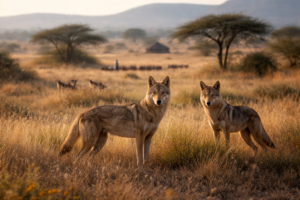
The howl comes just after dusk—a low, wavering cry that rises and falls against the vast expanse of the Deccan plateau. For a moment, the cricket song ceases, and the scrub forest holds its breath. Then silence returns, and the wolves melt back into the shadows, invisible witnesses to a landscape that is rapidly transforming around them.
Across India’s semi-arid grasslands, a quiet drama is unfolding. The Indian wolf (Canis lupus pallipes), one of the most ancient wolf lineages on Earth, is learning to navigate a world that no longer belongs to them. And in the process, they are changing in ways that scientists are only beginning to understand.
The Weight of Being Ancient
When you look into the amber eyes of an Indian wolf, you’re gazing at something extraordinary. Genetic studies suggest that these slender, tawny-coated canids split from other wolf populations hundreds of thousands of years ago, making them possibly the oldest surviving wolf lineage in existence. They are living relics, carrying genetic code that predates the ice ages that shaped wolves in Europe and North America.
But antiquity offers no protection against the modern world.
With an estimated population of just 2,500 to 3,800 individuals remaining in India, these apex predators are outnumbered by tigers and lions in the country—both of which command far more conservation attention and funding. Listed under Schedule I of the Wildlife Protection Act, the Indian wolf technically enjoys the same legal protection as tigers. But paperwork doesn’t save species. Habitat does. And habitat is disappearing.
The Shrinking Stage
The grasslands and scrublands that wolves call home are among India’s most neglected ecosystems. Lush forests get national park status. Charismatic megafauna get global campaigns. But the rolling, thorny, seemingly barren expanses where wolves hunt? They get converted into solar farms, industrial zones, and housing developments. They get fenced for intensive agriculture. They get designated as “wasteland” in government records—a tragic misnomer for one of the most biodiverse and ecologically vital landscapes in the subcontinent.
“When people think of conservation in India, they picture tigers in tall grass or elephants in forest corridors,” explains a wildlife biologist who has studied wolf behavior for over a decade. “But wolves live in the places that developers see as empty. They’re fighting a war of attrition, and the battlefield is shrinking every year.”
As the grasslands fragment, so does wolf society. Pack territories that once stretched across hundreds of square kilometers now exist as isolated patches, separated by highways, canals, and towns. Wolves must travel through human-dominated landscapes to find mates, to establish new packs, to access water. Every crossing is a gamble.
The Silence of Survival
Perhaps the most haunting evidence of wolf adaptation comes not from what they do, but from what they no longer do.
In the dense forests of yesteryear, wolves howled freely. Their calls served as territorial declarations, pack reunions, and social bonding rituals—a wild symphony that rolled across the plains under starlit skies. But researchers have documented something remarkable and sad: wolves living near human settlements have begun suppressing their howls.
“They’ve learned that noise attracts attention,” says Sougata Sadhukhan, assistant professor at the Institute of Environment Education and Research in Pune. “Attention brings danger. So they’ve adapted by becoming quieter in areas with high human presence. It’s a survival strategy, but it also means the breakdown of natural communication. We’re essentially listening to a silenced landscape.”
This vocal suppression represents more than just behavioral flexibility. It’s a fundamental shift in wolf society. Howls carry information about pack size, individual identity, reproductive status, and emotional state. When wolves stop howling, they lose a channel of connection that has bound their species together for millennia.
The Dog in the Mirror
The pressures of habitat loss are creating another, potentially more insidious change: genetic dilution.
As wolf populations become smaller and more isolated, encounters with free-ranging dogs are becoming more common. In some areas, researchers have documented interbreeding between wolves and dogs—a phenomenon that conservationists view with deep concern.
The problem isn’t just about “pure” wolves versus hybrids. It’s about ecological function. Wolves are apex predators, finely tuned by evolution to hunt wild prey across vast territories. Dogs are scavengers, adapted to live on the edges of human society. A wolf-dog hybrid occupies an uncertain middle ground—potentially less effective at hunting, more comfortable around humans, and carrying genes that could spread through the shrinking wolf population.
“When wolves breed with dogs, they’re not just losing genetic purity,” one researcher notes. “They’re losing the traits that make them wolves. The ability to coordinate pack hunts. The wariness of humans that keeps them safe. The deep instincts that have guided their lineage for hundreds of thousands of years. Once those genes are diluted, you can’t get them back.”
When Prey Becomes Problem
The most visible consequence of habitat loss, however, plays out in the daily struggle for food.
Indian wolves evolved to hunt blackbuck, chinkara, and other native ungulates—animals that once thundered across the grasslands in vast herds. But those herds have largely vanished, replaced by sheep and goats that belong to pastoralist communities. For a wolf, the calculation is simple: chase a diminishing population of wild prey across fragmented habitat, or take the domestic animal standing right there.
This is not a choice born of malice or bloodlust. It’s mathematics. Energy expenditure versus caloric return. Survival.
“When wolves turn to livestock, they’re not being ‘problem animals,'” explains a conservationist working in Maharashtra. “They’re being wolves. The problem is that we’ve removed their natural options. We’ve taken their grocery store and replaced it with a vending machine, then we blame them for using it.”
The result is predictable and tragic. Wolves kill livestock. Livestock owners kill wolves. Communities that might have coexisted with wolves for centuries become battlegrounds. And the wolves, already teetering on the edge, take another step toward local extinction.
The Bahraich Echo
The recent attacks in Bahraich district, Uttar Pradesh, have thrust wolves back into the national conversation. In 2024 and again in early 2026, suspected wolf attacks on humans sent shockwaves through local communities, prompting culling operations and panicked responses.
These incidents are complex, involving multiple factors that likely converged to create a perfect storm. Habitat loss pushing wolves into closer contact with humans. Declining natural prey. Possibly individual animals with learned behaviors. Perhaps even desperation born of injury or old age.
But the response—fear, anger, retribution—reveals how fragile the relationship between humans and wolves has become. In a landscape where both species are competing for the same resources, conflict isn’t just possible. It’s inevitable.
“We need to move beyond the narrative of good wolves and bad wolves,” urges a wildlife conflict specialist. “These are animals responding to conditions we’ve created. If we want different outcomes, we have to change the conditions. That means protecting grassland habitats, securing livestock, compensating losses fairly, and educating communities about coexistence.”
The Keepers of the Grasslands
Amid the challenges, there are bright spots—places where wolves and humans have found ways to share the land.
In parts of Maharashtra and Karnataka, traditional pastoralist communities have coexisted with wolves for generations. Their livestock grazing practices, developed over centuries, leave enough wild prey for wolves while protecting domestic animals through vigilant herding and night enclosures. These communities often view wolves with a mixture of respect and acceptance, recognizing their role in the landscape.
“Indigenous knowledge is invaluable,” Sadhukhan emphasizes. “These communities understand wolf behavior in ways that science is only beginning to document. They know when wolves are likely to approach, how to protect their animals without killing predators, and which areas are important for wolf breeding. We need to learn from them, not replace their knowledge with top-down solutions.”
This coexistence isn’t always easy or perfect. Livestock losses still occur. Tensions still flare. But the foundation of tolerance exists—a foundation that’s crumbling in areas where traditional practices have been replaced by modern, intensive systems.
The Road Ahead
Conserving India’s wolves requires thinking differently about what conservation means. It’s not about creating vast, fenced reserves where wolves can live untouched by human influence. That ship has sailed. Instead, it’s about designing landscapes where wolves and humans can coexist—patchworks of protected grasslands, carefully managed grazing areas, wildlife corridors that allow movement between habitat fragments, and communities that are equipped and motivated to share their land with predators.
Region-specific strategies are essential. Wolves in the arid grasslands of Gujarat face different challenges than those in the scrub forests of Uttar Pradesh or the plateaus of Karnataka. Their conservation requires understanding local conditions, local cultures, and local conflict patterns.
Research gaps need urgent attention. Basic questions about wolf population size, distribution, behavior, and ecology remain unanswered in many parts of India. Without this information, conservation efforts are guesswork—well-intentioned but potentially misguided.
And perhaps most importantly, the narrative needs to shift. Wolves are not villains in this story. They’re not victims either. They’re survivors, doing what survivors do: adapting, changing, finding a way to exist in a world that offers fewer options with each passing year.
The Symphony Continues
On a cool evening in the Deccan, if you’re lucky, you might still hear them. Not the full-throated choruses of the past, but something quieter—a tentative howl, answered by another, then another. The wolves are still there, still communicating, still maintaining the threads of their society across the fragmented landscape.
Their song has changed. It’s softer now, more cautious, hedged with the awareness that silence is sometimes safer than song. But it continues.
And as long as it continues, there’s hope. Hope that with the right protection, the right understanding, and the right willingness to share this crowded land, the ghosts of the grasslands will keep howling. Hope that future generations will stand under the same stars, listening to the same wild music that has echoed across India’s plains for thousands of years.
The wolves are changing. The question is whether we can change too—fast enough, wisely enough, compassionately enough—to ensure that their ancient lineage survives this moment of crisis. The answer lies not in the wilderness, but in the choices we make in the shared spaces where wolves and humans meet.
You must be logged in to post a comment.