
The Ghost of John Elk: Why a 19th Century Treaty Breach Haunts Today’s Citizenship Debate
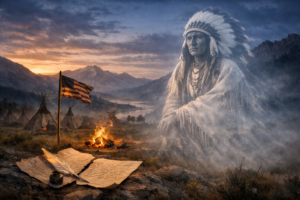
The Ghost of John Elk: Why a 19th Century Treaty Breach Haunts Today’s Citizenship Debate
On April 5, 1880, a man named John Elk walked into a voting registrar’s office in Omaha, Nebraska, and attempted to do something that, in the eyes of the law, was an impossibility. He tried to become a full participant in the American experiment.
Elk, a member of the Winnebago Tribe, had cut his hair, left his reservation, and settled among the white populace. He had “severed his tribal relations,” as the legal jargon of the day put it, and subjected himself to the jurisdiction of the United States. When Charles Wilkins, the registrar, turned him away, Elk didn’t just walk back to his boarding house. He sued, arguing that by virtue of his birth on U.S. soil, the 14th Amendment guaranteed him citizenship.
The Supreme Court disagreed. In Elk v. Wilkins (1884), the justices ruled that while Elk was born within the geographical boundaries of the United States, he was not born “subject to the jurisdiction thereof.” The court deemed Native Americans as members of “quasi-sovereign” nations, owing allegiance to their tribes rather than the federal government.
Nearly 150 years later, the ghost of John Elk is back in the courtroom. As the Supreme Court prepares to hear arguments in the latest challenge to birthright citizenship, the administration of President Donald Trump is reaching back into the 19th century to resurrect this ruling. The goal is to reinterpret the 14th Amendment to exclude children born to undocumented immigrants and those with temporary legal status. But to Native American law experts, historians, and constitutional scholars, this reliance on Elk is not just legally dubious—it is a profound misreading of a painful chapter in American history.
The Citizenship Clause and the Erasure of Tribes
To understand why the Elk v. Wilkins case is a dangerous precedent for the administration to lean on, one must first understand what the 14th Amendment was actually trying to fix. Ratified in 1868, the Citizenship Clause was a direct response to Dred Scott v. Sandford, the infamous 1857 decision that declared African Americans could never be citizens.
The authors of the 14th Amendment wanted a sweeping, bright-line rule: if you are born here and are subject to American laws (as opposed to being a foreign diplomat), you are a citizen. For the vast majority of people born in the United States, this has been the settled interpretation for over a century.
But for Native Americans, the story was different. The Elk decision did not arise from a vacuum of constitutional understanding; it arose from a policy of exclusion. In the 19th century, the U.S. government treated tribes as foreign nations for the purpose of treaties but domestic dependents for the purpose of control. This “unique” status, as modern lawyers describe it, allowed the court to claim that Native Americans owed their primary political allegiance to their tribes, not to the United States.
As legal scholars Bethany Berger and Gregory Ablavsky noted in their brief challenging the current executive order, the Elk ruling was steeped in a logic that was designed to exclude a specific racial group. It wasn’t a neutral interpretation of jurisdiction; it was a legal justification for the dispossession of Indigenous people.
A Legal House of Cards
The Trump administration’s current legal strategy hinges on a specific line from the Elk decision. The government argues that because the Supreme Court once said Native Americans were not “subject to the jurisdiction” of the U.S. for citizenship purposes, the term “jurisdiction” must have a narrow meaning that can also apply to the children of undocumented immigrants.
But this logic falls apart under the slightest scrutiny. As Solicitor General D. John Sauer argues in court filings, Elk supposedly shows that birthright citizenship isn’t automatic. Yet, what the administration glosses over is the fact that Elk was effectively overturned by an act of Congress (the Indian Citizenship Act of 1924) and fundamentally undermined by a subsequent Supreme Court ruling just 14 years later.
That ruling was United States v. Wong Kim Ark (1898). In a fascinating twist of legal history, Wong Kim Ark was also authored by Justice Horace Gray—the same justice who wrote the Elk opinion. In Wong Kim Ark, Gray specifically distinguished the two cases. He ruled that a man born in San Francisco to Chinese parents was a citizen, noting that Elk concerned “only members of Indian tribes within the United States” and had “no tendency to deny citizenship to children born in the United States” who were not subject to tribal sovereignty.
Gray’s distinction is critical. The reasoning in Elk wasn’t about geography; it was about sovereignty. Native Americans were denied citizenship because the U.S. government recognized tribal sovereignty as an impediment to individual allegiance. In contrast, immigrants—even those excluded by the Chinese Exclusion Act—had no competing sovereign demanding their exclusive loyalty. They were fully “subject to the jurisdiction” of the United States the moment they set foot on American soil.
The Uncomfortable Irony of the Argument
For the administration to lean so heavily on a case about Native American exclusion is not just a legal irony; it is a rhetorical and moral one. The history of the U.S. government’s treatment of tribes is a history of broken treaties, forced assimilation, and the denial of humanity. Using that history to strip citizenship from a new generation of Americans—even if the administration’s supporters do not see the connection—is a move that many Indigenous legal experts find deeply troubling.
As Leonard Fineday, general counsel of the National Congress of American Indians, pointed out in response to the recent legal maneuvers, the Elk decision rests entirely on the “quasi-sovereign” nature of tribal governments. That context does not translate to the situation of immigrants, who hold no such sovereignty.
Moreover, the absence of tribal organizations filing briefs in the current case speaks volumes. As experts note, tribes are largely ambivalent or opposed to being dragged into this fight. For one thing, the legal wound of Elk was healed by Congress in 1924; Native Americans are now guaranteed citizenship by statute, regardless of the 19th-century court ruling. For another, invoking Elk as a positive precedent is, to many, like invoking Dred Scott to argue for states’ rights. It is a relic of an era where the Constitution was interpreted to exclude those deemed “other.”
Redefining Jurisdiction
The crux of the matter comes down to the definition of “jurisdiction.” The traditional interpretation, upheld for 150 years, holds that nearly everyone born in the U.S. is subject to its jurisdiction. If you can be arrested, taxed, drafted, or deported by the U.S. government, you are under its jurisdiction. The only exceptions—children of diplomats and enemy invaders—are immune precisely because the U.S. does not have legal authority over them.
The administration’s argument, borrowing from the logic of Elk, tries to create a third category: people who are physically present but not politically or allegiantly “subject.” The government argues that children of undocumented immigrants are born under a “partial” jurisdiction, mirroring the court’s view of Native Americans in the 1880s.
But as the ACLU and other challengers note, this is a category that doesn’t exist in modern constitutional law. You cannot be partially subject to the speed limit or partially subject to the IRS. The government’s attempt to revive a 19th-century distinction designed to justify the subjugation of Indigenous peoples to apply it to modern immigrant families is an attempt to rewrite the social contract.
What the Stakes Reveal
As the justices prepare to hear arguments, the reliance on Elk v. Wilkins reveals a deeper tension in the case. It shows that the current debate over birthright citizenship is not really about the text of the 14th Amendment; it is about whether the court will honor the “original public meaning” of the amendment or whether it will reach back to a darker, more exclusionary interpretation that was rejected over a century ago.
John Elk’s fight for citizenship was a lonely one. He lost at the Supreme Court, and he died before Congress finally extended citizenship to all Native Americans in 1924. His case was a product of a time when the United States was trying to define who belonged by defining who did not.
Today, as the administration dusts off the Elk ruling, it is asking the modern Supreme Court to do what the 19th-century court did: to create a carve-out. In the 1880s, the carve-out was for Native Americans. Today, it is for the children of undocumented immigrants.
For the critics of this strategy, the lesson of Elk v. Wilkins is not that jurisdiction is narrow. It is that when the Supreme Court has tried to narrow the scope of constitutional citizenship in the past, it has often been wrong—and eventually, Congress or future courts have had to correct the injustice. Whether the current justices will see Elk as a precedent to follow or a historical mistake to avoid will determine the fate of birthright citizenship for a new generation of Americans.
You must be logged in to post a comment.