
The Geopolitics of Oil: Decoding America’s ‘Permission’ for India to Buy Russian Crude
The United States has granted India a temporary 30-day waiver to purchase Russian oil that is currently stranded on tankers at sea, following India’s compliance with an earlier U.S. request to halt such purchases last fall. While U.S. officials frame this as giving India “permission” to buy the crude as a short-term measure to ease global oil supplies amid escalating West Asia conflict, the move has sparked political controversy in India—with the Opposition calling it “humiliating” and questioning why India needs American approval for its energy security, while the ruling BJP hails it as a success of strategic diplomacy. The carefully calibrated arrangement allows India to access stranded oil without providing significant new revenue to Russia, revealing the complex interplay between U.S. sanctions policy, India’s energy needs, and the pragmatic adjustments required to maintain global market stability during times of conflict.
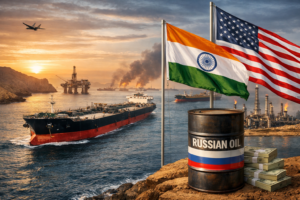
The Geopolitics of Oil: Decoding America’s ‘Permission’ for India to Buy Russian Crude
In a diplomatic development that has sent ripples through global energy markets and political circles alike, United States Treasury Secretary Scott Bessent made a striking revelation this week: India had halted purchases of sanctioned Russian oil at Washington’s request, and now the U.S. was temporarily “allowing” New Delhi to resume those acquisitions.
The statement, delivered during a Fox Business interview on Friday, March 6, 2026, has ignited a firestorm of debate about the nature of India-U.S. relations, the complexities of global energy security, and the delicate balancing act that defines modern geopolitics.
But beneath the carefully crafted diplomatic language lies a far more nuanced story—one that reveals the intricate dance between strategic autonomy, energy dependence, and the ever-shifting landscape of international alliances.
The Anatomy of a Diplomatic Disclosure
“The Indians had been very good actors. We had asked them to stop buying sanctioned Russian oil this fall. They did,” Bessent stated matter-of-factly during his interview. “They were going to substitute it with U.S. oil. But to ease the temporary gap of oil around the world, we have given them permission to accept the Russian oil.”
The timing of this announcement is anything but coincidental. With West Asia tensions escalating and the U.S.-Israel conflict with Iran entering a particularly volatile phase, global oil markets have been holding their breath. The specter of supply disruptions from the Strait of Hormuz—through which approximately 20% of the world’s petroleum passes—has sent policymakers scrambling for creative solutions.
Enter the floating oil conundrum.
According to Bessent, there are “hundreds of millions of sanctioned barrels of crude on the water”—Russian oil that has been sitting idle on tankers, unable to find buyers due to U.S. and allied sanctions. By temporarily unsanctioning these specific cargoes, the Treasury Department effectively creates an immediate supply buffer without waiting for new production to come online.
“In essence, by unsanctioning them, Treasury can create supply,” Bessent explained. “And we are looking at that. We are going to keep a cadence of announcing measures to bring relief to the market during this conflict.”
The 30-Day Window: What It Actually Means
On Thursday, the Treasury Department formalized this approach by issuing a temporary 30-day waiver specifically allowing Indian refiners to purchase Russian oil that is already stranded at sea. The deliberately short-term nature of this measure is crucial—it signals that this is an operational adjustment, not a fundamental policy shift toward Russia.
Energy Secretary Chris Wright elaborated on the mechanics in a separate interview with ABC News Live. “We’ve reached out to our friends in India and said, ‘Buy that oil. Bring it into your refineries.’ That pulls stored oil immediately into Indian refineries and releases the pressure on other refineries around the world to buy oil that they’re no longer competing with the Indians for in that marketplace.”
Wright was careful to frame this as a temporary measure with no broader implications. “This is no change in policy towards Russia. This is a very brief change in policy just to keep oil prices down a little bit better than we could otherwise.”
For Indian refiners, this represents an opportunity to access crude that has been effectively trapped in maritime limbo—oil that Russia desperately needs to monetize but cannot move through normal channels. The vessels in question have been loitering primarily around Southern Asia, with Wright noting that China—typically a major buyer of Russian crude—has not been treating its suppliers well, leaving these barrels stranded.
The Political Firestorm at Home
While the diplomatic and economic implications of this waiver are significant, its political reception within India has been equally dramatic and perhaps more revealing.
The Opposition Congress party was quick to seize on Bessent’s language, particularly his repeated use of the word “permission.” In a strongly worded response, party leaders characterized the development as “humiliating” for a nation that prides itself on strategic autonomy.
“Why does India require U.S. nod for securing its energy needs?” demanded Opposition leaders, framing the waiver as evidence of diminished sovereignty in foreign policy decision-making. The critique taps into deep-seated anxieties about the nature of India’s growing partnership with the United States—is it a relationship between equals, or has India become a junior partner whose energy security depends on Washington’s forbearance?
The ruling Bharatiya Janata Party (BJP), naturally, offered a starkly different interpretation. Party spokespersons hailed the development as the “success of PM Modi’s strategic oil diplomacy,” framing the 30-day waiver as evidence of India’s skillful navigation of global tensions.
This domestic political divide illuminates a fundamental tension in how India’s foreign policy is perceived. Is obtaining U.S. “permission” a sign of subordination or a testament to diplomatic skill in securing favorable terms from a superpower? The answer, predictably, depends on where one sits on the political spectrum.
The Context: India’s Russian Oil Journey
To understand the significance of this moment, one must appreciate how dramatically India’s oil import patterns have shifted since Russia’s invasion of Ukraine in February 2022.
Prior to the conflict, Russian crude represented a negligible fraction of India’s energy imports—less than 2%, largely due to prohibitive transportation costs. But as Western sanctions reshaped global energy flows, Russia began offering its oil at steep discounts, desperate to maintain market share. Indian refiners, ever pragmatic, stepped in.
By mid-2023, Russia had become India’s single largest oil supplier, surpassing traditional partners like Iraq and Saudi Arabia. At its peak, Russian crude accounted for nearly 40% of Indian imports—a staggering transformation that fundamentally altered global energy dynamics.
This shift was made possible by a sophisticated workaround: Indian refiners purchased oil at prices below the G7’s price cap mechanism, using Western insurance and shipping services that were technically prohibited but effectively tolerated. The arrangement suited all parties: Russia maintained oil revenues (albeit reduced), India secured cheap energy, and Western powers avoided a catastrophic price spike that would have damaged their own economies.
However, this balancing act grew increasingly precarious as the conflict dragged on and sanctions enforcement tightened. By fall 2025, with a new U.S. administration in place, the pressure on India intensified—culminating in the request to halt purchases that Bessent now acknowledges India dutifully honored.
The Pragmatic Calculus
Behind the diplomatic theater lies a cold strategic calculation that both Washington and New Delhi understand perfectly.
For the United States, the calculus is straightforward. With conflict raging in West Asia and the ever-present risk of Iranian retaliation disrupting Strait of Hormuz traffic, maintaining stable global oil prices is a paramount strategic objective. High energy prices fuel inflation, destabilize economies, and erode political support for incumbents—including the current administration.
By allowing India to draw down floating Russian oil inventories, the U.S. effectively creates an immediate supply buffer without increasing Russian revenues. The oil is already out of the ground, already loaded on ships, already destined for someone’s refinery. If not India, who else would buy it? The stranded barrels represent sunk costs for Russia—allowing them to move does not fund new production or generate additional revenue for Moscow’s war machine.
For India, the calculation is equally pragmatic. The country imports approximately 85% of its crude oil requirements, making it exceptionally vulnerable to global price volatility. Every dollar increase in oil prices widens India’s trade deficit, weakens the rupee, and fuels domestic inflation. Securing affordable energy is not merely an economic objective—it is a matter of national security and political stability.
The temporary waiver allows Indian refiners to access oil that may be available at favorable terms, helping manage the country’s energy costs during a period of heightened global uncertainty. Moreover, by demonstrating responsiveness to U.S. concerns (by halting purchases when asked) and then receiving “permission” to resume them, India reinforces its image as a responsible, reliable partner—a reputation that carries significant diplomatic weight.
The Message in the Language
Perhaps the most revealing aspect of this episode is the language U.S. officials have chosen to employ.
Bessent’s repeated characterization of the arrangement as the U.S. giving India “permission” to buy Russian oil—and framing India as having been “very good actors” for complying with U.S. requests—reflects a particular worldview of international relations. It suggests a hierarchical relationship in which the United States sets the rules and India, as a partner, follows them.
Energy Secretary Wright’s framing was slightly different but equally telling. He emphasized that the U.S. had “reached out to our friends in India” and said “buy that oil”—language that implies direction rather than consultation.
Indian officials, predictably, have offered a different interpretation. In background briefings, they emphasize that India’s decision to halt Russian oil purchases last fall was not merely compliance with U.S. demands but a strategic choice based on India’s assessment of its own interests. The current waiver, they suggest, is not “permission” but recognition of India’s importance as a stabilizing force in global energy markets.
The truth, as is often the case, likely lies somewhere in between. India undeniably values its relationship with the United States and takes U.S. concerns seriously. Equally undeniably, India makes its own decisions based on its own interests. The two propositions are not mutually exclusive—they are simply the reality of international relations in a complex, multipolar world.
The Market Mechanics
For those interested in the practical implications, the waiver addresses a specific logistical challenge that has been building for months.
When sanctions tighten, oil that is already in transit presents a unique problem. Tankers loaded with Russian crude have been plying global waters, their cargoes effectively unsellable to buyers who fear sanctions violations. These vessels represent a floating inventory—oil that exists physically but cannot enter the market through normal channels.
Some of these tankers have been loitering off the coasts of Southern Asia, waiting for a resolution. Others have been sitting in storage facilities, their owners reluctant to sell at distressed prices. The longer they wait, the more they cost their owners in demurrage charges and opportunity costs.
By allowing Indian refiners to purchase this specific oil, the U.S. creates a pathway for this inventory to enter the market without undermining the broader sanctions regime. The oil is already produced, already shipped—allowing it to be refined in India does not create new revenue streams for Russia’s energy sector or enable additional production.
From a market perspective, this is elegant: it increases effective supply without increasing production, helping to moderate prices without benefiting the sanctioned entity in ways that would enable future production.
What Comes Next
The 30-day window creates as many questions as it answers.
Will Indian refiners actually purchase significant volumes during this period? The answer depends on pricing. Russian sellers, knowing that this represents a limited window of opportunity, may seek to extract premium prices. Indian buyers, knowing that the oil has limited alternative buyers, will push for discounts. The outcome will be determined by hard negotiation.
Will the waiver be extended? U.S. officials have emphasized its temporary nature, but “temporary” can mean many things in diplomacy. If West Asia tensions persist, if floating inventories remain substantial, if global prices continue their upward trajectory—any of these factors could justify an extension.
What about U.S. oil? Bessent noted that India had been planning to substitute Russian oil with U.S. crude. The temporary waiver delays but does not eliminate that transition. For U.S. producers, India represents a massive potential market—one that the administration clearly hopes to develop over the longer term.
And what of Russia? Moscow will likely interpret this waiver as evidence that sanctions are buckling under pressure—a narrative it will exploit for propaganda purposes. The reality is more nuanced: targeted, temporary exceptions designed to manage market disruptions are not the same as sanctions erosion.
The Bigger Picture
Behind the headlines and political point-scoring lies a deeper truth about the nature of power in the 21st century.
The United States remains the world’s dominant military and economic power, capable of projecting force and imposing costs on adversaries. But that power has limits—limits revealed whenever sanctions threaten to disrupt global energy markets on which even America’s allies depend.
India has emerged as a significant power in its own right—not a client state seeking permission, but a major economy whose choices shape global outcomes. The fact that U.S. officials speak of “allowing” India to buy oil reflects American diplomatic framing, but the reality is that India will make its own decisions based on its own interests.
The temporary waiver represents an attempt to align those interests—to create a situation where what India wants (affordable energy) aligns with what the U.S. wants (stable markets and maintained sanctions pressure). This is diplomacy at its most practical: finding intersections of interest rather than demanding compliance.
Whether this approach will succeed over the longer term remains to be seen. The 30-day window will pass, and the fundamental tensions will remain. Russia will continue seeking buyers for its oil. India will continue seeking affordable energy. The U.S. will continue seeking to constrain Russian revenues while maintaining global energy stability.
These objectives are not easily reconciled, and the temporary waiver—whatever its immediate effects—does not resolve the underlying contradictions. It merely postpones them, buying time for other solutions to emerge.
Conclusion
The news that the United States has temporarily allowed India to purchase stranded Russian oil is simultaneously significant and unsurprising. Significant because it represents a concrete adjustment to sanctions enforcement in response to real-world pressures. Unsurprising because it reflects the pragmatic, interest-based calculations that have always characterized international relations.
For Indian readers, the episode offers lessons about both the opportunities and constraints of the country’s growing partnership with the United States. The relationship delivers real benefits—including, in this case, flexibility in energy procurement. But it also creates expectations and pressures that must be managed.
For American readers, the episode illustrates the limits of unilateral power in a interconnected world. Even the world’s dominant superpower cannot ignore market realities or the interests of major partners. Sanctions are powerful tools, but they are not magic—they require constant calibration and occasional exceptions.
And for observers everywhere, the episode reveals the continuing centrality of energy to global politics. Oil remains the lifeblood of the world economy, and those who control its flow—whether through production, transportation, or purchasing—wield influence far beyond their nominal power.
The 30-day waiver will pass. The tankers will discharge their cargoes. The oil will flow through Indian refineries and into vehicles, factories, and power plants across the subcontinent. And the geopolitical dance will continue, with each partner seeking advantage while managing constraints.
That is not submission or domination—it is simply the complex reality of international relations in a world where no nation, however powerful, can entirely control the forces it has helped set in motion.
You must be logged in to post a comment.