
The Geography of Waiting: When Two Kilometers Become a Daily Odyssey
The arduous three-hour commute faced by Palestinian teacher Laila al-Halasa to travel a mere two kilometers within Jerusalem encapsulates the profound human cost of bureaucratic fragmentation and political control in East Jerusalem. Her daily ordeal, resulting from the unexplained closure of a once-convenient checkpoint, represents a systematic appropriation of time and dignity for hundreds of residents, where movement is re-engineered through detours, uncertainty, and arbitrary restrictions without transparency or explanation. This reality transforms a short distance into a draining saga of psychological strain, economic burden, and stolen hours, functioning as a tool of demographic management that fragments Palestinian urban life and asserts authority through the silent, humiliating mechanics of delay and obstruction, making the simple act of commuting a daily act of resilience against a policy designed to make presence itself unsustainable.
The Geography of Waiting: When Two Kilometers Become a Daily Odyssey
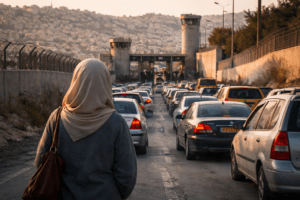
For Laila al-Halasa, a special-education teacher in Jerusalem, the arithmetic of her daily life is a study in absurdity. The distance from her home to her classroom is roughly two kilometers—a distance an average person can walk in 25 minutes, or cycle in less than 10. Yet, her journey is not measured in distance, but in time: three hours. Every morning, she embarks on a commute that defies geography, logic, and the basic human right to mobility. Her story, detailed in a recent report, is not an anomaly but a shared ritual of endurance for hundreds of Palestinians in East Jerusalem, where a once-convenient checkpoint now stands as a monument to opaque authority and fragmented lives.
This is not merely a traffic report. It is a window into a reality where space is politically re-engineered, where the simple act of moving from point A to point B becomes a draining negotiation with invisible rules. The checkpoint near Al-Sawahreh al-Sharqiyeh, which once provided direct access to the city, now denies passage to most neighborhood residents without explanation. This silence from the authorities is perhaps the most deafening part of the ordeal—a policy enacted not through loud decrees but through quiet, bureaucratic negation, leaving people navigating a maze with no map.
The Human Cost of Fragmented Space
To understand the three-hour commute, one must abandon the notion of “as the crow flies.” For Palestinians in East Jerusalem, geography is not linear; it is a circuitous route dictated by walls, barriers, permits, and checkpoints. What looks like a straight line on a map becomes a jagged journey through a fractured landscape. Laila’s drive likely involves detours to distant, congested checkpoints open to her, weaving through alternate neighborhoods, joining queues of vehicles filled with people sharing the same resigned fatigue.
The cost is multidimensional. First, it is a theft of time—three hours daily is 15 hours a week, over 60 hours a month. That’s time stolen from family, from rest, from preparation for the vulnerable children she teaches. For a special-education teacher, whose role demands immense reserves of patience and empathy, starting the day already drained is a professional handicap that ultimately affects her students.
Second, it is an economic and environmental tax. The fuel costs for such a convoluted journey are significant for a teacher’s salary. The environmental impact of hundreds of idling cars taking unnecessarily long routes is collectively destructive.
Third, and most profound, is the psychological toll. This daily ritual is a constant, low-grade humiliation, a reminder of one’s conditional existence. The unpredictability—could it be two hours one day, four the next?—erodes any sense of autonomy or planning. It instills a pervasive sense of powerlessness, where your time, your most finite resource, is controlled by faceless mechanisms.
A System of Bureaucratic Opacity
The phrase “with no explanation from the authorities” is the keystone of this injustice. When rules are unexplained, they cannot be challenged, appealed, or understood. They become arbitrary, and arbitrariness is a tool of control. It creates a society that must constantly guess, assume, and live in anxiety. Is the closure temporary? Permanent? Based on security? Demographics? Bureaucratic whim? The lack of transparency transforms a public policy into a private burden shouldered by individuals like Laila.
This opacity is strategic. It prevents collective, organized response because the grievance is nebulous. Who do you petition? What law do you cite? The checkpoint itself becomes a passive-aggressive assertion of sovereignty, saying, “Your access is not a right, but a privilege we can revoke without comment.”
The Ripple Effects: Beyond the Commute
Laila’s story is a single thread in a larger tapestry of fragmentation. Consider her students, both in her special-education class and beyond. How many of their classmates or teachers are also caught in this geographic labyrinth? What does it teach the children watching the adults in their lives be systematically delayed and disempowered? Education is meant to build futures, but how can one build when the very journey to the building site is an exhausting daily siege?
Consider the medical worker, the shopkeeper, the student, the elderly person needing hospital care. For each, the “two-kilometer irony” shapes their life. It discourages economic enterprise, strains family ties separated by a few miles that feel like continents, and turns a city into a cluster of isolated islands.
The Broader Context: Jerusalem’s Fractured Soul
This is not a isolated logistical failure but a feature of the long-standing conflict over Jerusalem. The policy of separating East Jerusalem neighborhoods from the city’s core, despite their official annexation by Israel, is a means of demographic management and political control. It aims to ensure a Jewish majority in the city while simultaneously diluting the Palestinian presence within its functional fabric. The checkpoint is a pressure valve, slowing and discouraging Palestinian movement, making life so persistently inconvenient that the very idea of a unified, vibrant Palestinian urban life in Jerusalem becomes unsustainable.
Thus, Laila’s three-hour commute is a microcosm of a macro conflict. It is the daily, lived experience of statelessness within a city she calls home. She is not crossing an international border; she is traveling within the municipal boundaries of Jerusalem, yet treated as a potential threat on a journey to her job serving the city’s children.
Toward a Recognition of the Intangible
Addressing this requires moving beyond seeing it as a mere “transportation issue.” It is a profound human rights issue centered on freedom of movement, the right to work, and the right to family life. Solutions demand transparency and equity: clear, published criteria for checkpoint restrictions subject to oversight; investment in infrastructure that connects rather than divides; and, ultimately, a political vision that sees Palestinian residents of Jerusalem as rights-bearing residents, not a demographic problem to be managed.
The real insight here is that occupation and conflict are not just about land, but about time. They are about the systematic appropriation of a population’s time—through waits at checkpoints, through lengthy permit processes, through court delays for home demolitions. This stolen time is the invisible currency of the conflict. It is life itself, slowly eroded.
When a two-kilometer journey takes three hours, the message is clear: your place is not here, your time is not valuable, your life is not seamless. For Laila al-Halasa and hundreds like her, the daily commute is a silent, grinding resistance—a refusal to let that message make them abandon their homes, their jobs, or their dignity. They pay for their resilience in hours, in fuel, in exhaustion. Until their time is recognized as equally precious, the geography of Jerusalem will remain a map not of places, but of waiting.
You must be logged in to post a comment.