
The Gaza Experiment: A Technocratic Path to Peace or Another Layer of Conflict?
The newly formed National Committee for the Administration of Gaza represents a controversial, U.S.-backed attempt to transition from war to governance through a three-tiered international structure.
While the ground-level committee of Palestinian technocrats is tasked with restoring civilian services, its success is critically undermined by the absence of a clear security mechanism to disarm Hamas and the complete lack of Palestinian political representation on the higher oversight boards, which are dominated by U.S. officials and regional actors like Turkey and Qatar. This externally imposed framework, topped by President Trump’s ambitious “Board of Peace,” attempts to substitute technocratic administration and international investment for a genuine political process, creating a structure heavy on managerial oversight but fundamentally weak in legitimacy and enforcement, leaving Gaza in a fragile state between reconstruction and unresolved conflict.
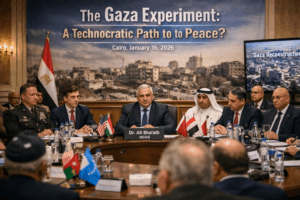
The Gaza Experiment: A Technocratic Path to Peace or Another Layer of Conflict?
A fragile new governing structure is taking shape in Gaza, promising restoration but raising serious questions about sovereignty, security, and who truly holds power in the devastated territory.
The inauguration of the National Committee for the Administration of Gaza (NCAG) in Cairo on January 16, 2026, marked the official start of what American officials call “phase two” of the post-war plan. Led by Dr. Ali Sha’ath, a Gazan engineer with past ties to Fatah, this 15-member body of Palestinian technocrats has a monumental task: to rebuild civil life from the rubble of a two-year war. Yet, this committee is just the bottom tier of a complex, three-layered international architecture. Above it sits a maze of boards, overseen by a U.S.-dominated “Board of Peace,” that aims to manage everything from reconstruction to ultimate security, with no Palestinian political voice at the highest levels.
This ambitious framework represents a radical departure from previous governance models in Gaza. It aims to replace Hamas’s rule with apolitical administration and to channel reconstruction through a results-oriented, business-minded international board. However, this experiment is mired in contradictions. It operates with the grudging acquiescence of a weakened Hamas, depends on regional actors with deep ties to the group, and lacks the clear, enforceable security mechanisms needed to prevent a return to violence. As the world watches, the critical question remains: Is this a genuine pathway to stability and Palestinian renewal, or merely a sophisticated form of externally managed limbo?
The Three-Tiered Governance Structure: A Breakdown
To understand the plan’s ambition and its inherent tensions, it is essential to examine the roles and relationships within its unique structure.
Table: The Three-Tiered Governance Structure for Gaza
| Tier | Name | Key Function | Notable Members/Composition |
| Top Tier | Board of Peace | High-level strategic oversight and resource mobilization; described by critics as a potential rival to the UN. | Chaired by U.S. President Donald Trump; invitations extended to world leaders, including Vladimir Putin. |
| Middle Tier | Gaza Executive Board | On-the-ground oversight of reconstruction and governance, interfacing with security arrangements. | Mix of U.S. envoys (Steve Witkoff, Jared Kushner), regional ministers (Turkey, Qatar, UAE, Egypt), and international figures (Tony Blair). |
| Ground Tier | National Committee for the Administration of Gaza (NCAG) | Day-to-day civil administration: restoring services, managing early recovery, and stabilizing daily life. | 15 Palestinian technocrats, led by Dr. Ali Sha’ath; members vetted by multiple parties including Israel and Hamas. |
The Technocratic Gambit: Can Administrators Govern?
The National Committee for the Administration of Gaza (NCAG) is the most tangible element of the plan so far. Its mandate is strictly civilian: to restore electricity, water, healthcare, and municipal services, and to begin the Herculean task of reconstruction. The selection of its members was a laborious, months-long process involving vetting by a improbable coalition including Israel, the United States, Egypt, and even Hamas itself. The result is a committee of professionals—engineers, economists, former ministry officials—officially presented as independents, despite some, like Chair Ali Sha’ath, having past political affiliations.
This “technocratic” label is a deliberate political strategy. It aims to create a governing body acceptable to all sides by ostensibly removing partisan politics from the immediate task of survival and rebuilding. However, its limitations are severe. The committee has no political authority to represent Gazans internationally and exists outside the formal framework of the Palestinian Authority (PA), which still controls key administrative functions like issuing official documents. Most critically, its mission to “establish security control” is at odds with reality on the ground, as Hamas continues to retain de facto security control in the territory. The committee is being asked to govern without one of the fundamental tools of governance.
The Security Paradox: Disarmament, Departures, and Deterrence
The most volatile fault line in the entire plan is security. Phase two explicitly calls for the full disarmament of Hamas and the deployment of an International Stabilization Force (ISF) commanded by U.S. Army Maj. Gen. Jasper Jeffers. Yet, there is no visible pathway to achieve this. Israel remains fiercely opposed to security roles for countries like Turkey and Qatar, which it views as Hamas supporters. Meanwhile, the ISF is, in the words of one analyst, “a force that doesn’t seem to have any soldiers at the moment”.
A potential, albeit controversial, component of the security puzzle involves the voluntary exit of senior Hamas leaders from Gaza. Reports suggest that as part of the transition, figures like Izz al-Din Haddad, head of Hamas’s military wing, may leave for destinations such as Turkey. Hamas frames this as logistical support for the technocratic committee, while other sources describe it as a complex intelligence-driven operation being negotiated in Cairo. However, this is not a full dissolution. It potentially removes key military decision-makers while leaving the group’s structure and ideology intact, a half-measure that satisfies no one’s ultimate goals.
The underlying paradox is stark: the success of the civilian technocratic committee is wholly dependent on a stable and secure environment. But creating that environment requires confronting and dismantling Hamas’s military wing—an action that could itself trigger a violent collapse of the ceasefire. This circular dilemma leaves Gaza in what one report describes as an “unbearable purgatory” between war and peace.
The “Board of Peace”: Visionary Club or Imperial Court?
Hovering over the entire Gaza operation is President Trump’s Board of Peace, a body whose scope and purpose have sparked confusion and controversy. Officially, it provides strategic oversight for the Gaza plan under Trump’s chairmanship. However, its recently circulated charter describes a permanent global peace-building body with ambitions that seem to extend far beyond Gaza, leading critics to accuse Trump of a “bait-and-switch” at the UN.
The Guardian has characterized the board as an “imperial court completely unlike what was proposed,” arguing that UN Security Council Resolution 2803, which endorsed the Gaza plan, was used as a false prospectus to launch a Trump-dominated global club. The board’s rules grant the chairman (Trump) overwhelming power, including the ability to select and terminate members. Reports that countries were asked to contribute $1 billion for a “life-membership” have further fueled perceptions of it as a “pay-to-play” venture that swaps the UN’s flawed equality for a model where influence is dictated by wealth.
The inclusion of invitations to controversial figures like Russia’s Vladimir Putin and Belarus’s Alexander Lukashenko has drawn criticism from allies like the UK. Conversely, when French President Emmanuel Macron declined to join, Trump threatened a 200% tariff on French wine, revealing the hard power and economic coercion underpinning the diplomatic initiative. This mix of billionaire advisors, geopolitical strongmen, and financial demands has led to a central critique: the structure is less about Palestinian self-determination and more about consolidating a new, transactional model of American-led global governance.
The Palestinian Voice: Absent at the Highest Levels
A consistent and glaring omission across the upper tiers of this structure is meaningful Palestinian political representation. While the NCAG is composed of Palestinians, it is a technical, not a political, body. No Palestinian political representative sits on the Gaza Executive Board or the higher Executive Board. This absence is not lost on observers. Gershon Baskin, an Israeli peace activist involved in the talks, noted, “The strangest thing in my mind about this committee is that there’s no Palestinian representative there. I think there has to be a Palestinian political agency at this level”.
This gap creates a profound legitimacy deficit. Nidal Foqaha of the Palestinian Peace Coalition stressed that “the United States cannot give legitimacy to this committee only,” arguing that a sense of Palestinian ownership is essential. The risk is that the entire architecture is perceived, especially by Palestinians, as an externally imposed framework—a “Trump invention” managed by his envoys and allied billionaires. Without a political channel for Palestinian aspirations, the technocratic work on the ground may fail to win the public trust necessary for long-term success, leaving a vacuum that Hamas or other factions could eventually refill.
A Fragile Foundation Amid Regional Upheaval
The Gaza experiment is launching into an uncertain regional landscape. The plan’s supporters hope it can disconnect Gaza from broader regional conflicts, particularly from Iranian influence. As Gershon Baskin argues, Hamas is a Sunni movement with a different agenda from Iran’s Shia proxies like Hezbollah, and its capabilities have been severely degraded. However, critics warn that actors like Turkey and Qatar, who have seats on the Executive Board, remain sympathetic to Hamas and the Muslim Brotherhood and could work to reconstitute the group’s political influence.
Furthermore, the plan currently focuses exclusively on Gaza, deliberately sidelining the more politically contentious issue of the West Bank. Foqaha warns that this is a critical flaw: “I believe the West Bank dimension should be connected to the Gaza dimension; otherwise, we cannot cement any kind of breakthrough for the Palestinian issue as a whole”. This separation may be politically expedient for now, but it ignores the interconnected reality of Palestinian politics and territory.
The coming year is also poised for potential political upheaval within Palestinian leadership, with elections promised in 2026 that could finally end the long rule of Mahmoud Abbas and bring a new generation to the fore. The success or failure of the Gaza technocracy will significantly influence those elections and the future of Palestinian political legitimacy.
Conclusion: A Bridge to Nowhere or a New Beginning?
The inauguration of the National Committee for the Administration of Gaza is a significant diplomatic milestone, marking the first attempt in over two years to move from pure ceasefire to structured governance. Its technocratic approach offers a plausible, if limited, mechanism to address Gaza’s immediate humanitarian catastrophe and begin rebuilding.
However, the structure built above it is heavy with ambition and light on political resolution. It attempts to substitute international administration and billionaire investment for a genuine political process. It seeks demilitarization without a clear enforcement mechanism and hopes for stability while excluding the people most affected from its highest councils of power.
The plan’s ultimate test will not be in the signing of charters in Cairo or Davos, but on the ground in Gaza. Can the technocratic committee deliver tangible improvements in daily life without control over security? Will the international community fund a reconstruction overseen by a controversial “Board of Peace”? And will Palestinians accept governance without representation? The fragile new architecture in Gaza is less a finished blueprint for peace and more a high-stakes gamble—a bridge whose foundations are still being poured, stretching toward a destination that remains dangerously undefined.
You must be logged in to post a comment.