
The Gaza Disarmament Deadlock: Why the Latest Peace Plan Is Already Falling Apart
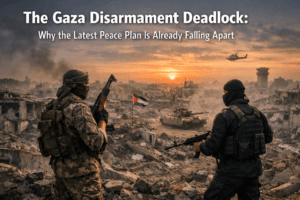
The Gaza Disarmament Deadlock: Why the Latest Peace Plan Is Already Falling Apart
As Israel demands Hamas surrender its weapons first, experts warn the 20-point agreement contains a fatal flaw—sequencing that guarantees failure and potentially a return to full-scale war.
JERUSALEM — In the cramped offices of the National Committee for the Administration of Gaza in Cairo, fifteen Palestinian technocrats wait with packed bags and no clear path home. They have budgets to allocate, ministries to rebuild, and a shattered territory of 2.2 million people to govern. What they don’t have is any idea when—or if—they will ever cross into Gaza.
Three thousand miles away in Washington, Donald Trump’s newly assembled Board of Peace held its first working meeting last Thursday. The session produced photo opportunities and carefully worded statements about historic breakthroughs. What it failed to produce was clarity on the single issue that threatens to unravel the entire US-brokered ceasefire: who disarms first, and how.
The answer to that question may determine whether Gaza’s exhausted population finally gets a chance to rebuild or finds itself plunged back into a war that has already consumed two devastating years.
The 20-Point Plan That Isn’t Really a Plan
The second phase of the ceasefire, announced with considerable fanfare in January, reads like a diplomatic wish list. Hamas disarms. Israeli forces withdraw. A Palestinian interim administration backed by an international stabilisation force takes control. The Board of Peace oversees implementation. Trump claims credit.
What the document lacks is any meaningful detail about sequencing—the diplomatic equivalent of building a house without specifying whether the foundation comes before the roof.
“The 20-point plan is vague on sequencing,” the Guardian reported on Wednesday, and that vagueness has proven fatal. Israel’s government, led by a coalition that includes ministers openly advocating for permanent Israeli control of Gaza, has seized on the ambiguity to demand that Hamas disarm completely before any other steps occur.
“Hamas would have to hand over an inventory of its heavy weapons, as well as a map of the network of tunnels it has dug under Gaza,” according to a report in the rightwing Israel Hayom newspaper that Israeli officials have not disputed. The report, which reads like a compilation of Israeli talking points, describes a six-month disarmament process beginning with heavy weapons and ending with light firearms.
Only after Hamas surrenders its arsenal, the report states, would other militias, armed clans, and gangs be required to disarm. Every subsequent step in phase two would be contingent on prior Hamas compliance.
The Ultimatum That May Never Come
Israeli officials have been briefing journalists for days that an American ultimatum is imminent. Finance Minister Bezalel Smotrich told public radio on Monday that Washington would soon give Hamas 60 days to disarm completely. Foreign Minister Gideon Saar reportedly told Israel’s security cabinet that Trump would deliver the ultimatum personally within days.
Then Tuesday night arrived, and Trump delivered his State of the Union address without mentioning Hamas, without mentioning the Board of Peace he had hailed four days earlier as a historic turning point, and without issuing any ultimatum.
The silence was deafening—and revealing.
“Netanyahu is doing everything he can to collapse phase two and resume military operations,” said Muhammad Shehada, a Gaza analyst at the European Council on Foreign Relations. “He’s doing the same trick as in Iran, making maximalist demands to get Hamas/Iran to say no to, then persuade Trump that the military option is the only way.”
The strategy, if that’s what it is, follows a familiar pattern. Present demands so extreme that the other side cannot possibly accept them, then declare negotiations failed and return to military action. It worked for Netanyahu with Iran nuclear negotiations. He appears to believe it can work with Gaza.
What Hamas Actually Might Accept
The portrayal of Hamas as an organisation that will simply hand over its weapons because the United States demands it reflects a fundamental misunderstanding of the group’s psychology and strategic position.
“Hamas is more likely to accept freezing, locking up and decommissioning its offensive weapons (eg rockets), while retaining light weapons to protect themselves against clans and gangs or should the IDF resume military operations,” Shehada said.
This distinction matters. Rockets that can reach Tel Aviv are offensive weapons. Rifles for self-defence against armed gangs or a potential Israeli reinvasion are something else entirely. Hamas has spent decades portraying itself as the armed resistance to Israeli occupation. Surrendering all weapons simultaneously, without any guarantee that Israel will actually withdraw or that other armed groups will be disarmed, would leave Hamas members potentially defenceless against multiple threats.
“The details in the Israel Hayom report would be promptly rejected by Hamas,” Shehada added. “It basically asks them to hand over everything gradually.”
Michael Milshtein, head of the Palestinian Studies Forum at Tel Aviv University’s Moshe Dayan Center and a former colonel in military intelligence, dismissed the Israeli press accounts as “more wishful thinking than a serious plan.”
Hamas’s leadership has reportedly reinforced its determination to retain weapons precisely because it believes Israel intends to resume the war. The Times of Israel cited a message from Hamas leadership in Gaza to the politburo in Qatar stating that the group must be “ready to fight the IDF again, as it is convinced that Israel is going to reinvade Hamas-held areas.”
When one side believes the other is preparing to attack, demands for unilateral disarmament become non-starters.
The Administration That Can’t Govern
Even if Hamas somehow agreed to disarm, it’s unclear who would receive the weapons. The National Committee for the Administration of Gaza—fifteen technocrats carefully selected for their lack of affiliation with any Palestinian faction—remains stuck in Cairo with no clear path into the territory they’re supposed to govern.
Their problems are multiple and compounding.
Funding has arrived slowly, leaving the committee unable to pay salaries or begin reconstruction planning. Security arrangements haven’t been finalised, making it impossible to enter Gaza safely. A police force is being trained in Jordan and Egypt to serve under the committee, but Israel is vetting every recruit and vetoing anyone who served in the Gaza police under Hamas rule.
The logic is understandable—Israel doesn’t want Hamas-affiliated officers policing Gaza—but the practical effect is devastating. Thousands of experienced officers have been excluded, leaving a few thousand newly trained recruits to manage security for 2.2 million people in the aftermath of a two-year bombardment that destroyed much of the territory’s infrastructure.
“The NCAG is far from ready to enter Gaza,” the Guardian reported, and the gap between diplomatic timelines and on-the-ground reality grows wider by the day.
The International Force That Nobody Wants to Fight
Indonesia, Morocco, Kazakhstan, Kosovo, and Albania have offered troops for the planned 20,000-strong International Stabilisation Force. Preparations are underway for a large barracks in southern Gaza. What hasn’t been agreed is what these troops would actually do—specifically, whether they would be expected to forcibly disarm Hamas.
Troop-contributing countries have made their position clear: they don’t want their soldiers dying in house-to-house weapons searches. The ISF’s mandate remains undefined precisely because potential contributors won’t sign up for a mission that requires combat operations against Hamas fighters who refuse to surrender their arms.
This creates an impossible situation. Israel demands Hamas disarmament as a precondition for withdrawal. Hamas won’t disarm without guarantees of Israeli withdrawal. The international force won’t disarm Hamas by force. And the Palestinian administration can’t enter Gaza until security is arranged.
Every party is waiting for someone else to move first, and nothing moves at all.
Two Competing Models: Northern Ireland vs. Total Conquest
Behind the diplomatic stalemate lies a fundamental disagreement about what disarmament should look like and who should oversee it.
Egypt and Saudi Arabia are reportedly advocating for a model based on the Northern Ireland peace agreement. Under that approach, an independent commission would oversee the phased disarmament of all paramilitary groups simultaneously. The process would be gradual, verified, and reciprocal—each side giving up weapons as the other takes parallel steps.
The United Arab Emirates has taken a different position, siding with Israel’s demand that Hamas disarm completely before any other steps occur. This approach, analysts say, virtually guarantees failure.
“The process is made to depend on Hamas disarming; otherwise, everything else is temporarily held up, until Israel decides to return to full-scale war,” said HA Hellyer, a senior associate fellow at the Royal United Services Institute. “This isn’t a situation that lends itself to positive outcomes.”
Smotrich, Israel’s far-right finance minister, has been characteristically blunt about what he expects to happen. “In the end, Israel will occupy the Gaza Strip, implement a military government and establish Jewish settlements there,” he said this week, adding: “It doesn’t matter if it happens in a year, two years, or three years.”
When a senior Israeli minister openly discusses permanent occupation and settlement as the inevitable outcome, it becomes difficult for Hamas to view disarmament as anything other than a prelude to destruction.
The Human Cost of Diplomatic Failure
Lost in the discussion of ultimatums, sequencing, and mandates is what this stalemate means for ordinary Gazans.
Two years of bombardment have reduced entire neighbourhoods to rubble. The health system functions at a fraction of its pre-war capacity. Clean water is scarce. Children have missed years of education. Families live in tents amid the wreckage of their homes.
The ceasefire’s first phase brought a desperately needed pause in fighting. Relief supplies entered. Some hostages and prisoners were exchanged. For the first time in years, Gazans could venture outside without immediate fear of airstrikes.
But a pause is not peace. Reconstruction cannot begin while the threat of renewed war hangs over every decision. International donors won’t commit billions to rebuild homes that may be bombed again. Families can’t plan for the future when they don’t know if their children will survive the year.
“The light weapons would be under a strict policy of no use, no public display,” Shehada suggested as a potential compromise. “Anyone showing a gun in public would be arrested by NCAG’s police.”
Such an arrangement might work. It would allow Hamas to maintain defensive capabilities while visibly disarming in public spaces. It would give the NCAG authority to enforce order. It would provide Israel with evidence that weapons are being secured rather than used.
But compromise requires both sides to want it. The evidence increasingly suggests that at least one party to this conflict sees more advantage in war than in peace.
Trump’s Board of Peace and the Missing President
The Board of Peace was supposed to provide oversight and momentum. Trump hailed it four days before his State of the Union address as a historic turning point—a mechanism that would cut through diplomatic bureaucracy and deliver results.
Then Tuesday night came, and Trump didn’t mention it at all.
The omission speaks volumes about where Gaza ranks on the president’s priority list. With midterm elections approaching, with economic concerns dominating domestic news, with multiple international crises competing for attention, the fate of a small Mediterranean territory may not command the sustained presidential focus that peace agreements require.
Israeli officials continue to insist that Trump will deliver his ultimatum. “It is estimated that, in the coming days, Hamas will be given an ultimatum to disarm and fully demilitarise Gaza,” Smotrich told public radio, attributing the impending deadline to Washington.
But estimates are not commitments, and the days keep passing without action.
What Comes Next
The most likely outcome, analysts suggest, is not compromise but collapse. Hamas will refuse maximalist demands. Israel will declare negotiations failed. The United States will offer rhetorical support for renewed military action. And Gaza will return to war.
“The Israeli approach would virtually guarantee the collapse of the 20-point plan,” Hellyer said, and nothing that has happened in recent days suggests otherwise.
Smotrich, at least, is honest about his preferences. He expects disarmament to fail, expects renewed war, expects permanent Israeli control. “It doesn’t matter if it happens in a year, two years, or three years,” he said.
For Gazans, it matters enormously. Another year of war means more deaths, more destruction, more children growing up amid rubble and grief. Two years means another generation lost. Three years means the complete eradication of any remaining infrastructure for normal life.
The fifteen technocrats waiting in Cairo represent the last best hope for a different future. They have budgets to allocate, ministries to rebuild, a population to serve. What they don’t have is any control over the forces that will determine whether they ever get the chance.
In Washington, the Board of Peace meets and issues statements. In Jerusalem, ministers demand unconditional surrender. In Gaza, families huddle in tents and wait to learn whether the silence above them means peace is coming or war is about to resume.
The weapons that stall this peace plan are not abstractions. They are loaded rifles and hidden rockets, tunnel maps and inventory lists—physical objects that real people will either surrender or keep, with consequences that will ripple across generations.
Until someone answers the sequencing question—who disarms first, and how, and with what guarantees—those weapons will remain where they are. And the peace plan that was supposed to end Gaza’s suffering will join the long list of diplomatic efforts that promised much and delivered nothing.
You must be logged in to post a comment.