
The Gaza Dilemma: As Political Elites Debate “Peace Boards,” a Generation Freezes in the Mud
In January 2026, a U.S.-backed plan for postwar Gaza governance, featuring a “Board of Peace” and an advisory “Executive Board” that includes critics of Israel like Turkey and Qatar, has sparked furious rejection from Israel’s far-right coalition ministers, who demand full annexation and settlement instead, exposing Prime Minister Netanyahu’s precarious political tightrope; meanwhile, this high-stakes geopolitical clash stands in stark, grim contrast to the reality in Gaza, where a fragile ceasefire has not stopped civilian deaths, with recent winter storms flooding displacement camps and claiming lives, including infants dying from hypothermia, highlighting a devastating disconnect between political maneuvering and the immediate, uninhabitable suffering on the ground.
The Gaza Dilemma: As Political Elites Debate “Peace Boards,” a Generation Freezes in the Mud
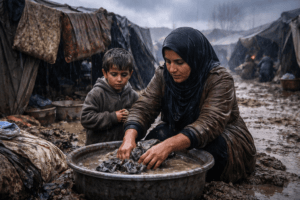
The image is almost biblical in its suffering: a young Palestinian boy stands beside his mother as she washes clothes in a basin, their world reduced to the confines of a rain-lashed tent. Mattresses, soaked and heavy, hang like forgotten flags over a makeshift camp. This is the “postwar” reality of Gaza in January 2026—a state not of peace, but of precarious pause, where death now comes not only from bombs but from collapsing tent walls and hypothermia.
While this scene of profound human distress unfolds, a parallel drama is being staged in the halls of power. This week, the revelation of a U.S.-backed plan for Gaza’s future governance—a complex structure of “Boards” and technocratic committees—has not heralded unity, but ignited a fresh political inferno within Israel’s own government, exposing the chasm between geopolitical engineering and ground-level survival.
The Far-Right Revolt: Annexation Over Administration
At the heart of the storm are Prime Minister Benjamin Netanyahu’s far-right coalition partners, for whom the White House’s plan is not a solution, but a betrayal. Finance Minister Bezalel Smotrich, a foundational figure of the settler movement, labeled Netanyahu’s engagement the “original sin.” His alternative is stark, simple, and to much of the world, incendiary: full Israeli military control, state-backed settlement, and the explicit encouragement of Palestinian emigration.
Smotrich’s vision is a deliberate echo of a past paradigm, one that rejects the very premise of Palestinian self-governance. His furious rejection of Turkish and Qatari roles on the proposed “Gaza Executive Board” is telling. “The countries that inspired Hamas cannot be the ones that replace it,” he declared. This framing reduces nuanced regional diplomacy to a binary of good and evil, and in doing so, it boxes Netanyahu in. The Prime Minister’s survival depends on these allies, yet their demands—effective permanent annexation—are anathema to the U.S.-led international framework he is being pressed to accept.
Netanyahu’s own terse complaint that board appointments were “not coordinated with Israel” reveals a leader caught in an impossible bind. He must perform sovereignty for his right-wing base while navigating immense American pressure. His instruction to Foreign Minister Gideon Sa’ar to call U.S. Secretary of State Marco Rubio was less a diplomatic maneuver and more a public display of strained allegiance.
Decoding the “Board of Peace”: A New Model or a Geopolitical Marketplace?
The structure proposed by the Trump administration is Byzantine in its complexity, raising as many questions as it aims to resolve.
- The Board of Peace: Chaired by Donald Trump himself, it reads like a gallery of strategically chosen, strong-minded leaders: Turkey’s Recep Tayyip Erdoğan, Egypt’s Abdel Fatah al-Sisi, Argentina’s Javier Milei, and the UK’s Tony Blair. Its function seems more declarative than operational—a high-level endorsement body for a plan bearing its chairman’s name.
- The Palestinian Technocratic Committee: Tasked with the day-to-day governance of Gaza, this group, which has already met in Cairo, faces a Herculean task. It must build a functional administration from the rubble of war, with no democratic mandate, under the gaze of hostile Israeli neighbors and a suspicious Palestinian public.
- The Gaza Executive Board: This advisory body is where the controversy festers. Including Turkey and Qatar—two of Hamas’s most prominent international interlocutors—is a clear U.S. attempt to co-opt potential spoilers into the system. For Israel’s right, it’s an affront. For observers, it prompts a critical question: is this genuine inclusion, or a tactic to neutralize criticism?
Most revealing, however, is the reported funding model. The draft charter’s clause allowing countries to extend their three-year membership by contributing $1 billion in cash transforms the board from a purely political body into something resembling a high-stakes club. This “pay-to-stay” mechanism risks commodifying peacemaking, privileging wealthy Gulf states and creating a tiered system of influence. It suggests a vision where commitment is measured not in diplomatic capital or political compromise, but in direct deposits.
The Chilling Disconnect: Politics Versus the Perishing
This fierce political debate over boards, billion-dollar fees, and annexation exists in a haunting vacuum, disconnected from the immediate reality it claims to address. The so-called “second phase” of the ceasefire may focus on “disarmament, governance, and reconstruction,” but in Gaza’s displacement camps, the focus is on staying alive until morning.
The statistics are a quiet scream: at least 451 Palestinians killed since the ceasefire began, not in a grand military offensive, but in the relentless, grinding violence of a shattered environment. The recent winter storms have been as lethal as any weapon, killing four when tent walls collapsed. The death of a 27-day-old baby from severe cold is not just a tragedy; it is an indictment. That this infant becomes the eighth child to die of hypothermia this season reveals a catastrophic failure of provision.
This is the core insight that the political theatrics obscure: “Postwar” Gaza is currently uninhabitable. No governance plan, however cleverly architected, can succeed if the population is literally freezing to death in tents. Reconstruction cannot begin when people lack the basic shelter to survive a rainstorm. Demilitarization is a hollow concept for parents whose primary enemy is the winter wind.
The dissonance is staggering. As Smotrich lectures on the strategic necessity of settlement, the land he speaks of settling is a flooded, traumatized, public health catastrophe. As diplomats debate the composition of an executive board, the only board most Gazans know is the plywood holding up their shelter.
The Path Ahead: A Test of Competing Realities
The current impasse presents a fundamental test of competing realities. One reality, held by Israel’s far-right and segments of its public, is one of absolute security achieved through total control. The other, advanced by the U.S. and a fractured international community, is of stability achieved through a patched-together regional consortium and technocratic management.
Both are crashing into the third, and most urgent, reality: that of 2.2 million people in acute humanitarian peril, for whom these political designs are an abstraction. The Biden administration’s plan, for all its flaws, at least acknowledges that Israel cannot simply occupy Gaza in perpetuity without catastrophic regional and moral consequences. The far-right’s plan, for all its brutal clarity, ignores the human powder keg it would sit upon.
The baby who died of cold did not perish because of Hamas or the Israeli military. She died of neglect—the neglect inherent in a transition process that treats governance as a puzzle to be solved in capital cities before the basic conditions for human life are secured on the ground.
The real insight for readers is this: watch the babies, not just the boards. The viability of any peace plan will be determined not by who sits on which committee, or even by billion-dollar contributions, but by whether a mother in a tent can keep her child warm. Until the political energy matches the urgency of that most basic human task, the elegant frameworks and angry declarations will remain just so much words, blowing through camps where the laundry never dries and the cold, quiet suffering continues unabated.
You must be logged in to post a comment.