
The Gavel and the Globe: What Trump’s Supreme Court Defeat Really Means for the Future of American Power
The article analyzes the profound constitutional and political implications of the Supreme Court’s ruling against Donald Trump’s use of emergency powers to impose sweeping global tariffs, framing it as a fundamental reassertion of congressional authority over the “power of the purse” rather than a mere policy dispute. It explores Trump’s defiant reaction—threatening alternative legal tools like Section 122 and Section 301 investigations—as a window into the philosophical clash between executive supremacy and constitutional checks and balances, while examining the real-world impact on American farmers, manufacturers, and global alliances. Ultimately, the piece argues that the ruling restores predictability and due process to trade policy, reminding citizens that the United States remains “a nation of laws, not of men,” where even the presidency must operate within constitutional guardrails.
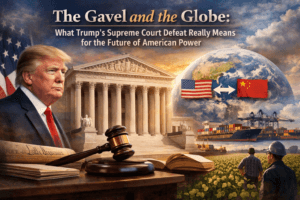
The Gavel and the Globe: What Trump’s Supreme Court Defeat Really Means for the Future of American Power
In the tapestry of American governance, few threads are as fiercely contested as the boundary between executive action and legislative authority. On a recent Friday, that boundary was not just tested but redrawn, as the Supreme Court delivered a landmark ruling that struck at the very heart of Donald Trump’s second-term economic agenda. The former president’s immediate, visceral reaction—”I can do anything I want”—was less a statement of fact and more a window into a philosophical clash that will define the republic for years to come. This is not merely a story about tariffs; it is a story about the soul of the presidency, the resilience of the Constitution, and the unpredictable winds of the global economy.
The Illusion of Absolute Power
To hear Donald Trump tell it, the presidency is a bulwark against a chaotic world, best wielded by a single, decisive will. His address following the ruling was vintage Trump: defiant, aggrieved, and sweeping. “There are methods that are even stronger available to me,” he warned, a phrase that sent ripples of anxiety through diplomatic circles and boardrooms alike. He spoke of being “absolutely ashamed” of the justices, accusing them of a lack of courage.
But beneath the bluster lies a fundamental tension. The Supreme Court’s 6–3 decision was not a partisan squabble over economic theory; it was a profound reassertion of a core constitutional principle: the power of the purse belongs to Congress. By ruling that Trump’s use of emergency powers to impose sweeping global tariffs was unlawful, the Court effectively told the executive branch that it cannot rewrite trade law simply by invoking a crisis.
This is where the human insight comes in. For the average observer, “tariffs” are abstract concepts that translate to slightly higher prices on foreign goods. But for the institutional health of the country, this ruling is a warning shot. It says that the President is not a king, and the economy cannot be restructured on a whim. It reminds us that the Founding Fathers, wary of a monarch’s ability to unilaterally control commerce, placed that authority squarely in the people’s House.
Section 122 and the Ghosts of Presidents Past
In his agitated response, Trump threatened to invoke Section 122 of the Trade Act of 1974 to impose a 10% global tariff. This is a fascinating pivot that reveals the legal tightrope the administration must now walk. Section 122 is a dusty relic of a different era, a law that allows a president to impose temporary tariffs to deal with balance-of-payments deficits. But it is a pale shadow of the authority Trump previously claimed.
Here lies the genuine value for readers trying to understand the stakes: invoking Section 122 is an admission of weakness. It is a statutory backstop, not a blank check. It allows for tariffs, but they must be temporary and are subject to specific international rules. By threatening to use it, Trump is signaling that while he lost the battle over emergency powers, he is willing to rummage through the legislative attic to find any tool that keeps his protectionist agenda alive.
The mention of Section 301 investigations further complicates the picture. Unlike the broad, emergency-based tariffs that were struck down, Section 301 is a specific tool designed to combat unfair trade practices by specific nations. It is slower, more surgical, and requires evidence. This shift from a “scorched earth” global tariff to a more targeted (albeit still aggressive) approach suggests that even as Trump rails against the Court, his administration is being forced to play by the rules of law, rather than the rules of power.
The Human Cost of “Reciprocal” Trade
It is easy to get lost in the legal jargon of “emergency powers” and “congressional approval.” But to understand the real impact of this ruling, we must look at the people it affects.
Consider the soybean farmer in Iowa. Under the original tariff regime, he watched as China, hit with retaliatory duties, stopped buying his crop. His livelihood became a bargaining chip in a geopolitical game. Or think of the manufacturer in Ohio who relies on imported steel for his supply chain. His costs skyrocketed, forcing him to delay hiring or raise prices, feeding the very inflation he was told the tariffs would combat.
The Supreme Court’s ruling is a victory for these Americans in the long run, not because it stops all tariffs, but because it insists on predictability and due process. Business leaders crave stability. They need to know that the rules won’t change overnight because a president woke up frustrated by a court ruling. By striking down the “emergency” justification, the Court has restored a measure of predictability to the market. It forces the debate back to Congress, where it belongs, and where the complex, diverse interests of 330 million Americans can be heard, rather than filtered through the singular worldview of the Oval Office.
“I Am Ashamed”: The Psychology of a Defeat
Trump’s reaction—singling out specific justices for shame—offers a crucial psychological insight into the modern presidency. It reveals a belief that the judiciary is not an independent arbiter but an extension of the political will. When he says the justices lacked “courage,” he implies that courage means deference to the executive.
This is a dangerous narrative. The courage of the judiciary lies precisely in its ability to say “no” to power. The justices who ruled against Trump did not make a political statement about tariffs; they made a constitutional statement about process. They affirmed that even popular (or unpopular) policies must be enacted through the correct channels.
For the average citizen, this is the ultimate protection. The machinery of government is designed to be slow and cumbersome because speed and efficiency are the hallmarks of authoritarianism, not democracy. The Court’s ruling is a reminder that the guardrails of democracy, however frayed they may seem, still hold.
The Global Domino Effect
Trump’s threat of a 10% global tariff under Section 122, if enacted, would not happen in a vacuum. It would trigger a cascade of international retaliation. Allies like the European Union and Japan, who were caught in the crossfire of the original tariffs, have already drawn up retaliatory lists targeting iconic American exports—from Harley-Davidson motorcycles to bourbon whiskey.
The “human insight” here is the fragility of global goodwill. The United States built the post-World War II global order on the promise of open markets and mutual defense. When the U.S. unilaterally imposes tariffs under the guise of “emergencies” or “unfairness,” it erodes that trust. It forces other nations to look elsewhere for trade partners, accelerating the very fragmentation of the global economy that stability relies upon.
Countries like China watch these events with keen interest. A U.S. that is bogged down in legal battles over its own trade policy is a U.S. that is less able to present a unified front on the global stage. The Supreme Court’s ruling, while a domestic legal matter, has effectively clipped the wings of American economic foreign policy, forcing a more multilateral and negotiated approach.
The Future of Executive Power
This ruling will be studied by legal scholars for decades. It establishes a critical precedent: the President cannot use a broad interpretation of emergency powers to remake vast swaths of the economy. Future presidents, regardless of party, will have to think twice before invoking the same statutes.
This is a return to normalcy, but in today’s polarized environment, normalcy feels like revolution. The Court has essentially said that if the President wants a new trade war, he must convince Congress to authorize one. Given the gridlock in Washington, this means that the era of major, unilateral trade actions may be over.
However, the story does not end with a happy sigh of relief. The threats remain. The investigations under Section 301 will continue. The political pressure to be “tough on China” or “tough on trade” is not dissipating. What has changed is the mechanism. The battle has moved from the Rose Garden to the committee rooms of the Capitol.
Conclusion: A Republic, If You Can Keep It
Donald Trump’s declaration that he can “do anything I want” was the rallying cry of a populist executive. The Supreme Court’s response was the quiet, firm answer of a constitutional republic: “No, you can’t.”
For readers trying to make sense of this, the takeaway is not about whether tariffs are good or bad. It is about who gets to decide. The Supreme Court has reminded us that the United States is a nation of laws, not of men. The frustration in Trump’s voice is the sound of power hitting the limits of its leash.
As we look ahead, the global economy will remain a battleground. But thanks to this ruling, that battle will be fought in the open, with debate, with representation, and with a process that values the consent of the governed over the will of one. In an age of uncertainty, that is not just a legal victory; it is a reassurance to every American that the founding principles of checks and balances are not just historical footnotes—they are living, breathing safeguards that still have the power to shape our future.
You must be logged in to post a comment.