
The Gavel and the Clock: Can the Supreme Court Impose Timelines on a President’s Assent?
In a landmark constitutional moment, the Supreme Court is set to deliver its opinion today on a presidential reference that questions whether the judiciary can impose timelines for the President and Governors to grant assent to state bills when the Constitution itself prescribes no such deadlines.
This confrontation was triggered by the Court’s own April 2025 ruling, which directed the President to decide on bills from Tamil Nadu within three months, leading President Droupadi Murmu to invoke Article 143 and ask the central question: how can a court mandate what the constitutional text does not? The Court’s response will fundamentally redefine the boundaries of judicial power and executive discretion, determining whether the silence of the Constitution permits judges to prevent legislative paralysis by reading a “clock” into its provisions, thus deciding the future balance of power in India’s federal structure.
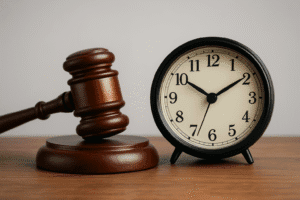
The Gavel and the Clock: Can the Supreme Court Impose Timelines on a President’s Assent?
In a constitutional showdown that strikes at the very heart of India’s federal structure and the separation of powers, the Supreme Court is poised to deliver a landmark opinion today. At the center of the storm is a deceptively simple question: In a democracy governed by a written Constitution, what happens when the document is silent on a critical procedural detail? More specifically, can the judiciary read a “clock” into the Constitution, forcing the President and Governors to act on bills within a defined timeframe?
This isn’t an abstract legal debate. It is the direct consequence of a political and constitutional impasse, sparked by the actions of the Tamil Nadu Governor and culminating in a historic reference from President Droupadi Murmu herself. The Court’s answer will not merely interpret the law; it will redefine the balance of power between the Centre, the States, and the Judiciary for generations to come.
The Genesis of the Crisis: From Chennai to Raisina Hill
The chain of events leading to this unprecedented moment began in Tamil Nadu. Governor R.N. Ravi withheld assent to a batch of 10 bills passed by the state’s legislative assembly, eventually reserving them for the consideration of the President—a move the Supreme Court would later brand as “illegal and erroneous.”
In its groundbreaking ruling in April 2025, the Supreme Court didn’t just criticize the Governor; it took the extraordinary step of allowing the Tamil Nadu government to notify the bills without the Governor’s assent. More crucially, it directed the President to take a decision on the bills reserved for his consideration within three months.
This judicial directive, while solving an immediate crisis, opened a Pandora’s Box of constitutional questions. The Constitution, under Articles 200 and 201, meticulously outlines the options available to a Governor and the President when a bill is presented to them—they can assent, withhold assent, or (in the case of the Governor) reserve the bill for the President’s consideration. However, it is conspicuously silent on the time within which this power must be exercised.
It is this silence that President Murmu has invoked, using the advisory jurisdiction under Article 143 to seek the Supreme Court’s opinion on 14 pointed questions. Her central, almost philosophical query is: “How can the Court set a timeline when the Constitution does not?”
Deconstructing the President’s 14 Questions: A Clash of Doctrines
The President’s reference is a masterclass in constitutional law, probing the limits of judicial power, the nature of executive discretion, and the very structure of Indian federalism. The questions can be grouped into several critical themes:
- The Nature of Executive Discretion and Its Justiciability (Questions 1, 2, 3, 4, 6, 9)The core issue here is whether the Governor and President exercise “constitutional discretion” or are bound by the aid and advice of the Council of Ministers. For the Governor, the debate is fierce. While they are typically expected to act on ministerial advice, certain situations (like reserving a bill for the President if it undermines the High Court’s power) are seen as discretionary.
The President’s reference questions whether this discretion is absolute and beyond judicial review. The Supreme Court has historically held that no power under the Constitution is unbridled, but venturing into the content of a bill before it becomes law, as Question 9 asks, is a judicial minefield the Court has traditionally avoided.
- Judicial Law-Making vs. Constitutional Silence (Questions 5, 7, 10, 13)This is the heart of the matter. The Court’s three-month deadline was an example of what is often called “judicial activism” or, more charitably, “constitutional instrumentation”—the process of filling in the gaps left by the framers of the Constitution to make it a living, functional document.
The President’s questions challenge this directly. They ask if the judiciary can, through its orders under Article 142 (which allows it to pass any decree necessary for “complete justice”), create substantive procedures that the Constitution itself does not prescribe. Is the Court interpreting the law, or is it legislating from the bench? The answer will define the limits of the Court’s immense power under Article 142.
- The Unique Position of the President (Questions 7, 8)Question 8 is particularly intriguing. It asks if the President, as the highest constitutional authority, isrequired to seek the Supreme Court’s advice via a reference when a Governor reserves a bill. This touches upon the President’s own duty to act independently and deliberately. Is the Article 143 reference a constitutional obligation or merely an optional power? The Court’s view on this could create a new precedent for resolving future Centre-State deadlocks.
- Federalism and Dispute Resolution (Question 14)This question broadens the scope significantly, asking ifArticle 131 (which gives the Supreme Court original jurisdiction in disputes between the Union and States) is the only way to resolve such conflicts. The Tamil Nadu case was not filed under Article 131 but as a writ petition. A narrow interpretation here could force all future federal disputes into a specific, and potentially more cumbersome, legal pathway.
The Human and Democratic Cost of “Indefinite Abeyance”
Beyond the legal jargon lies a pressing democratic reality. As the Supreme Court itself noted, the absence of a timeline creates a state of “indefinite and uncertain abeyance.” This is not a victimless procedural delay.
Imagine a state legislature, elected by the people, passing a bill for a farmer loan waiver, a critical public health scheme, or a major educational reform. That bill then lands on the Governor’s desk and enters a black hole. The government’s mandate is stalled, public funds are frozen, and the welfare measures intended for millions of citizens are held hostage to political calculation or simple inertia. This undermines the very principle of responsible government and renders the state legislature impotent.
The judiciary’s imposition of a timeline, therefore, is not merely about efficiency; it is about preserving the functional integrity of India’s parliamentary democracy at the state level. It is a check against the potential misuse of a constitutional office to paralyze a politically rival administration.
The Road Ahead: A Constitutional Watershed
The Supreme Court‘s opinion today is advisory, not binding. However, given the Court’s stature, it will carry immense legal and moral weight and will likely be treated as the law of the land.
The Court faces a delicate balancing act. On one hand, it must respect the text of the Constitution and the defined boundaries of each branch of government. Imposing rigid timelines on the highest executive offices could be seen as a judicial overreach.
On the other hand, the Constitution is not a suicide pact. Its silences cannot be interpreted as licenses for paralysis. The Court’s fundamental duty is to uphold the Constitution’s basic structure, which includes democracy, federalism, and the rule of law. An unchecked power to indefinitely delay legislation strikes at the root of all three.
The most likely outcome is a nuanced one: the Court may reaffirm that while it cannot legislate a specific number of days into the Constitution, it retains the power of judicial review to prevent the “abuse” of power. It could establish the principle that assent or refusal must be given within a “reasonable time,” with the definition of “reasonable” being context-dependent but judicially enforceable. This would provide a constitutional principle without micromanaging the executive.
Whatever the verdict, November 20, 2025, will be remembered as the day the Supreme Court was asked to decide if, in the grand, ticking clock of Indian democracy, time itself is a constitutional virtue.
You must be logged in to post a comment.