
The Gatekeepers and the Gagged: Inside the Collapse of Israel’s High-Profile Prison Abuse Case
Israeli military prosecutors have dropped all charges against five soldiers accused of the aggravated sexual abuse of a Palestinian detainee at the Sde Teiman military prison, a case that had sparked national controversy after leaked CCTV footage allegedly showed the guards using a sharp object to inflict severe internal injuries requiring hospital treatment. The military cited procedural failures, including the former Military Advocate General’s unauthorized leak of evidence and complications arising from the detainee’s release back to Gaza, as reasons for withdrawing the indictment. Prime Minister Benjamin Netanyahu praised the decision as ending a “blood libel” against “heroic fighters,” while human rights groups condemned it as a systematic whitewash that effectively grants soldiers impunity for abusing Palestinian prisoners.
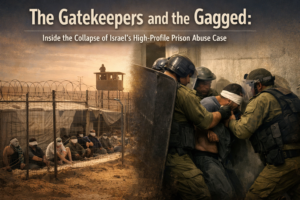
The Gatekeepers and the Gagged: Inside the Collapse of Israel’s High-Profile Prison Abuse Case
For seven months, five Israeli soldiers stood accused of a crime that horrified even hardened military legal experts—using a sharp object to penetrate a Palestinian detainee so severely that it left him with a punctured lung, cracked ribs, and a torn rectum. This week, all charges were quietly erased.
The decision landed like a thunderclap in Israel’s legal and human rights communities. On Thursday, Maj Gen Itai Ofir, Israel’s new Military Advocate General, announced the complete withdrawal of indictments against five guards at the Sde Teiman military detention facility. The men had been charged with aggravated sexual abuse and causing serious bodily harm to a Palestinian detainee from Gaza—charges they consistently denied.
But this is not simply a story about five soldiers and one alleged victim. It is a story about leaked CCTV footage, a general turned criminal defendant, the impossible task of prosecuting wartime abuses, and the widening chasm between how Israel sees its military and how the world judges its conduct.
The Desert Prison That Became a Flashpoint
Sde Teiman sits in the Negev desert, a sprawling military base that was never designed to be a prison. After October 7, 2023, when Hamas fighters breached Israel’s border and killed approximately 1,200 people, Israel transformed the base into a temporary detention center for Palestinians captured during the Gaza offensive.
What emerged was something unprecedented in modern Israeli history. Detainees arrived bound and blindfolded, held in crowded enclosures originally intended for short-term military use. Human rights organizations began receiving alarming reports: men stripped to diapers, forced into stress positions for hours, denied adequate food and water.
The military consistently denied systematic abuse, insisting that all detainees were treated according to international law. But in July 2024, something happened inside Sde Teiman that would force the issue into public view—and ultimately tear apart the military justice system itself.
The Night Watch: What the Cameras Captured
According to charging documents later filed by the Military Advocate General’s Corps, the incident occurred during a night shift when a group of guards confronted a detainee. What exactly triggered the confrontation remains disputed, but CCTV footage captured fragments of what followed.
The video shows guards pushing the detainee against a wall. Then, in a detail that would become central to the case, they shielded him from camera view using their riot shields. Behind that temporary wall of polycarbonate, prosecutors alleged, something brutal occurred.
The detainee was later rushed to a hospital outside the base. Medical staff documented injuries that went far beyond what standard guard-detainee altercations typically produce: cracked ribs, a punctured lung, and a severe internal tear near his rectum consistent with penetration by a sharp object. He required emergency surgery.
The military’s initial statement was unusually explicit: the soldiers were accused of “stabbing the detainee’s bottom with a sharp object, which had penetrated near the detainee’s rectum.” Five guards were identified, charged, and the case seemed headed for court-martial.
Then the video leaked.
The General Who Leaked Evidence
In August 2024, an Israeli television channel broadcast portions of the Sde Teiman CCTV footage. The broadcast sparked immediate outrage—but not for the reasons one might expect. Some right-wing politicians and commentators seized on the footage not as evidence of abuse, but as proof that the charges were fabricated.
Maj Gen Yifat Tomer-Yerushalmi, then Israel’s Military Advocate General, found herself at the center of a political firestorm. How had this sensitive evidence reached the public? Weeks later, the answer emerged: Tomer-Yerushalmi herself had authorized the leak.
Her explanation, delivered in a resignation letter that would later become evidence in her own criminal case, was striking. She said she approved releasing the footage “in an attempt to counter false propaganda against the army’s law enforcement authorities.” Translation: she wanted to show the public that there was genuine evidence supporting the charges, to push back against claims from nationalist politicians that the abuse allegations were fabrications designed to persecute heroic soldiers.
Instead, the leak backfired spectacularly. Tomer-Yerushalmi was arrested, charged with improper conduct, and forced to resign. The case against the five guards suddenly had a new problem: the highest-ranking military lawyer in the country, the very person responsible for prosecuting them, had been arrested for mishandling their evidence.
The Legal Collapse
By the time Maj Gen Itai Ofir took over as Military Advocate General, the case was already crumbling. On Thursday, he laid out the reasons for dropping all charges in terms that left human rights lawyers shaking their heads in disbelief.
The military cited “exceptional circumstances that negatively affected the ability to prosecute the case while also preserving the right for a fair trial of the defendants.” More specifically, they pointed to:
- The complexity of evidence — A standard challenge in detention cases, where witnesses are detainees and guards whose accounts rarely align.
- “Extremely exceptional and unprecedented circumstances” stemming from the former Military Advocate General’s conduct — a direct reference to the leak investigation that consumed the military’s legal leadership.
- Difficulties transferring investigative material from police — bureaucratic delays that prosecutors said hampered their ability to build the case.
- The detainee’s release — Perhaps the most practical obstacle: the alleged victim, whose testimony would have been central to any trial, was freed in October and allowed to return to Gaza. Whether military prosecutors could have secured his cooperation from inside the war zone remains unclear.
Lt Gen Eyal Zamir, Chief of the General Staff, issued instructions for personnel to “draw lessons and to take all the requested steps to prevent similar cases.” It was the kind of vague, forward-looking statement that often accompanies legal embarrassments—acknowledging something went wrong without specifying what.
“Blood Libel” or Systematic Abuse?
Prime Minister Benjamin Netanyahu greeted the decision with characteristic defiance. “The State of Israel must hunt down its enemies—not its heroic fighters,” he declared, hailing the end of what he called a “blood libel”—a term steeped in historical resonance, originally referring to false accusations of murder leveled against Jews.
For Netanyahu and his supporters, the dropped charges represent justice served: soldiers who acted in good faith, protecting their country, finally freed from politically motivated prosecution. The five guards were not abusers, in this telling—they were victims of an overzealous legal system and a former general who leaked evidence for her own purposes.
But across the political and human rights spectrum, a very different interpretation emerged.
Sari Bashi, executive director of the Public Committee Against Torture in Israel, did not mince words. “Israel’s military advocate general just gave his soldiers license to rape—so long as the victim is Palestinian,” she told the Associated Press. Her organization has documented dozens of abuse cases in Israeli detention facilities since October 7, 2023, and argues that the Sde Teiman case fits a broader pattern.
“The decision to drop these charges is the latest in a long line of actions that whitewash abuses against detainees whose frequency and severity have worsened dramatically” since the war began, Bashi said.
The Broader Context: Detention in Wartime
To understand why this case matters beyond the five soldiers involved, one must understand what has happened inside Israeli prisons since October 2023.
The United Nations Committee Against Torture issued a deeply critical report in November, expressing alarm about what it described as “a de facto state policy of organized and widespread torture and ill treatment” of Palestinian detainees. The allegations, the committee noted, had “gravely intensified” after the Hamas attacks.
Human rights groups have documented deaths in custody—at least 94 Palestinians died in Israeli prisons over a two-year period, according to one count. They have collected testimonies from released detainees describing sexual abuse, prolonged shackling, sleep deprivation, and denial of medical care.
Israel’s government has consistently rejected these allegations as biased and politically motivated, insisting that its detention practices meet international legal standards. The military maintains robust mechanisms for investigating complaints, officials argue, and any abuses that occur are aberrations, not policy.
The Sde Teiman case was supposed to test that claim. Here was an incident partially caught on video, with identifiable soldiers and documented medical injuries. If any case could prove that the system works—that abuses are investigated and punished—it was this one.
Instead, the charges were dropped.
The Human Price of Legal Complexity
Lost in the legal maneuvering and political recriminations is the man at the center of it all: the Palestinian detainee whose injuries required emergency surgery, whose torn rectum and punctured lung allegedly resulted from an encounter with armed guards.
He is now back in Gaza, assuming he survived the war. What justice exists for him? His alleged attackers face no consequences. The evidence that might have supported his account—the CCTV footage—is now tainted by the circumstances of its release. The former general who could have championed his case is herself under criminal investigation.
His name has never been publicly released. He exists in the record only as “a Palestinian detainee from Gaza,” a cipher in someone else’s legal drama. For human rights advocates, that anonymity is itself symbolic: Palestinian victims, they argue, are never quite real to the Israeli legal system, never quite worthy of the full weight of justice.
What Comes Next
The military has closed this chapter, but the questions it raised remain open. Can any abuse case against Israeli soldiers succeed when the accused are framed as “heroic fighters” and the victims are invisible enemies? Did the former Military Advocate General’s leak—intended to prove the charges were real—actually ensure they would never be proven? And what message does this send to guards in Sde Teiman and other detention facilities about the consequences of excessive force?
For the five soldiers, life returns to normal. Their names, unlike their alleged victim’s, will remain known to military authorities but shielded from public view. They walk away with their careers intact, their denials standing, their version of events unchallenged in any courtroom.
For the Palestinian man who needed surgery for injuries allegedly inflicted behind a wall of riot shields, there is only silence—and the knowledge that in Israel’s military justice system, some victims matter more than others.
The Sde Teiman abuse case began with cameras capturing something terrible. It ends with those same cameras recording nothing at all.
You must be logged in to post a comment.