
The Fragile Truce: How Gaza’s Ceasefire Became a Stage for Continued Conflict
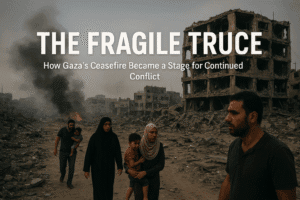
The Fragile Truce: How Gaza’s Ceasefire Became a Stage for Continued Conflict
When a ceasefire between Israel and Hamas took effect on October 10, 2025, it offered a desperate glimmer of hope for Gaza’s beleaguered population. Mediated by international powers and designed as a phased roadmap to peace, the agreement promised an end to hostilities, the exchange of hostages and prisoners, and the unimpeded flow of humanitarian aid. Yet, in the 50 days that followed, that hope has been systematically shattered. According to figures from Gaza’s Health Ministry, at least 357 Palestinians have been killed since the truce began, a stark testament to a peace process unraveling in real-time.
This continuing violence raises profound and disturbing questions. What is the value of a ceasefire that fails to stop the killing? How can a political agreement hold when the reality on the ground is one of persistent military engagement? The story of this fractured truce is not just one of breached terms but of a deeper failure—a failure to address the core drivers of a conflict that has now claimed over 70,000 Palestinian lives since October 2023.
Beyond the Headlines: What a Ceasefire Really Means
The term “ceasefire” suggests a clean halt to fighting, but in the complex arena of international law and asymmetric warfare, the reality is often murkier. According to legal analysis, a ceasefire is designed to “freeze a conflict in place” and halt active combat. However, its strength depends entirely on the political will of the parties involved and the agreement’s specific provisions. Resuming hostilities may breach a political deal, but it does not necessarily constitute a violation of international law unless the ceasefire is embedded within a binding treaty or a United Nations Security Council resolution.
The October 2025 agreement was ambitious on paper. Its first phase included an immediate end to hostilities, the release of all captives held in Gaza, the release of Palestinian prisoners, the lifting of the Israeli blockade on aid, and the withdrawal of Israeli forces to a “yellow line”. By postponing the most politically sensitive issues—like Hamas’s complete disarmament and Gaza’s future governance—the deal aimed to create a framework both sides could accept in the short term.
Yet, from the outset, its foundations were shaky. The signing ceremony was notably attended by representatives from 30 countries, but both Israel and Hamas were absent. This lack of direct buy-in from the primary belligerents created a critical vulnerability, leaving the truce exposed to the slightest provocation or shift in tactical calculations.
A Truce in Name Only: The Anatomy of 50 Days of Violence
The data paints a picture of a ceasefire existing more in diplomatic communiqués than in the streets and homes of Gaza. From October 10 to December 2, Israeli forces violated the agreement at least 591 times, according to Gaza’s Government Media Office. These violations were not minor infractions but included 280 incidents of bombing and shelling, 164 instances of direct gunfire toward civilians, and 118 property demolitions.
Violence has been near-daily. An analysis found that Israel attacked Gaza on 43 out of the first 54 days of the ceasefire, meaning there were only 11 days without reported violence, deaths, or injuries. Certain dates stand out for their brutality:
- October 29: Following an exchange of gunfire in Rafah, Israeli forces killed 109 people in a single day, including 52 children.
- October 19: After two Israeli soldiers were killed, a wave of air raids killed 45 people across Gaza.
- December 2: Palestinian journalist Mahmoud Wadi was killed in an airstrike, bringing the total number of journalists killed since October 2023 to at least 257.
The Israeli military often states that these operations are responses to specific threats or violations of the agreed “yellow line”. For instance, after a December drone strike killed two young brothers, the IDF stated it had struck “two suspects who had crossed the so-called yellow line”. Their family, however, said the children were merely gathering firewood. This pattern highlights how the ceasefire’s security arrangements, intended to de-escalate, can instead become triggers for renewed violence and tragic miscalculation.
The Human Cost: Suffering Compounded by a Blockade
The violence is only one layer of the humanitarian crisis. The ceasefire explicitly stipulated that “full aid will be immediately sent into the Gaza Strip”. The reality, however, is a distribution system choked by restrictions. The World Food Programme reports that only half the required food aid is currently reaching Gaza. A coalition of Palestinian relief agencies states that total deliveries amount to just one-quarter of what was agreed upon.
From October 10 to December 1, only 6,277 aid trucks reached their intended destinations inside Gaza, according to UN monitoring. Truck drivers face significant delays at Israeli inspections. Furthermore, essential nutritious items like meat, dairy, and vegetables are frequently blocked, while non-essential goods like snacks and soft drinks are allowed in—a policy that does nothing to address the looming threat of malnutrition and disease.
This restricted access has devastating consequences. Public health experts warn that the official death tolls, horrific as they are, are likely a significant undercount, as they do not include those dying from “preventable disease, malnutrition and other consequences of the war”. A study published in The Lancet estimated that by October 2024, traumatic injuries alone had likely killed over 70,000, and that this figure “underestimate[s] the full impact” when accounting for deaths from collapsed health services and sanitation.
The Political Stalemate: Why Does the Violence Continue?
Understanding why this ceasefire has failed requires looking at the unresolved political tensions it was built upon. The international community, through the UN General Assembly, has repeatedly stressed a vision for peace based on a two-state solution with Israel and Palestine living side-by-side in security. A recent resolution, adopted by 151 nations, demanded that Israel withdraw from the Palestinian territory occupied since 1967 and end all settlement activity.
However, a fundamental legal and political disagreement undercuts this consensus. From the Palestinian and international perspective, the 1967 lines (the “Green Line”) represent a critical baseline for a future state. Yet, Israeli officials and some legal scholars argue these lines were never sovereign borders but temporary armistice demarcations that are militarily indefensible. They point to UN Security Council Resolution 242, which calls for Israeli withdrawal “from territories” (not all territories) and for “secure and recognized boundaries”.
This disagreement is not academic. It translates directly into the current impasse. Israel has pledged “not to allow a Palestinian state” in terms demanded by the UN, while continuing to receive large-scale arms transfers and diplomatic backing from the United States. With no credible political horizon for a final settlement, temporary ceasefires become mere interludes between rounds of fighting, lacking the foundation needed for a lasting peace.
The Path Ahead: From a Broken Truce to a Genuine Peace?
The call from UN General Assembly President Annalena Baerbock is unequivocal: “decisive action” is needed to end this decades-long stalemate. She argues that the conflict “cannot be resolved through illegal occupation, de jure or de facto annexation, forced displacement, recurrent terror or permanent war”. The solution, she asserts, lies in “two sovereign and independent states”.
For this to move from rhetoric to reality, the current ceasefire must be more than a paused war. It needs to evolve into a permanent end to hostilities, which requires addressing its current failures. This means:
- Ensuring unhindered humanitarian aid in full accordance with international law.
- Establishing a credible and independent mechanism to monitor violations and de-escalate incidents, moving beyond the current “he said, she said” dynamic that fuels retaliation.
- Most critically, reinvigorating a political process that tackles the core issues the ceasefire deferred: security guarantees, governance, and the ultimate status of the territories.
The deaths of 357 people under a banner of peace are 357 testaments to a failed strategy. They underscore that in the absence of justice, political courage, and a genuine commitment to shared security, a ceasefire is merely a piece of paper—one that the winds of conflict can tear apart all too easily. The international community now faces a choice: to watch this fragile truce disintegrate completely or to marshal the decisive action required to build a peace that is more than just the absence of war.
You must be logged in to post a comment.