
The Forgotten War: How the Pakistan-Afghanistan Conflict is Reshaping Asia
Beneath the international community’s focus on the crisis in Iran, a significant yet underreported war has been raging between Pakistan and Afghanistan since late February 2026, fundamentally redrawing South Asia’s power dynamics. The conflict was ignited by Pakistan’s demand that the Afghan Taliban cease harboring the Tehrik-e-Taliban Pakistan (TTP), the group behind the 2014 Peshawar school massacre, a request Kabul has refused due to fears of internal discord. This bilateral clash has rapidly evolved into a proxy battleground for regional giants, with Pakistan relying on its deepening military alliance with China—tested in previous clashes with India—while Afghanistan finds itself becoming an unexpected partner for New Delhi, which seeks to counter Pakistani influence and prevent militant infiltration into Kashmir. Fought along the porous and historically contentious Durand Line, this war represents the first sustained confrontation between a nascent Indian ally and the forward edge of China’s military partnership with Pakistan, carrying immense human cost for local populations while the world remains largely oblivious to its long-term consequences.
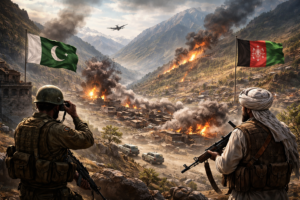
The Forgotten War: How the Pakistan-Afghanistan Conflict is Reshaping Asia
While the world’s gaze remains fixed on the explosions and exodus along the Iran-Iraq border, a different kind of fire is quietly reshaping the map of South Asia. Since late February 2026, Pakistan and Afghanistan have been engaged in open, albeit largely unreported, warfare. It is a conflict without dramatic tank columns or front-page city battles, yet it carries the seeds of a conflagration that could draw in the world’s two most populous nations and redraw the security architecture of an entire continent.
To call this a “border skirmish” is to miss the forest for the trees. This is a war of drones, artillery duels in the mountainous terrain of Khost and Kunar, and covert operatives slipping across the infamous Durand Line. It is a war fought in the shadow of a larger crisis, but its consequences—rooted in decades of betrayal, religious schism, and great-power rivalry—will echo for generations.
The Tinderbox: The Pakistani Taliban’s Sanctuary
The proximate cause of this conflict is as old as the mountains themselves: sanctuary. For years, Islamabad has watched with growing alarm as the Tehrik-e-Taliban Pakistan (TTP), a conglomerate of militant groups known as the Pakistani Taliban, has grown bolder from its havens inside Afghanistan.
The TTP is not the Afghan Taliban, though they share a lineage and a hardline Islamist ideology. While the Afghan Taliban concentrates on ruling their country, the TTP’s sole raison d’être is to wage war against the Pakistani state. They were the architects of the 2014 Army Public School massacre in Peshawar, where 144 people—mostly schoolchildren—were gunned down in a crime that still haunts Pakistan’s national psyche.
For the Afghan Taliban leadership in Kabul, the request to hand over their ideological cousins is a poison pill. The bonds forged in the trenches of the Soviet-Afghan war and the two-decade insurgency against the US are not easily broken. Many Afghan Taliban fighters see the TTP as brothers-in-arms. Forcing them out or, worse, extraditing them to Pakistan, risks fracturing the Afghan Taliban’s own internal cohesion and sparking a bloody rebellion from within. They remember all too well the fate of the Islamic State in Khorasan Province (ISIS-K), which they crushed with ruthless efficiency; they fear that turning on the TTP could create a similar, but larger, monster.
The ultimatum was simple, and it failed. When Pakistan’s patience ran out on 27 February, its air force began striking what it claimed were TTP hideouts deep inside Afghan territory. The Afghan Taliban, honouring its obligation to the soil if not to international norms, retaliated by targeting Pakistani military posts across the border. The war had begun.
The Ghosts of the Durand Line
To understand the visceral nature of this conflict, one must walk the line itself. The Durand Line, the 2,600-kilometer border drawn by a British civil servant in 1896, cuts straight through the heart of Pashtun land. It divides families, tribes, and villages. For the Pashtuns on both sides, the border is an artificial scar, a colonial imposition that has no meaning in their cultural or emotional geography.
This shared ethnicity is the war’s tragic undercurrent. On the Pakistani side of the border, in the former Federally Administered Tribal Areas (FATA), the army has fought for two decades to pacify the region. Now, they watch as relatives and tribesmen across the invisible line provide shelter to the very insurgents they have been trying to kill. It creates a crisis of loyalty. Is a soldier from Waziristan supposed to shoot at his cousin’s house on the Afghan side?
Meanwhile, Afghan villagers in Khost and Paktika now live in fear of Pakistani jets that can appear over the horizon with no warning. “We survived the Americans, and now we must survive the Pakistanis,” one elder was overheard saying in a market in Khost, a sentiment that speaks to the exhaustion of a populace that has known nothing but war for nearly half a century. The bombing is not just a political act; it is a personal trauma renewing itself.
The Silent Partners: India’s Footprint and China’s Spear
But this is not just a bilateral bloodletting. It has become a chessboard for two nuclear-armed giants: India and China. This is the first sustained encounter between an emergent Indian ally and the western edge of China’s military influence.
For Pakistan, the nightmare scenario is “strategic encirclement.” For decades, Islamabad viewed Afghanistan as its own strategic backyard—a source of “strategic depth” in case of an all-out war with India. With the return of the Taliban, they expected a pliant, friendly government. Instead, they see the outlines of a new alliance taking shape. India, seizing an opportunity it lost in 2021, has been quietly rebuilding its ties with Kabul. It has not officially recognized the Taliban regime, but technical teams, humanitarian aid, and back-channel diplomacy have kept the relationship alive.
New Delhi’s calculus is simple and shrewd. By building bridges with Kabul, it achieves two critical objectives. First, it ties down the Pakistani military on a second front, forcing them to divert resources away from the Indian border. Second, and perhaps more importantly, it aims to blunt the ideological export of jihad. Veterans of the Afghan war in the 1980s fueled the insurgency in Indian Kashmir in the 1990s. By fostering a stable—or at least cooperative—Afghanistan, India hopes to ensure that Kashmir remains a political dispute, not a theater for foreign-trained militants.
Countering this Indian influence is China. Beijing’s partnership with Pakistan is no longer just about “all-weather friendship”; it is a fully militarized alliance. The test came in May 2025 during “Operation Sindoor,” when India carried out strikes on Pakistani soil. During that brief, sharp conflict, Chinese-provided air defense systems and Chengdu J-10C fighter jets reportedly gave Pakistan a technological edge that surprised Indian planners.
Now, that same military architecture is being deployed against Afghanistan. Chinese intelligence is likely feeding Pakistan real-time data on militant movements. Chinese air defense batteries are protecting Pakistani cities from potential cross-border retaliation. For Beijing, propping up Pakistan in this fight sends a clear message to New Delhi: any attempt to use Afghan soil to bleed Pakistan will be met with the full weight of the Sino-Pakistani alliance. The war is a live-fire exercise for this new partnership.
The Human Cost of a Forgotten War
In the cacophony of geopolitics, the human voices are often lost. The first week of the war saw the exodus of thousands of families from the border regions. In the Pakistani city of Parachinar, a Shia-majority enclave surrounded by Sunni tribes, the fear is palpable. They have been the target of sectarian violence for years, and the breakdown of law and order on the border leaves them feeling exposed and vulnerable.
On the Afghan side, the economy, already in a state of catastrophic collapse, is grinding to a halt. The closure of the Torkham and Chaman border crossings—the arteries for trade between the two nations—has strangled the flow of food and medicine. In Kandahar, prices for flour and cooking oil have doubled in a week. The Taliban’s interim government, which has struggled to transition from an insurgency to an administration, now faces the existential threat of failing to provide for its people in a time of war.
There is also a quiet, desperate plea from the families of soldiers on both sides. In the villages of Punjab, Pakistan’s heartland, mothers pray for sons stationed at the border, not fully understanding who they are fighting or why. In the hills of Khost, a Taliban fighter watches the sky, wondering if the drone overhead is American, Pakistani, or Chinese. He fights for his version of God and country, caught in a web of alliances he did not weave.
The Future: A War Without End?
This conflict has no easy off-ramp. Pakistan cannot back down without appearing to surrender its sovereignty to militancy. Afghanistan cannot give up the TTP without risking a civil war among its own ranks. The war, for now, seems destined to settle into a low-boil stalemate—periodic airstrikes, border skirmishes, and a grinding proxy war.
But the silence from the international community is dangerous. While the world focuses on Iran, a new power axis is hardening. Pakistan, with Chinese support, is testing its mettle as a regional enforcer. Afghanistan, under Taliban rule, is being pushed into the arms of India. The Pashtun people, as they have been for 150 years, are caught in the middle.
This forgotten war is not just a local dispute. It is the sound of tectonic plates shifting. It is the first real test of a post-American South Asia, where the old rules no longer apply and where the next great power struggle is being fought not in the deserts of the Middle East, but in the mountains of a land that time forgot. And unless the world starts paying attention, it may one day wake up to a crisis far larger than the one it chose to ignore.
You must be logged in to post a comment.