
The Flag and the Law: How a Jerusalem Raid Tests the Limits of International Order
On December 8, 2025, Israeli forces raided a UNRWA compound in East Jerusalem, detaining guards, seizing property, and replacing the UN flag with an Israeli flag—an act the UN condemned as a blatant violation of international law and the inviolability of its premises.
While Israel justified the raid as a tax collection effort, the incident represents a severe escalation in its campaign to dismantle UNRWA, following 2024 legislation banning the agency and a subsequent International Court of Justice opinion that found Israel’s severance of ties unlawful. Beyond the immediate legal clash, this confrontation dangerously undermines the foundational principles of multilateralism and directly imperils the delivery of critical humanitarian aid to Gaza, where UNRWA serves as an irreplaceable lifeline for a population facing catastrophic famine and economic collapse.
The Flag and the Law: How a Jerusalem Raid Tests the Limits of International Order
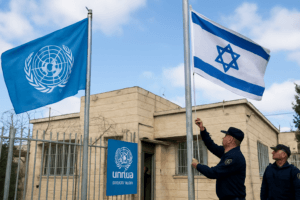
In the early hours of Monday, December 8, 2025, a quiet neighborhood in East Jerusalem became the stage for a confrontation with global implications. Israeli police, accompanied by municipal officials, cut through chains and locks to enter the fenced compound of the United Nations Relief and Works Agency for Palestine Refugees (UNRWA). Inside, they seized office furniture and equipment, detained UN security guards in a room, and performed a starkly symbolic act: lowering the blue flag of the United Nations and raising the flag of Israel in its place.
Officially, the raid was described by Israeli authorities as a “debt-collection procedure” for unpaid municipal taxes. Yet to the United Nations and much of the international community, it represented something far more consequential: a direct challenge to the foundational principles of international law and the inviolability of UN premises. This incident is not an isolated event but the latest and most dramatic escalation in a protracted campaign by the Israeli government against UNRWA, unfolding against the backdrop of a devastating war in Gaza and a profound crisis of humanitarian aid.
More Than a Tax Dispute: The Clash Over Inviolability
The Israeli government’s justification—that UNRWA owed millions in local property taxes—was immediately rejected by the United Nations. UN spokesperson Stéphane Dujarric stated that such taxes are “not applicable under the general conventions that govern the relationship between the United Nations and member states”. This rebuttal points to a core legal principle at the heart of the dispute.
Under international law, particularly the 1946 Convention on the Privileges and Immunities of the United Nations, UN premises are considered inviolable. This means they are immune from search, seizure, or any form of interference by the host state. UN Secretary-General António Guterres emphasized this point in his condemnation of the raid, urging Israel to “restore, preserve and uphold the inviolability” of the compound. The status of the building is not changed by its vacancy; it remains protected UN property.
This legal immunity exists for a critical reason: to allow UN agencies to operate independently and safely, especially in conflict zones, without fear of coercion or harassment by national governments. By forcibly entering the compound, Israel acted in a manner that UNRWA Commissioner-General Philippe Lazzarini called “a blatant disregard” of its obligations as a UN member state, creating “a dangerous precedent anywhere else the UN is present across the world”.
The Broader Campaign: From Legislation to Raid
The raid is the physical manifestation of a political and legal offensive that has been building for over a year. The friction intensified following the horrific Hamas-led attacks on Israel on October 7, 2023. Israel accused UNRWA of being deeply compromised, alleging that some of its employees participated in the attacks and that the agency’s facilities and operations had been infiltrated by Hamas.
In late 2024, the Israeli Knesset transformed this hostility into law, passing legislation that prohibited UNRWA’s operations inside Israel and barred official cooperation with the agency. This legal move prompted the UN General Assembly to seek an advisory opinion from the International Court of Justice (ICJ) on Israel’s obligations.
In a significant ruling on October 22, 2025, the ICJ found that Israel had violated international law by severing ties with UNRWA without providing a practical alternative for delivering essential humanitarian aid. The court acknowledged Israel’s security concerns but concluded that the evidence presented was “not sufficient to establish UNRWA’s lack of neutrality”. It underscored that in the current catastrophic circumstances in Gaza, UNRWA’s capacity “cannot be replaced on short notice”.
The December raid, therefore, can be seen as Israel defying this international legal opinion and asserting its sovereign authority over a UN agency it has vowed to dismantle. A spokesperson for Prime Minister Benjamin Netanyahu called UNRWA “a stain on the United Nations” and stated, “It is time for it to be dismantled”.
The Stakes: A Humanitarian Lifeline on the Brink
The confrontation over a vacant building in Jerusalem has immediate and life-or-death consequences 50 miles away in Gaza. UNRWA is not a marginal actor; it is the backbone of the humanitarian response in the territory. It provides essential services—food, healthcare, and education—to millions of Palestinian refugees. The agency reports having enough supplies in neighboring countries to feed Gaza’s entire population for three months, but these stocks are trapped, with only about half the necessary aid trucks being allowed in.
UN experts describe a man-made economic catastrophe in Gaza: unemployment over 80%, a decimated banking system, hyperinflation, and famine conditions. In this context, obstructing UNRWA’s operations and funding has a multiplier effect of suffering. As UNRWA Deputy Commissioner-General Natalie Boucly warned, the collapse of the agency would leave a void no other organization can fill, with dire consequences for a traumatized population, particularly children.
The Legal and Political Crossroads
The table below summarizes the central, conflicting positions that define this crisis:
| Perspective | Core Argument | Supporting Action / Justification |
| Israeli Government | UNRWA is compromised by Hamas and perpetuates the refugee issue; sovereign right to enforce domestic law (e.g., tax collection) on its territory. | Raid on compound; 2024 law banning UNRWA operations; public campaign for agency’s dissolution. |
| United Nations & ICJ | UN premises are inviolable under international law; UNRWA is an irreplaceable humanitarian lifeline; Israel’s obligations as an occupying power include facilitating aid. | Condemnation of raid; citation of UN Convention on Privileges & Immunities; ICJ advisory opinion condemning Israel’s severance of ties. |
| Humanitarian Reality | The political and legal conflict directly impedes the delivery of lifesaving aid, exacerbating a catastrophic human crisis in Gaza. | Reports of aid trucks blocked; warnings of famine; descriptions of systemic economic collapse. |
A Dangerous Precedent in a World of Challenged Multilateralism
The raid on the UNRWA compound reverberates beyond the Israeli-Palestinian conflict. It touches on a fundamental tension in the international system: the balance between national sovereignty and the rules-based multilateral order. When a member state forcibly takes control of UN property, it challenges the very framework that enables international organizations to function.
This incident is uncomfortably reminiscent of other recent assaults on UN protections. In Yemen, Houthi authorities have arbitrarily detained 59 UN personnel, holding them incommunicado without due process—another clear violation of international immunities. While the contexts differ, both situations reveal a growing willingness by state and non-state actors to disregard the protections long granted to international bodies.
For the United Nations, the failure to secure a swift and definitive reversal of the Jerusalem raid risks signaling that its inviolability is negotiable. This could embolden other governments in conflicts around the world to pressure or interfere with UN operations, citing domestic priorities over international law.
Conclusion: A Symbolic Battleground
The image of an Israeli flag flying over the former UNRWA compound in Sheikh Jarrah is a powerful symbol. It represents a claim of sovereign control over a piece of land and a defiant rejection of an agency’s legitimacy. Yet, that same flag, raised through an act deemed unlawful by the UN, also symbolizes a deepening crisis for the international system itself.
The dispute is ostensibly about taxes, security, and humanitarian practice. At its core, however, it is about whether the rules governing international institutions will hold firm against the pressures of a protracted and bitter national conflict. The vacant building in East Jerusalem has become an unlikely battleground. Its eventual fate—whether it is restored to UN control or absorbed by Israeli authorities—will send a clear message about the strength of international law in an increasingly fractured world. The resolution, or lack thereof, will either reinforce the crumbling walls of multilateral cooperation or contribute significantly to their erosion.
You must be logged in to post a comment.