
The Final Insult: How Burial Denials in India Reveal a Deepening Crisis of Faith and Identity
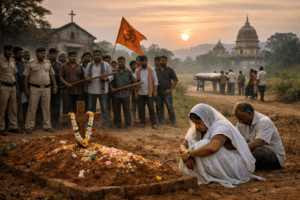
The Final Insult: How Burial Denials in India Reveal a Deepening Crisis of Faith and Identity
In the tribal heartlands of Chhattisgarh, India, a new and chilling frontier of religious persecution has emerged, targeting the community not in life, but in death. In November 2025, the grieving families of Raman Sahu and Manoj Nishad encountered a profound cruelty: they were barred from burying their loved ones in their ancestral villages solely because they had converted to Christianity. These are not isolated tragedies but the sharpest symptoms of a systemic campaign to erase the identity of minority Christians, a campaign now leveraging the most fundamental human rites to enforce conformity.
A Pattern of Denial, Not Isolated Incidents
The cases of Raman Sahu in Jewartala village and Manoj Nishad in Kodekurse village follow an almost identical, brutal script. Upon bringing the bodies home for Christian burial rites, the families were met with physical blockades and vandalism by fellow villagers. The demand was unequivocal: burial would only be permitted if conducted under traditional Hindu rituals. In Kodekurse, the mob presented a grotesque ultimatum—renounce Christianity and reconvert to Hinduism, and the burial could proceed.
Local police and district administrations, present at the scenes, proved largely helpless or unwilling to enforce the families’ constitutional rights. Negotiations stretched for hours and days, leaving bodies in mortuaries while families scrambled for solutions. Ultimately, both men were buried miles from their homes, their funerals transformed from sacred rites into journeys of exile.
This pattern is widespread. In January 2025, the body of Pastor Subhash Baghel lay in a mortuary for three weeks as his son, Ramesh, fought a legal battle all the way to the Supreme Court. Despite a history of Christian burials in his village dating back decades, a village council resolution explicitly barred converts from the graveyard. More than 350 such burial denials have been reported in Bastar District alone.
The following table summarizes key incidents that highlight the systematic nature of this persecution:
| Date | Location (District) | Victim | Key Details | Outcome |
| Jan 2025 | Chhindwada (Bastar) | Pastor Subhash Baghel | Village council resolution barred burial; 3-week legal battle to Supreme Court. | Supreme Court split verdict; forced burial 25 miles away. |
| Nov 5, 2025 | Kodekurse (Kanker) | Manoj Nishad | Family blocked from private land; body shuttled for days; offered burial if they reconverted. | Body transported 200km to Raipur for burial. |
| Nov 8, 2025 | Jewartala (Balod) | Raman Sahu | Procession vandalized; police negotiations failed. | Buried at distant Sankra burial ground. |
| May 2025 | Sanaud Village | A Christian Woman | 8-hour blockade at public burial ground led by village head. | Buried 19 miles away in Dhamtari. |
The Legal and Political Backdrop: From Courts to Grassroots Mobs
This crisis exists at a tense intersection of law, politics, and grassroots majoritarianism. At the very top, the judiciary has sent mixed signals. In the Baghel case, the Supreme Court issued a split verdict: one justice called the denial a violation of constitutional secularism, while the other prioritized “public order” concerns. Critically, the court did order the Chhattisgarh government to “demarcate exclusive sites as graveyards for burial of Christians throughout the State” within two months. By April 2025, no action had been taken, and the deadline had passed.
This state inaction occurs within a charged political climate. Since the Hindu-nationalist Bharatiya Janata Party (BJP) took power in Chhattisgarh in 2023, tensions have increased. The state is governed by the Chhattisgarh Freedom of Religion Act (2006), an anti-conversion law, and the Deputy Chief Minister has announced plans for a stricter version, requiring a 60-day notice for conversion. Critics argue such laws embolden vigilantes by framing conversion itself as a suspicious or criminal act.
The data shows a stark correlation. Nationally, documented anti-Christian incidents have skyrocketed by 500% over the past decade, from 139 cases in 2014 to 834 in 2024. Chhattisgarh is the second-worst affected state, with over 926 incidents recorded in that period. Perhaps most damning is the near-total impunity: in the first nine months of 2025, police filed First Information Reports—the essential first step for an investigation—in only 39 of 579 documented cases, a 93% “justice gap”.
The Core Conflict: Identity, Land, and “Foreignness”
To understand the venom behind burial denials, one must look beyond religion to issues of identity and resources. Most Christians in Chhattisgarh are Adivasis, or indigenous tribal people. Hindu nationalist ideology, however, promotes the concept of Hindutva, which holds that to be truly Indian is to be Hindu. From this viewpoint, tribal converts to Christianity are not just religious dissenters but cultural defectors and “outsiders”.
This rhetoric directly fuels the burial conflicts. An affidavit from a Bastar police official to the Supreme Court argued that ceremonies should adhere to “traditional customs” and that those who “forswear the tradition of the community” lose burial rights. Village resolutions similarly declare that converts “abandon the traditional faith” and thus forfeit their place in the community, even in death.
The conflict is also profoundly material. Tribal Christians have reported intense pressure in mineral-rich states like Chhattisgarh, with threats of being “delisted” from the Scheduled Tribe (ST) roster. ST status provides critical constitutional protections for land rights, forest access, and educational opportunities. Loss of this status would make these communities vulnerable to displacement by mining and development projects. Denying burial rights is a potent form of social ostracism that reinforces this message: you are no longer one of us, and you have no claim to this land, not even a six-foot plot.
A Broader Campaign of Fear
The denial of burial rights is the tip of a spear. The campaign against Christians in the region is multifaceted:
- Violence and Displacement: In December 2022, attacks across 20 villages in Kondgaon and Narayanpur districts destroyed 16 Christian homes and four churches, forcing about 200 believers to flee after being given ultimatums to renounce their faith or leave.
- Economic and Social Boycott: The village resolution in Chhindwada that barred Christian burials also imposed a comprehensive boycott, denying Christians access to government ration shops and banning them from operating businesses.
- Targeting of Institutions: In September 2025, Raipur authorities banned over 200 house churches to “maintain harmony”. Earlier in the year, a Hindu nationalist mob vandalized a church and school in Narayanpur, an attack that only gained national attention when the intervening police superintendent was injured.
The Unanswered Cry for Dignity
The Christian response has been a mix of desperate protest and organized advocacy. Families have placed bodies in front of police stations in silent, powerful protest. In November 2025, approximately 2,000 Christians from over 200 denominations gathered at a National Christian Convention in New Delhi, voicing their concerns just a kilometer from Parliament. They presented the alarming data on violence and the 93% justice gap, calling for the repeal of discriminatory laws and protection of their constitutional rights.
Leaders like Arun Pannalal of the Chhattisgarh Christian Forum accuse authorities of being “helpless before the mob” and demand the protection of designated burial lands. International human rights groups, including Christian Solidarity Worldwide (CSW) and the U.S. Commission on International Religious Freedom (USCIRF), have called for investigations and labeled India a country of particular concern.
The denial of a burial is more than an act of religious discrimination. It is a profound human rights violation that weaponizes grief to sever a person’s final connection to their home, heritage, and community. It tells the living that their identity makes them perpetual outsiders. As Ramesh Baghel, who fought for his father’s burial, stated, “This isn’t just about my father anymore. It is about the dignity and rights of every Christian”.
In the quiet villages of Chhattisgarh, a struggle is unfolding that goes to the very heart of what it means to belong in modern India. It asks whether the promise of secularism and constitutional freedom can withstand the pressures of majoritarian ideology enforced at the village gate. Until that question is answered, for India’s tribal Christians, the threat of exile does not end at the grave—it is cemented by it.
You must be logged in to post a comment.