
The Final Homecoming: Israel’s Declared End to a Hostage Saga and the Unanswered Questions of a Two-Year War
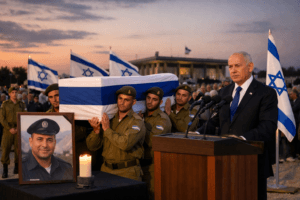
Israel’s Prime Minister Benjamin Netanyahu declared on January 26, 2026, that the state had fulfilled its “moral and ethical mission” with the repatriation of the remains of Ran Gvili, the final hostage held in Gaza since the October 7, 2023 Hamas attack, thereby closing a two-year military and recovery operation centered on the promise to leave no citizen behind. While the government frames this as a definitive achievement, the declaration arrives after a devastating conflict that has left Israeli society deeply divided and Gaza in ruins, shifting the political focus to postwar challenges and unresolved questions about security, governance, and long-term stability in the region, even as the nation seeks a measure of closure from the traumatic hostage saga.
The Final Homecoming: Israel’s Declared End to a Hostage Saga and the Unanswered Questions of a Two-Year War
In a solemn statement to the Knesset on January 26, 2026, Israeli Prime Minister Benjamin Netanyahu declared the completion of a “moral and ethical mission.” The remains of Ran Gvili, a police officer killed on October 7, 2023, and held in Gaza for over two years, had been identified and repatriated. With this, Israel announced that the grueling chapter of recovering all hostages taken during Hamas’s deadly assault was closed. “We brought them all back, down to the very last captive,” Netanyahu stated, framing it as an extraordinary achievement and a kept promise.
Yet, this moment of declared closure is not a neat period at the end of a sentence, but a heavy, complex full stop in a narrative saturated with trauma, political maneuvering, and an uncertain future. The return of the final hostage signifies the end of one specific objective, but it casts a long shadow over what has been sacrificed, what narratives are being solidified, and what peace, if any, lies ahead.
The Weight of a Promise: “Never Leave Anyone Behind”
The Israeli military’s statement accompanying the news was steeped in the ethos of the Israel Defense Forces (IDF): “the promise between the IDF and the citizens of the State of Israel — to never leave anyone behind.” This principle is a cornerstone of Israeli national identity and military doctrine. For two years, it fueled relentless military campaigns, paused ceasefires for complex negotiations, and held the Israeli public in a state of anguished suspense.
Ran Gvili’s story embodies the tragic archetype of that day. Nicknamed the “Defender of Alumim,” he was killed in combat near his kibbutz, and his body was taken into Gaza—a final act of cruelty that denied his family immediate burial. For his family, and for the nation, his recovery was non-negotiable. The process, as described by the military, involving the National Forensic Centre, police, and military rabbinate, highlights the meticulous, sacred weight given to the identification and return of every individual.
Netanyahu’s “Moral Mission”: Political Closure Amid Lingering Divisions
Prime Minister Netanyahu’s framing is powerfully deliberate. By declaring the mission “moral and ethical,” he seeks to transcend politics, positioning the state’s action as a fundamental duty fulfilled. This language is aimed at providing a sense of national unity and resolution, a powerful tool for a leader whose tenure has been defined by this prolonged conflict.
However, this declared closure arrives amidst profound societal fissures. The war, which stretched for over two years, saw immense costs: thousands of Israeli soldiers killed and wounded, a deeply traumatized civilian population in the south and north, and a domestic political landscape scarred by debates over strategy, the price of victory, and the government’s priorities. For the families of hostages returned alive earlier—through deals that sometimes involved the release of Palestinian prisoners—the joy was tempered by the ongoing wait for others. For the families of those like Gvili, the return brings the bittersweet solace of burial, but not of life.
The announcement effectively draws a line under the hostage crisis as a military and recovery operation. It allows the government to shift the public discourse, potentially toward postwar planning, security arrangements, and legacy. Yet, for many citizens, the moral mission extends beyond recovery to encompass ensuring such an attack can never happen again and grappling with the strategic outcomes of a war that has reshaped the region.
The Gaza That Remains: A Landscape of Ruin and Unresolved Futures
While Israel speaks of a completed mission, Gaza exists in a state of catastrophic limbo. Two years of “intense combat” have left the territory utterly devastated. The human cost is staggering, with Palestinian casualty figures in the tens of thousands, a generation displaced, and infrastructure annihilated.
The recovery of the final hostage from this rubble speaks to the terrifying thoroughness of the conflict. It also raises urgent, unanswered questions: What is the political and humanitarian future of Gaza? Who will govern it? How will reconstruction, which will take decades, be managed and funded? Hamas’s military capacity may be severely degraded, but as seen in recent reports, the group is already seeking a role in civil policing—a signal that the post-war power dynamics are far from settled.
Israel’s closure on the hostage issue stands in stark contrast to the wide-open wound that is Gaza. The international community, including regional players and global powers, is now faced with the colossal task of managing a postwar scenario that lacks a clear political horizon. The danger is that this moment of Israeli internal resolution becomes a pretext for disengagement from Gaza’s plight, sowing the seeds for future instability.
Beyond the Headlines: The Enduring Human Legacy
The story of Ran Gvili, and the over 200 hostages before him, is ultimately a human one. It’s a story of families who lived for two years in a hell of uncertainty, of a nation that marked time with hostage posters and yellow ribbons, and of soldiers who fought with the weight of that promise on their shoulders.
The “moral mission” Netanyahu cites is rooted in this human imperative. Its completion offers a profound measure of relief and a space for collective mourning. National days of remembrance will now have a defined roster of names. Yet, the healing is just beginning. The trauma of October 7th and the subsequent long war is intergenerational. The societal debate over its conduct and consequences will continue for years.
Furthermore, the very concept of “closure” is personal. For a nation, it may be symbolized by a military statement. For a family laying a son to rest years after his death, closure is a more private, fraught, and ongoing process.
Conclusion: A Chapter Closes, A Volatile Volume Remains Open
The repatriation of Ran Gvili is a significant, solemn milestone. It allows Israel to honor a sacred covenant with its citizens. Prime Minister Netanyahu’s declaration is a powerful piece of political narrative-setting, aiming to bookend a period of immense national trial with a note of resolution and duty fulfilled.
However, true moral and ethical missions are not so easily bounded. They extend into how a society reckons with the costs of its security, how it engages with the suffering of its neighbors, and how it builds a future that prevents such cycles of atrocity and response. The guns may have largely fallen silent over the hostage issue, but the echoes of this war will shape Israeli and Palestinian realities for decades. The final hostage has come home, but the search for a lasting, just, and secure peace remains agonizingly incomplete. The end of this recovery mission is not the end of the story; it is the turning of a page into a new, uncertain, and volatile chapter for the entire region.
You must be logged in to post a comment.