
The Final Ceasefire: The Return of Hadar Goldin and the Unending War for the Dead
The recent return of Israeli soldier Lieutenant Hadar Goldin’s remains, after being held by Hamas for eleven years since his death in a violated 2014 ceasefire, closes a painful chapter for his family but starkly illustrates the brutal, protracted nature of the conflict where even the dead are leveraged as strategic assets.
His repatriation, achieved through a recent truce deal, highlights Hamas’s tactic of using bodies as bargaining chips for concessions and safe passage, while also exposing the profound psychological toll on families denied closure. Although Goldin’s return allows for a proper burial and ends his family’s agonizing vigil, it underscores the unfinished business of the ongoing hostage crisis, serving as a somber reminder that the resolution of one tragic saga does little to alleviate the collective trauma or secure the freedom of those who remain captive.
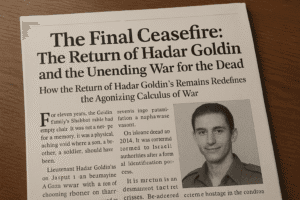
The Final Ceasefire: The Return of Hadar Goldin and the Unending War for the Dead
For eleven years, the Goldin family’s Shabbat table had an empty chair. It was not a metaphor for a memory; it was a physical, aching void where a son, a brother, a soldier, should have been. Lieutenant Hadar Goldin was killed on August 1, 2014, in the brutal chaos of a Gaza war, just two hours after a humanitarian ceasefire was supposed to have taken hold. In an instant, he was transformed from a living soldier into a strategic asset, his body seized by Hamas and held in the subterranean gloom of the Gaza Strip.
This week, that chair is symbolically filled. The return of Hadar Goldin’s remains to Israel, confirmed by the Israeli authorities after a formal identification process, marks the end of one of the most protracted and agonizing sagas in the nation’s recent history. But this is not just a story of a body coming home. It is a stark lesson in the brutal, unyielding politics of conflict, where the dead are never merely the dead, and closure is a commodity bartered in back-channel deals and truce negotiations.
The Shattered Ceasefire and a Family’s Unending Vigil
To understand the weight of this moment, one must return to the day the ceasefire shattered. August 1, 2014, was meant to be a pause, a breath of hope in a 50-day war. But in the Gaza border town of Rafah, it lasted only 120 minutes. Lieutenant Hadar Goldin, then 23, was part of an elite unit engaged with Hamas militants when he was pulled into a tunnel. The attack, which also killed two other soldiers, was a devastating violation that Israel cited as a key reason for continuing its military campaign.
From that day forward, the Goldin family’s war did not end. While Israel moved on to other conflicts and political crises, Leah and Simcha Goldin, Hadar’s parents, spearheaded a relentless, public campaign. They were not activists by choice, but by necessity. They erected billboards, lobbied politicians, and held vigils, ensuring their son’s face—a young man with a determined gaze and a slight smile—was never forgotten by the public or the government.
Their fight was twofold: against Hamas, the captor of their son’s body, and against the inertia of their own government, which they often accused of not doing enough to prioritize the return of the fallen. Theirs was a unique and profound agony. They were not the parents of a missing soldier who might be alive in a dungeon; they were the parents of a confirmed fallen soldier denied the basic human and Jewish rite of burial. In Jewish law, halakha, the imperative to bury the dead, Kevurat Met, is a supreme commandment. The Goldins were denied the ability to fulfill this sacred duty, leaving their son’s soul, in their belief, in a state of unrest.
The Body as a Bargaining Chip: The Gruesome Economy of Conflict
The holding of Hadar Goldin’s remains for over a decade is a grim testament to a particular tactic in asymmetric warfare. For Hamas, Goldin’s body was not a mere trophy; it was leverage. In the gruesome economy of this conflict, the dead hold value. They are chips to be cashed in for prisoner releases, for the repatriation of militants’ bodies held by Israel, or for strategic concessions.
This recent handover did not occur in a vacuum. It was part of the complex, US and Qatari-brokered truce and hostage-prisoner exchange deal between Israel and Hamas. The timing is telling. Hamas’s announcement that the remains were “found” in a tunnel in Rafah is viewed by many analysts not as a coincidence, but as a calculated move. Israeli media reported that Hamas may have been using the body as a last-minute bargaining tool to secure safe passage for over 100 of its militants currently encircled by Israeli forces in that same city.
This reveals a chilling reality: even in a deal designed to bring living hostages home, the calculus of the dead remains integral. The return of Goldin closes a painful pre-2014 chapter, but it also underscores a brutal continuity. Hamas’s strategy demonstrates a long-term, patient approach to asset accumulation, holding onto remains for years to extract maximum value at a future, more opportune moment.
Beyond the Headlines: The Psychological Toll of the Unreturned
While politicians and generals speak of strategy and security, the human cost of holding the dead is immeasurable. The phenomenon of “ambiguous loss”—a loss without closure or verification—is a recognized psychological trauma. For the Goldin family, and for the families of other soldiers whose remains are still held, this ambiguity was a permanent state of being.
They lived in a tortuous limbo. They could not mourn fully, for there was no grave to visit. They could not move on, for the official mission of “bringing him home” was ongoing. Every national holiday, every Memorial Day, was a fresh wound, a reminder that their son was not just a memory, but a political file still open on some negotiator’s desk.
The work of the Red Cross in this transfer is a critical, often neutral, thread in this tapestry of conflict. Acting as an intermediary, they facilitated the physical handover, a delicate operation that requires trust from both sides. Their white vehicles emblazoned with the red cross become the temporary sanctuaries in which the transition from captive to kin takes place.
The Shadows That Remain: The Unfinished Business of the Hostage Crisis
Prime Minister Benjamin Netanyahu’s confirmation of Goldin’s return was somber. He spoke of ending the family’s agony and the importance of a Jewish burial. Yet, his statement was immediately followed by a sobering reminder: “The bodies of four dead hostages remain in Gaza.”
The return of Hadar Goldin brings one story to a close, but it casts a long, dark shadow over the ongoing hostage crisis stemming from the October 7, 2023 attacks. For the families of those four, and for the families of the living hostages who may still be in captivity, Goldin’s return is a bittersweet symbol. It is proof that persistence and pressure can yield results, even after years. But it is also a terrifying reminder of the enemy’s willingness to use human beings, living and dead, as currency.
The Israeli government now faces the immense pressure of securing the return of all its citizens. The precedent is set: the issue of the dead is non-negotiable for Israeli society, a core tenet of its military ethos of leaving no one behind. Hamas, understanding this visceral need, will undoubtedly continue to use it to its advantage.
A Grave to Visit, A Nation to Heal
As Hadar Goldin is finally laid to rest in Israeli soil, his family can at last recite the Kaddish, the Jewish prayer for the dead, at his graveside. The ritual of sitting shiva, the seven-day mourning period, can properly begin. This is a profound, private relief after a very public, 11-year struggle.
But on a national scale, the return of one soldier’s remains is a punctuation mark in a sentence that is far from over. It is a moment of collective catharsis and a stark lesson in the enduring nature of this conflict. It proves that in the war between Israel and Hamas, the battles do not end with ceasefires. They continue in the tunnels where bodies are hidden, at the negotiating tables where their return is bartered, and in the hearts of families for whom the war is a personal, unending vigil.
The empty chair is now filled, but the table around which Israel sits remains surrounded by the ghosts of those still waiting to come home. The mission for Hadar Goldin is complete, but the national duty to all who remain in captivity, living and dead, has never been more urgent.
You must be logged in to post a comment.