
The EU’s Empty Threats: Why Economic Giant Can’t Stop Israel’s Wars
The European Union possesses enormous economic and diplomatic leverage over Israel—including a €68 billion trade agreement—yet remains paralyzed and unable to act as Israel wages war in Lebanon and Gaza, expands West Bank settlements, and advances the death penalty for Palestinians. Deep internal divisions among member states explain this failure: Ireland and Spain push for accountability, Germany and Austria hesitate due to Holocaust guilt, and Hungary’s Viktor Orbán actively vetoes even modest sanctions. Former EU officials and lawmakers like Barry Andrews call the bloc’s response “weak and pathetic,” arguing that words of concern without concrete measures amount to a “permission slip for endless war crimes.” With over 72,000 dead in Gaza, more than 1,240 killed in Lebanon, and settler violence intensifying in the West Bank, the EU’s unwillingness to suspend its association agreement or impose targeted sanctions has severely damaged its global credibility—rendering it a sidelined observer rather than a meaningful actor in the Middle East.
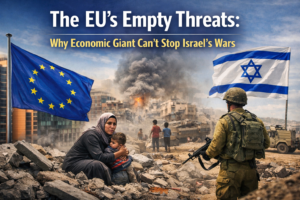
The EU’s Empty Threats: Why Economic Giant Can’t Stop Israel’s Wars
For all its economic clout and diplomatic weight, the European Union stands paralyzed as Israel presses forward on multiple fronts—and the damage to Europe’s global standing may be irreversible.
The scene in Beirut last month should have been a wake-up call. Irish MEP Barry Andrews walked through makeshift schools turned into emergency shelters, where displaced Lebanese families huddled on dirty mattresses, children developing skin infections from squalid conditions, parents too exhausted to even ask for help. One woman clutched her newborn in a converted classroom, the baby’s first weeks spent not in a nursery but in a building never designed for human habitation at this scale.
Andrews had come to Lebanon just two weeks after Hezbollah rockets first struck northern Israel, triggering the massive Israeli retaliation that has since killed more than 1,240 people—including at least 124 children—and forced over a million from their homes. But what struck him wasn’t just the immediate crisis. It was the sense of déjà vu.
“The conditions are worse than 2024,” he was told repeatedly. And worse than 2024 meant worse than the last time the world promised “never again.”
The €68 Billion Question
Here’s what makes the EU’s paralysis so bewildering: the numbers don’t add up to inaction.
The European Union and Israel share a €68 billion trading relationship—roughly £59 billion in annual commerce. That’s not pocket change. That’s the kind of economic interdependence that usually buys diplomatic influence. The EU-Israel Association Agreement, signed decades ago as a framework for cooperation on everything from scientific research to energy policy, gives Brussels substantial leverage. Suspend that agreement, as former EU representative to the Palestinian territories Sven Kühn von Burgsdorff has repeatedly urged, and Israel’s economy would feel the pinch almost immediately.
Yet the agreement remains fully intact. The trading continues. The diplomatic missions stay open. And Israel’s government, led by Prime Minister Benjamin Netanyahu, continues to operate with what Andrews calls “a permission slip for endless war crimes.”
The gap between European rhetoric and European action has rarely been wider. And the consequences extend far beyond the Middle East.
The Words That Mean Nothing
Let’s be precise about what the EU has actually done. Because the list is shorter than many Europeans realize.
The European Commission has issued statements. It has expressed concern. It has called the Knesset’s recent vote to reinstate the death penalty for Palestinians—but not for Jewish extremists convicted of similar crimes—”very concerning” and “a clear step backwards.” The Council of Europe, the continent’s human rights body that maintains 28 separate treaties with Israel, called the same vote “a legal anachronism incompatible with contemporary human rights standards.”
These are not small words. But they are, as Kühn von Burgsdorff puts it, “meaningless when not followed by effective measures to hold Israel to account.”
Consider what “effective measures” would actually look like. The EU could impose targeted sanctions on Israeli officials involved in settler violence in the West Bank—something Hungary’s Viktor Orbán has repeatedly blocked, even as settler attacks have driven entire Palestinian communities from their land. The EU could suspend the association agreement entirely, or at least the parts that benefit Israeli settlements in occupied territory. The EU could halt all military-related trade, including components that end up in weapons systems used against civilian populations.
None of this has happened. Not because the legal mechanisms don’t exist. Not because the humanitarian case isn’t overwhelming. But because the EU cannot agree among itself on what Israel is, or what it should be held accountable for.
The Ghosts of History and the Politics of the Present
The divisions within Europe run deeper than most outsiders understand.
On one side stand Ireland, Spain, and Slovenia—countries that have positioned themselves as consistent defenders of Palestinian rights, often at diplomatic cost. These nations see Israel’s occupation, settlement expansion, and military operations through the lens of international law and human rights. They are not alone in their concerns, but they are among the few willing to translate those concerns into concrete diplomatic pressure.
On the other side stands Germany, joined by Austria and others, whose approach to Israel is shaped by historical responsibility for the Holocaust. For German policymakers especially, any criticism of Israel carries an unbearable weight. The phrase “never again” has, in Berlin, come to mean never again allow Jewish people to face existential threats—a commitment that, in practice, has translated into deep reluctance to challenge Israeli government policies, even when those policies violate international law.
And then there is Hungary’s Orbán, whose alliance with Netanyahu transcends policy differences. Orbán has positioned himself as Netanyahu’s defender within EU councils, blocking measures that even Germany might reluctantly accept. The result is a diplomatic paralysis where the lowest common denominator—usually, nothing at all—becomes the only possible outcome.
One senior EU diplomat described the situation in Gaza and the West Bank in mid-March as “highly problematic,” while simultaneously suggesting that “there may come a point when we need to increase the pressure on Israel again.” The phrasing is telling. “May come.” “Again.” As if the pressure had ever been meaningfully applied in the first place.
The Numbers That Should Shame the World
While European diplomats debate process and procedure, the human toll continues to climb.
In Gaza alone, since the October ceasefire that briefly halted major combat operations, at least 673 people have been killed. That brings the total death toll in the devastated territory to more than 72,000—a figure that represents nearly 4% of Gaza’s pre-war population. These are not abstract statistics. They are mothers and fathers, children and grandparents, doctors and teachers and shopkeepers. They are people who, before October 2023, had lives and hopes and plans.
In the West Bank, violence has reached levels not seen in two decades. State-backed settler attacks have forced entire communities to flee lands they have inhabited for generations. Israeli military operations have killed hundreds of Palestinians, including children throwing stones. The death penalty vote in the Knesset, which would apply to Palestinians convicted of attacks but exempt Jewish extremists, threatens to formalize a two-tier justice system that even Israel’s allies have condemned.
And in Lebanon, the war that began with Hezbollah’s rocket attacks has become yet another front in a regional conflict that shows no signs of ending. More than 1.1 million people have fled their homes, many of them to shelters that lack basic sanitation, medical care, or adequate food. The aid budget cuts that Andrews heard about in Beirut mean international organizations are operating with one hand tied behind their backs.
What the EU Could Do—But Won’t
The frustrating thing, for those watching from outside Europe’s policymaking bubble, is that the tools are available. They simply aren’t being used.
The EU could invoke Article 2 of the Association Agreement, which makes respect for human rights and democratic principles an “essential element” of the relationship. Violation of that element allows for suspension of the entire agreement. This is not a novel legal theory—the EU has used similar provisions in agreements with other countries, including Russia after its invasion of Ukraine.
The EU could impose targeted sanctions on individual Israeli officials responsible for settler violence or military operations that violate international humanitarian law. The United States has done this, albeit inconsistently. The United Kingdom has done this. There is no legal barrier to EU action, only political unwillingness.
The EU could enforce existing regulations that prohibit trade with illegal settlements. European courts have already ruled that products from Israeli settlements must be labeled as such, but enforcement has been spotty at best. A serious effort to block settlement goods from entering the European market would send an immediate and unmistakable signal.
The EU could use its diplomatic weight to push for International Criminal Court investigations into alleged war crimes, rather than merely noting that such investigations exist. The EU could coordinate with other major powers to impose multilateral consequences for violations of international law. The EU could make future aid and cooperation conditional on concrete changes in Israeli policy.
None of these measures would require military intervention. None would threaten Israel’s existence or security. They would simply treat Israel like any other country whose actions violate international norms—the same standards Europe applies to Russia, to Iran, to North Korea.
The Geopolitical Blind Spot
The second EU diplomat who spoke to the Guardian raised an important point about maintaining contacts with Israeli society. He cited an open letter from 600 Israeli security officials last August calling for an end to the war in Gaza—”not peaceniks,” he emphasized, but security professionals concerned about their own government’s policies.
This argument has merit. Cutting off all contact with Israeli society would isolate precisely the voices pushing for change from within. It would strengthen Netanyahu’s hands by eliminating any incentive for moderation. It would play into the narrative that Israel has no friends and therefore nothing to lose.
But maintaining contacts is not the same as maintaining business as usual. The EU can keep diplomatic channels open while suspending the Association Agreement. It can fund civil society programs that bring Israelis and Palestinians together while imposing sanctions on settlement expansion. The choice is not between total isolation and total accommodation—there is a vast middle ground of calibrated pressure that the EU has simply refused to explore.
The deeper problem, as Kühn von Burgsdorff argues, is what Europe’s paralysis signals to the rest of the world. “How can it serve Europe to be seen as a sidekick of an erratic, unreliable and apparently megalomaniac US president, or of a warmongering, annexationist Israeli prime minister?” he asked. “That cannot be in Europe’s interest, because it comes at the expense of relations with other parts of the world.”
He is right. The Global South watches Europe’s response to Gaza, to Lebanon, to the West Bank. They see European condemnation of Russian war crimes in Ukraine alongside European inaction on Israeli war crimes in Palestine. They draw conclusions about European values—and about European hypocrisy.
Von der Leyen’s Unfinished Business
European Commission President Ursula von der Leyen proposed unprecedented sanctions against Israel last September. She cited the “manmade famine” in Gaza and the “clear attempt to undermine the two-state solution” through West Bank settlement expansion. For a German conservative who had previously been accused of being an uncritical defender of Israel, this represented a significant shift.
The sanctions never happened. They lacked majority support in the EU Council of Ministers. Then Donald Trump announced his Gaza ceasefire plan in October, and whatever momentum existed dissipated almost immediately. The moment passed. The window closed. And Israel continued its operations without facing any meaningful European consequences.
Von der Leyen’s failed gambit reveals something important about the EU’s political dynamics. Even the Commission president, with all her institutional authority, could not overcome the divisions among member states. The German-Israeli relationship, the Hungarian veto power, the Austrian reluctance—these forces proved stronger than humanitarian urgency or strategic calculation.
The Human Cost of Paralysis
It would be easy to write about EU policy as an abstraction—trade agreements, diplomatic notes, council voting procedures. But the people Andrews met in Beirut are not abstractions. The families sheltering in Gaza in the ruins of their former homes are not abstractions. The West Bank communities watching settlers approach their land with military escorts are not abstractions.
Every day the EU delays action, more people die. Every week the Council fails to reach consensus, more families are displaced. Every month the Association Agreement remains in force without conditions, Israel receives a signal that its behavior carries no cost.
Andrews did not mince words. The EU’s response, he said, has been “weak and pathetic.” Coming from a sitting member of the European Parliament, this is not hyperbole. It is a clinical assessment of institutional failure.
What Comes Next
The war on Iran—as Israel and the United States have framed their campaign—has changed the regional calculus. Israel is now fighting on multiple fronts, with American backing and with Hezbollah and Iran as direct adversaries. The EU’s initial caution, some diplomats suggest, reflected concern about targeting a regime the EU already condemns for its own atrocities and its destabilizing role in the region.
But caution has curdled into complicity. By refusing to use its leverage, the EU has effectively endorsed the status quo—endless war, endless occupation, endless displacement. The association agreement remains in force. The trade continues. The diplomatic language grows more strained, but the substance of the relationship remains unchanged.
The senior EU diplomat who spoke in mid-March about potentially needing “to increase the pressure on Israel again” captured the problem perfectly. “Again” implies that pressure existed before. It did not. “May come” implies that action is imminent. It is not.
At some point, perhaps, the gap between European words and European deeds will become unsustainable. At some point, the moral authority Europe claims for itself will require actual follow-through. At some point, the families in Beirut shelters and the communities fleeing West Bank settlements will become more than photo opportunities.
That point has not yet arrived. The EU remains divided, paralyzed, unable to translate its enormous economic leverage into political pressure. And Israel, reading the signals clearly, continues to operate as if Europe does not matter.
The tragedy is that for the people who matter most—the ones dying, the ones displaced, the ones living in fear—Europe has indeed made itself irrelevant. Not because it lacks power. But because it lacks the will to use it.
You must be logged in to post a comment.