
The Engineer Bringing Life-Changing Healthcare to India’s Doorstep
The Engineer Bringing Life-Changing Healthcare to India’s Doorstep
In a country where advanced medical care often remains out of reach for millions, one professor from IIT Madras is redefining what’s possible. Professor Mohanasankar Sivaprakasam isn’t just designing devices in a lab; he’s orchestrating a quiet revolution that moves sterile operating rooms into forgotten villages and puts clinical-grade diagnostics in the palms of people’s hands. His recent Rashtriya Vigyan Puraskar 2025 award is more than a personal accolade—it’s a testament to a proven model: that India can conceive, develop, and scale world-class, affordable medical technology right here at home.
Beyond the Lab: A Philosophy of Collaborative Impact
What sets Professor Sivaprakasam’s work apart isn’t merely technical brilliance, but a foundational philosophy. He challenges the archaic image of academia as an isolated ivory tower. “Our work is highly collaborative,” he explains. “We work with hospitals, doctors, industry, biologists, and international collaborators.” This ecosystem approach is his engine for translation.
His return to India in 2008, forgoing a faculty position in the United States, was driven by a clear mission. Witnessing India’s staggering import bills for medical devices—soaring from ₹35,000 crore to over ₹1 lakh crore—he saw not a problem, but a purpose. “What could be a better motivation?” he asks. This conviction fuels the two centres he directs: the Healthcare Technology Innovation Centre (HTIC) and the Sudha Gopalakrishnan Brain Centre. Remarkably, what began with government funding has evolved; today, over 60-70% of their support comes from private industry and philanthropy, signaling strong market and societal belief in their model.
The “Hospital on Wheels”: Surgery Where There Are No Hospitals
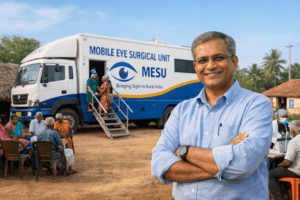
Perhaps the most vivid symbol of his mission is the **Mobile Eye Surgical Unit (MESU)**—a truck transformed into a fully sterile, self-contained operating theatre for cataract surgery. In a nation where rural healthcare access is a chronic crisis, this innovation doesn’t wait for patients to find a hospital; it brings the hospital to them.
Consider the enormity of this task. A moving vehicle must maintain an environment as sterile as a fixed operating room. Every element is engineered: from managing vibration and dust to ensuring uninterrupted sterile air and water supply. “The way we actually build intelligence into the system, and the way we measure and monitor determine how sterility is maintained,” says Sivaprakasam. The results speak volumes: over 30,000 sight-restoring surgeries across 225 rural sites in 14 years, without a single major adverse event. This isn’t just a mobile clinic; it’s a proof-of-concept that high-quality surgery can be delivered anywhere, safely and affordably.
Democratizing Diagnosis: AI and Ingenuity for the Masses
Sivaprakasam’s approach to affordability is rooted in intelligent design, not just cheaper materials. The Eye PAC system for ophthalmic screening exemplifies this. Instead of creating a low-cost copy of an expensive imported retinal camera, his team re-imagined the process. They built algorithms that perform first-order detection, flagging potential issues from diabetic retinopathy to glaucoma. This “intelligence” allows the hardware to be simpler and far less expensive—costing one-fifth of comparable imported systems.
The impact is staggering. The adult version operates in 2,900 sites across 40 countries, having conducted over 12 million exams. For newborns, a specialized version has screened 800,000 infants in 45 countries for retinopathy of prematurity, preventing lifelong blindness through early intervention. “You are able to save enormous healthcare costs before it becomes too expensive, or before it becomes irreversible,” he notes. This is preventative healthcare at a population scale, made viable through smart engineering.
From Fitness Trackers to Clinical Tools: The Wearables Revolution, Reborn
In a market flooded with fitness bands, Sivaprakasam saw an unmet need: clinically trustworthy wearables. His VITALSENS platform elevates wearable technology from hobbyist data to medically actionable insights. “Normally, when you look at wearables, they are used for hobbies and non-serious matters,” he contrasts. Grounded in rigorous physics and physiology, VITALSENS includes a fever monitor piloted in Tamil Nadu for vulnerable newborns and a cardiovascular device used for patient recovery and athlete monitoring. By bridging the gap between consumer electronics and medical-grade monitoring, he’s enabling continuous care outside hospital walls, empowering both patients and physicians.
The Hidden Architecture of Innovation: Less Flash, More Function
Some of the most profound innovations lie in removing complexity. ARTSENS is a masterclass in this principle. Traditional vascular ultrasound requires expensive imaging machines and expert sonographers to interpret artery images. ARTSENS strips away the image entirely. Using a simple probe, deep mathematical modeling, and algorithms based on arterial physiology, it measures key markers of early vascular ageing—like arterial stiffness—at one-twentieth the cost. Validated in 8,000 patients and moving toward FDA approval, it makes preventive cardiac screening feasible in primary health centres, potentially catching cardiovascular risks years before symptoms appear.
Similarly, the Insight bronchoscopy processor and SmartEye endoscopy platform tackle India’s dependency on imported procedural scopes. Instead of using fragile fiber-optic bundles that break and drive up costs, the team designed architectures based on tiny, durable CMOS camera chips. They faced new challenges—heat, power, image quality—and solved them by moving processing power outside the body. This not only made the devices more robust and affordable but also created a platform for embedding AI-driven diagnostic aids directly into the system.
Precision and Sustainability: The Cutting Edge
The work extends into highly specialized and systemic frontiers. The disposable ureteroscope addresses a critical issue in urology: infection risk from reused scopes. By making it affordable to use a new, sterile device for each procedure, infection rates can plummet to less than 1%. Meanwhile, DISHA X represents India’s first fully indigenous robotic spine surgery system, bringing unprecedented precision to complex neurosurgery within the country’s manufacturing ecosystem.
Beyond devices, his team’s machine learning framework for hospital decarbonization tackles the massive environmental footprint of healthcare. And at the Sudha Gopalakrishnan Brain Centre, they are mapping the human brain at cellular resolution, creating detailed 3D atlases (including a pioneering fetal brain atlas called DHARANI) that are attracting global scientific collaboration.
The Human Insight: Technology as an Act of Empathy
The through-line in Professor Mohanasankar Sivaprakasam’s diverse portfolio is not a specific technology, but a human-centric intent. Every innovation starts with a clear, pressing need experienced by real people: the villager who can’t travel for cataract surgery, the diabetic patient who misses retinal screening, the hospital burdened by imported device costs and infection risks.
His award, in the Vigyan Yuva category, is a powerful signal to young Indian engineers and scientists. It demonstrates that cutting-edge research and deep humanitarian impact are not separate paths. You can pursue globally significant science and see it translated into products that heal your community. You can build a sustainable model that attracts both government and private investment. Most importantly, you can look at India’s daunting healthcare challenges and see, as he does, not insurmountable obstacles, but a canvas for innovation.
In an era where technology often feels abstract or divisive, Professor Sivaprakasam’s “hospital on wheels” and its sibling inventions stand as tangible proof that engineering, at its best, is a profound act of kindness. It’s the quiet sound of sight being restored, of a disease caught in time, of a surgery performed safely in a remote village—all powered by the conviction that world-class healthcare should have no borders, and that India’s scientific future is not just about keeping pace, but about charting a uniquely compassionate course.
You must be logged in to post a comment.